
In the current educational climate, every school is unique, and there is no longer a “one-size-fits-all” solution. To differentiate your academy and justify premium pricing, you must first decide which AI path aligns with your pedagogical vision and business model.
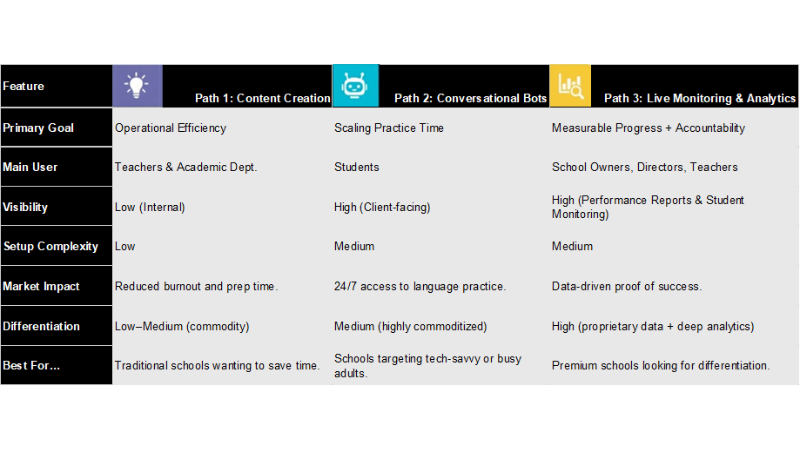
Path 1: Behind-the-Scenes Content Creation
This path focuses on using AI as a “Co-Pilot” for the academic team. It involves utilizing Generative AI to produce tailored worksheets, lesson plans, and assessment rubrics in seconds. It empowers teachers while keeping the technology invisible to the student.
Pros: It significantly reduces teacher burnout by automating administrative tasks, ensures that materials are always current and relevant to students’ interests, and maintains the traditional human-led classroom dynamic that many premium clients still crave.
Cons: It offers the least amount of visible innovation to the end-user, meaning you cannot easily market it as a “high-tech” feature to justify higher tuition fees since the student rarely sees the engine behind the curtain.
Path 2: Direct Conversational Bots
This strategy places AI in the hands of the student. It involves implementing 24/7 conversational agents that allow learners to practice speaking and writing in a low-stakes environment. While highly efficient, it is a path that requires careful management to ensure it supports, rather than replaces, your professional teaching staff.
Pros: It provides students with unlimited practice time outside of class hours, scales your school’s “contact time” without increasing payroll, and appeals to a younger, tech-savvy demographic that values flexibility and instant feedback.
Cons: It carries a high risk of “bot fatigue” where students feel they are paying for a glorified app rather than an education. If not integrated properly, teachers may feel threatened by the technology, leading to internal friction and a perceived drop in institutional value.
Path 3: Live Learning Intelligence
This approach brings AI directly into the learning process, transforming each class into a source of actionable insights.
Instead of simply delivering lessons, schools gain the ability to measure, understand and demonstrate student progress after every session.
This technology connects to live classes on Zoom or Microsoft Teams, analyzes the conversation automatically, and generates individual performance reports for each student within minutes after the class ends.
These reports provide clear insights into areas such as grammar, vocabulary development, pronunciation patterns and communication skills, allowing both teachers and students to understand exactly where progress is happening and where improvement is needed.
Pros:
This approach creates a powerful learning transparency system. Schools can clearly demonstrate progress to students and corporate clients, differentiate their programs with measurable outcomes, and support teachers with automatic feedback that helps them prepare more targeted lessons. It turns each class into a source of valuable data that improves both teaching quality and student engagement.
Cons:
Implementing this approach at scale is technically demanding. Most academies cannot deploy this type of system autonomously, as it requires a robust infrastructure including platform connectors, secure servers, and ongoing software maintenance. In practice, schools typically rely on specialized third-party providers that manage the technical layer, allowing the academy to focus on teaching while the technology operates in the background.
Strategic Conclusion
The era of simply “using AI” is dead. In 2026, differentiation relies on whether you use AI to hide the work, show the practice, or prove the results. Choose the path that reinforces your brand’s unique promise.
At BoostClass, we chose Path 3
We believe the future of language education lies in measurable learning, not invisible automation or chatbot conversations.
BoostClass connects to your existing Zoom or Microsoft Teams classes, analyzes what happens during each session, and automatically generates clear performance insights for every student.
This allows schools to demonstrate real progress, save around 20% of teachers administrative time, and differentiate their programs with data-driven learning outcomes.
If you’re ready to turn your teaching into a competitive advantage, request a free 30-minute demo and see how live monitoring can transform your academy.