

Real-time feedback means a student learns what was right or wrong while the thought is still fresh: during the sentence, the exercise or the lesson, not a week later on a returned worksheet. For language teachers, it is the difference between a mistake that gets corrected and a mistake that gets rehearsed. This guide covers what real-time feedback is, what the research says, how to deliver it without drowning in admin, and where AI helps and where it should step back.
TL;DR
- Real-time feedback is low-stakes, formative and immediate. It guides the next step of learning rather than grading the last one.
- Good feedback targets observed actions, invites self-assessment and ends with a plan. Avoid the “feedback sandwich”.
- AI is a strong first pass for grammar and vocabulary. Students still prefer teacher-led evaluation, so keep yourself in the loop for explanation, encouragement and judgment.
- Question design matters more than the tool. Ask questions that expose common errors.
- The real bottleneck is time. Automating the capture and follow-up of feedback is what makes it sustainable.
Table of Contents
- What real-time feedback means in a language class
- Why timing matters: what the evidence shows
- Question design beats tool choice
- How to deliver feedback people actually use
- Where AI fits: a fast first pass, not the final word
- A realistic real-time feedback routine
- Our perspective: feedback should reduce work, not add it
- Putting this into practice with BoostClass
- Common mistakes to avoid
- FAQ
- Sources
What real-time feedback means in a language class
Search for this phrase and most results are about customer reviews or employee performance. The idea is the same in a classroom, though. Real-time feedback is an immediate, ongoing form of communication where responses or evaluations arrive right after an action, so the person can adjust quickly. In education, that places it squarely in formative assessment: it happens during learning, is typically low-stakes and is usually not graded. A summative test, by contrast, evaluates what was learned at the end of a unit.
The U.S. Department of Education’s formative assessment guide describes the same purpose: helping educators make informed instructional decisions and give learners feedback in real time.
In a language class, “real time” shows up in several forms:
- Spoken correction: a recast or a prompt while a student is speaking.
- Quick checks: a poll, quiz item or short exercise mid-lesson that shows who has understood.
- Written comments: notes on a paragraph returned during or right after class.
- Post-lesson feedback: an individual summary sent while the lesson is still in the student’s memory.
The last one is often overlooked. Feedback delivered an hour after class still counts as timely in practice. Feedback delivered next week usually doesn’t.
Why timing matters: what the evidence shows
The What Works Clearinghouse, part of the Institute of Education Sciences, makes a simple point: students learn best when feedback is timely and targeted, but providing frequent, individualized assessment is hard, especially in large groups. That is why technology enters the picture.
One concrete example comes from physics. A 2017 study in which an audience response system was built into introductory courses reported a 13.5% increase in average grades compared with previous years. It also cut grading time from a full day to a few hours. It is a physics course, not a language class, and clickers are not conversation practice. Still, the mechanism carries over: instant feedback plus automated grading gives students more chances to correct themselves and gives the teacher time back.
The University of Nebraska’s Center for Transformative Teaching describes response technology as a way to build breaks into lectures and check understanding as you go. The principle is the same one a good language teacher already uses with mini-whiteboards or a show of fingers.
Question design beats tool choice
A fancy tool with weak questions produces fast, useless feedback. The What Works Clearinghouse recommends crafting questions that reveal common errors or spark debate, for example deliberately ambiguous prompts or scenarios with more than one defensible answer.
For language teaching, that translates well:
- Minimal-pair traps. Ask students to choose between “I have lived here for five years” and “I live here since five years,” then ask why.
- Ambiguous context. Give a sentence where both past simple and present perfect could work, and have students argue for one.
- Error-spotting. Show a paragraph containing the three mistakes your class makes most often and ask students to find them.
- Production over recognition. A multiple-choice item tells you who can recognize a form. A one-sentence response tells you who can use it.
If the question can be answered by guessing, the feedback you get back is noise.
How to deliver feedback people actually use
The speed of feedback is only half of it. The other half is how it lands. A Penn Medicine guide on giving real-time feedback was written for clinical workplaces, but its structure transfers neatly to teaching. It focuses on observed actions rather than outcomes alone and recommends the ADAPT sequence:
- Ask for self-assessment: “How do you think that went?”
- Discuss and reflect together.
- Assess by describing the impact of what you observed.
- Plan the next step together.
- Thank is not part of the formal model, so keep it natural and don’t force it.
The essence is to coach for change rather than simply point out errors. In a speaking lesson, that might sound like: “You told the story clearly. When you used the past tense for the first three events, I could follow the timeline easily. What could you do differently in the last two?”
Skip the feedback sandwich
The same guide warns against the “feedback sandwich”: a positive, a correction, another positive. Students tend to fixate on the middle layer, and the praise starts to feel like packaging. Its alternative is additive, opportunity-focused language such as “One thing that can make you even better is…” It keeps momentum and treats the correction as the next step rather than a verdict.
Keep it specific and small
In practice, three habits help most:
- One or two targets per piece of feedback. Fifteen red corrections on a paragraph teach nothing. Pick the two errors that matter for this learner’s level.
- Tie it to a goal the student knows. “Your article use is the thing blocking your IELTS writing score” beats “watch your articles.”
- Close the loop with practice. Feedback without a follow-up exercise is an observation, not a lesson.
Where AI fits: a fast first pass, not the final word
Teachers are right to be cautious about AI feedback. The research is mixed, and it points to a division of labor rather than a replacement.
A 2024 study on AI-powered corrective feedback with senior high school students learning English writing found value in AI’s speed and accuracy on grammar and vocabulary. It also highlights that students still strongly prefer teacher-led evaluation. The recommendation is to use AI as a mediated tool for initial instant feedback while the teacher stays present for the affective support and tailored explanations AI lacks.
A comparison of teacher and GPT-assisted written corrective feedback adds a practical warning. AI-generated feedback can be grammatically perfect yet redundant, or inconsistent when the same prompt is run on the same text. The authors’ advice is to check that tools align with course-specific goals rather than treating them as generic catch-alls.
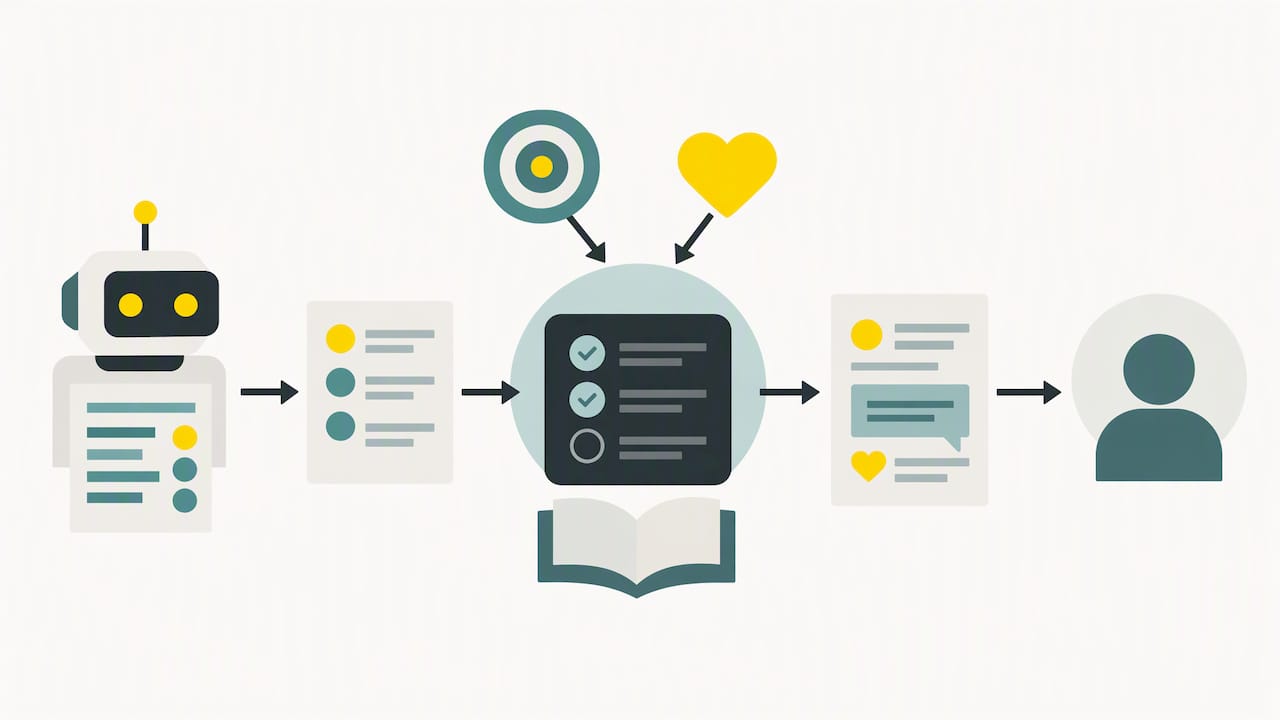
A literature review on AI automated feedback in English language learning looks at the technologies behind it, including natural language processing and machine learning, and is a useful starting point if you want to understand what is happening under the hood.
Put together, a sensible model looks like this:
| Feedback task | Best handled by |
|---|---|
| Grammar, spelling, vocabulary accuracy | AI first pass, teacher spot-checks |
| Identifying repeated errors across lessons | AI tracking, teacher interprets |
| Coherence, argument, register | Teacher |
| Encouragement, motivation, tone | Teacher |
| Grading, certification, discipline | Teacher, always |
That last row is not just our opinion. In its guidance on generative AI in education, UNESCO calls for human oversight and privacy protections for student data, and suggests a minimum age of 13 for classroom use of generative AI tools.
What to ask before you adopt any AI feedback tool
- Does it use my materials and my learning objectives, or generic content?
- What happens to student data, and is it used to train commercial models?
- Are the outputs consistent from one run to the next?
- Can I review and edit feedback before a student sees it?
- Can a school exit the contract if the tool fails on safety or bias? Researchers suggest sunset clauses in procurement for exactly this reason.
A realistic real-time feedback routine
Here is a workflow that fits a 60-minute online or in-person lesson and does not eat your evening.
Before class (10 minutes). Review what your students struggled with last time. Prepare two or three exercises aimed at those gaps. This is where most of the hidden workload lives. Generating ready-made exercises from previous lessons and identified gaps can turn an hour of preparation into minutes.
During class. Run one or two quick checks built on error-revealing questions. Use the ADAPT approach for spoken correction: ask the student to evaluate themselves first. Note patterns instead of stopping the flow every time.
Right after class (5 minutes). Send each student a short, individual summary: one thing that went well, one opportunity, one practice task. If you teach 20 students, writing this by hand is where good intentions die. Automation matters here.
Between classes. Give students practice aimed at their own mistakes, not the class average. A student who confuses prepositions and a student who struggles with word order should not do the same homework.
Our perspective: feedback should reduce work, not add it
We built BoostClass around a simple observation. Teachers know that individual, timely feedback works. They don’t skip it because they doubt it. They skip it because there are only so many hours in a week. Every extra student multiplies the admin.
So we think the question is not “AI or teacher?” It is “what should the machine take off the teacher’s plate so the teacher can do the part only a human can do?” Our answer: the capture, the first-pass analysis, the tracking and the targeted practice. The explanation, the encouragement, the judgment and the relationship stay with you.
That is also why we care that teachers keep their own teaching style and materials, and why students don’t need to install anything. A feedback tool that forces you to change how you teach is another job. One that works alongside Zoom, Microsoft Teams or Google Meet, or an in-person class, is a colleague.
We also take the worry about AI assistants seriously. If a tool cannot be checked, edited and overridden by the teacher, it should not be giving feedback to students. The research above says as much, and we agree.
— Cesar
Putting this into practice with BoostClass
If you want the routine above without building it by hand, BoostClass connects the three stages:
- Before class: Connected Activities generates over 20 types of ready-to-use exercises based on previous lessons, learning gaps and your objectives.
- After class: individual student feedback, progress tracking and personalized practice aimed at each learner’s actual mistakes are generated automatically.
- For schools: clearer visibility into learning outcomes and student engagement.
Pricing is published and month-to-month in structure: Activities is 5 € per month, and Student Intelligence is 19 € per month for up to 10 students, 34 € per month for up to 20 students and 49 € per month for up to 30 students. You can see the plans on the BoostClass pricing page, or start from the BoostClass home page to see how it fits your classes.
If you are weighing how AI fits a whole school rather than a single teacher, our articles on three AI models for language schools and on a human future for English language academies go deeper.
Common mistakes to avoid
- Treating speed as the goal. Fast feedback on a badly designed question is still bad feedback.
- Grading everything. Real-time feedback works because it is low-stakes. Turn it into a score on every task and students start gaming it.
- Correcting everything. Choose the two errors that matter.
- Using the sandwich by default. Say the useful thing plainly and kindly.
- Handing the whole job to AI. Use it as a first pass, then add what only you can.
- Ignoring privacy. Check how student data is stored and used before you upload a single paragraph.
FAQ
What is real-time feedback in education?
It is feedback given during or immediately after a learning activity, so students can adjust while the material is fresh. It is formative: low-stakes, usually ungraded, and meant to guide the next step. Examples include a mid-lesson quiz, a spoken correction and a same-day written comment.
Does instant feedback actually improve learning?
The evidence is encouraging but context-dependent. A 2017 physics study reported a 13.5% rise in average grades after instant-feedback clickers were introduced, alongside much faster grading. Results in language learning depend on the quality of the questions and what students do with the feedback.
Can AI replace the teacher for giving feedback?
Not according to current research. Students in a 2024 study still preferred teacher-led evaluation, and UNESCO insists on human oversight for grading and certification. AI works best as a first pass on grammar and vocabulary, with the teacher adding explanation and encouragement.
How do I give feedback without discouraging students?
Ask for their own assessment first, describe what you observed and agree on a next step. Instead of wrapping criticism in praise, use opportunity language like “One thing that can make you even better is…” The Penn Medicine guidance explains why the sandwich often backfires.
Sources
- Real-time Feedback: Definition, Benefits, and Best Practices (Spryple)
- Introduction to Formative Assessment (U.S. Department of Education)
- Using Technology for Classroom Feedback (IES, What Works Clearinghouse)
- In-class use of clickers and clicker tests improve learning (2017)
- Response technology (Clicker Questions), University of Nebraska
- Giving Real Time Feedback (Penn Medicine)
- AI-Powered Mediated Synchronous Corrective Feedback on EFL Students’ Paragraph Writing (2024)
- Teacher vs. GPT-assisted written corrective feedback (ScienceDirect, 2024)
- UNESCO guidance on generative AI in education (UN News)
