

AI helps a language school most when it takes over the work around the lesson: preparing activities, writing feedback, setting follow-up practice and tracking progress. The teacher stays at the front of the class. For owners and academic directors, that means less preparation time per lesson, more personal attention for each student and clearer evidence of what is happening in classes. Those are three of the things that decide whether students stay.
This guide covers where AI is already used in language teaching, which applications matter to a school, how to introduce it without losing your teaching identity, and what to check before you buy. We use BoostClass, our own platform, as a worked example.
TL;DR
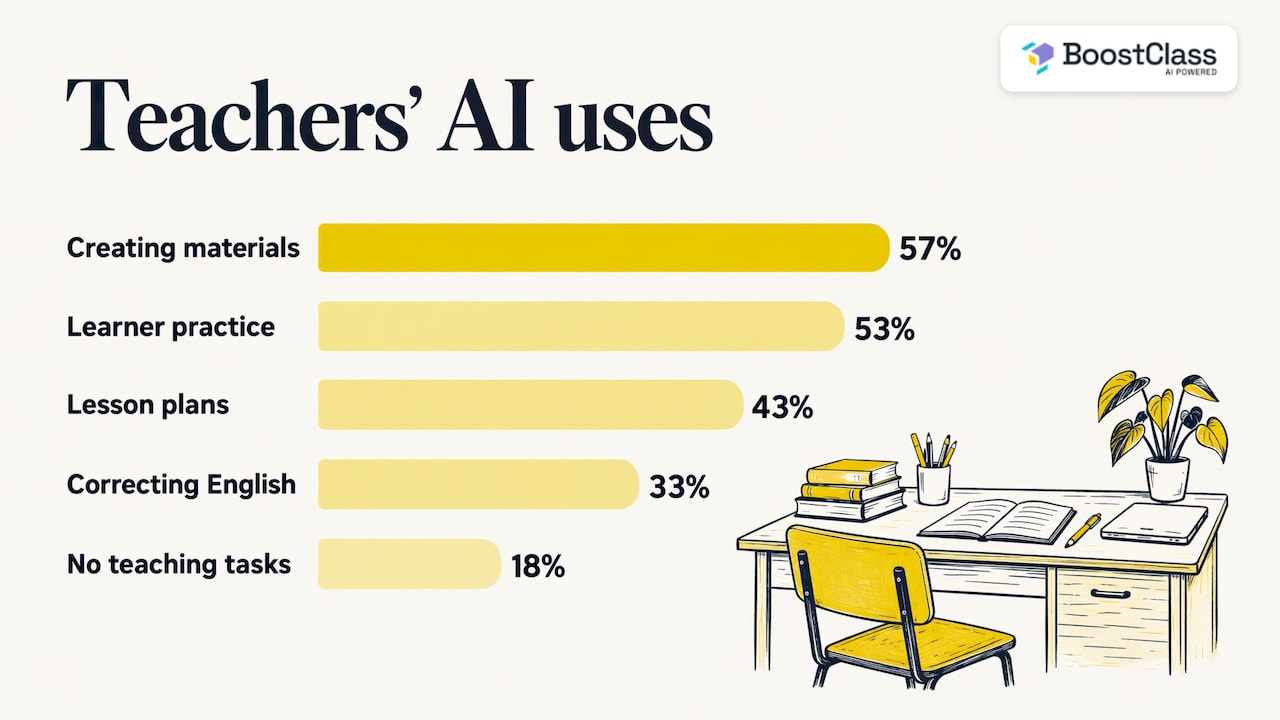
- Most AI use in English teaching today is about materials, lesson plans and learner practice, not replacing teachers. A British Council survey found 57 per cent of teachers use it to create materials and 43 per cent for lesson plans.
- The biggest gains for a school come from connecting four things: lesson preparation, what happens in class, individual feedback and follow-up practice.
- Personalisation works best when it is based on each learner’s real mistakes from real lessons, not on generic exercise banks.
- Choose tools on teacher control, data practices, reporting and fit with your existing platform and classroom setup.
- AI works best as a teacher’s assistant. Research keeps finding that learners still need teachers to interpret and apply AI feedback.
Table of Contents
- Where AI already sits in language teaching
- The five problems schools actually need AI to solve
- Practical applications for a language school
- A worked example: one week in a small online school
- AI empowers teachers, it does not replace them
- How to choose AI tools for your school
- Perspective: why the real class should be the centre
- See it in practice: BoostClass for schools
- FAQ
- Sources
Where AI already sits in language teaching
AI in language education is no longer a pilot project. In the British Council’s 2024 survey of English teachers, the most selected uses were creating materials (57 per cent), helping learners practise English (53 per cent), creating lesson plans (43 per cent) and correcting learners’ English (33 per cent). The same body reports that 18 per cent of teachers used AI for no teaching tasks at all, so adoption is wide but far from universal. In many schools, individual teachers are experimenting alone with general-purpose chatbots, and the school itself has no shared approach.
Academic work describes the same pattern. A 2026 systematic review in Frontiers in Education found that AI in EFL and ESL settings mostly supports teachers, generates content, assesses or diagnoses, and coaches practice. The reported benefits include more practice opportunities, faster feedback cycles and a redistribution of instructional labour. A 2025 meta-analysis of 25 studies with 2,431 participants found that students using generative AI tools in language learning outperformed those who did not, with an overall effect size of 0.75. Results depend heavily on how the tools are used, which is why the school’s approach matters more than the tool’s name.
If you want a broader view of how classroom teachers apply these tools, see our guide to AI for language teachers and our piece on how AI is transforming English language centres.
The five problems schools actually need AI to solve
Owners rarely ask for AI. They ask for fewer teacher resignations, better retention and consistent quality. Here is how AI connects to each.
Lesson preparation takes too long
Preparation is the invisible cost of teaching. A teacher with 25 contact hours a week may spend nearly as many preparing, much of it adapting materials to each group. AI cuts this by generating drafts: worksheets, role-plays, gap-fills and discussion prompts at a chosen level. Oxford University Press ELT publishes example prompts built on objectives, activities and student level, including a B1 plan on irregular past-tense verbs and a B2 present perfect worksheet.
The weakness of a general chatbot is that it knows nothing about your class. The teacher must explain who the students are, what they did last week and where they struggle, every time. A better approach is a tool that already holds that context. Our detailed walk-through is in AI lesson planning for language teachers.
Teacher workload drives turnover
Admin is what teachers resent: writing progress comments, chasing homework, producing reports for parents or HR. The University of Texas at Austin’s English Language Center reports that its instructors use AI to generate lesson plans, activities, writing models and diagnostic assessments, freeing time for pedagogy, mentoring and course design. The goal is not more output per teacher. It is giving teachers back the hours in which they do their best work.
Student engagement fades between lessons
A student who has one lesson a week has six days to forget it. Engagement drops when the practice between lessons is generic, too easy or too hard. AI can set short practice tied to what the learner actually got wrong, which keeps the language in mind and gives the student a reason to open the app before the next class.
Personalised learning is hard to deliver at scale
Personalisation is easy in a one-to-one lesson and very hard in a group of twelve. The British Council’s guide for school leaders describes AI’s promise as personalised learning pathways through adaptive diagnostics and timely, focused feedback in areas such as speaking and writing. In practice, that means each learner receives practice that reflects their own patterns, not the group average.
Retention and teaching quality are hard to see
Owners and academic directors often judge quality through observations a few times a year and through complaints. AI-generated reports on each student’s progress give you something between those two points. They let you show parents and learners tangible evidence of improvement, which is the most reliable answer to “is this worth paying for?” Analysis of lessons themselves, such as how much of the time the teacher is talking, adds another view of teaching quality.
Practical applications for a language school
Analysing online and in-person classes
Most AI tools for learners sit outside the lesson: a student talks to a chatbot alone. The school’s real asset, however, is the lesson itself, where a trained teacher and students interact. Tools that capture what happens in that lesson can identify recurring errors, hesitations and vocabulary gaps from the learners’ own speech.
BoostClass connects with Zoom, Microsoft Teams and Google Meet, and it also supports in-person teaching. Students do not need to install anything. Teachers keep their own teaching style and materials, and the platform works with what was actually said in class.
Identifying learning gaps
Generic placement tests tell you a learner’s level. Gap detection tells you why a B1 student still avoids the past perfect, or why a group keeps mixing up prepositions. The Voices magazine of the British Council notes that AI can highlight patterns in learners’ mistakes, suggest alternative expressions and help learners notice how language works. Patterns are exactly what busy teachers struggle to track across a full timetable.
Generating personalised practice
Once a gap is found, the follow-up must be quick and specific. In BoostClass, the Practice Zone gives each learner exercises that target their own mistakes and areas for improvement, based on their actual class interactions. A student who struggled with conditionals gets conditionals, not a random worksheet.
Preparing the next lesson
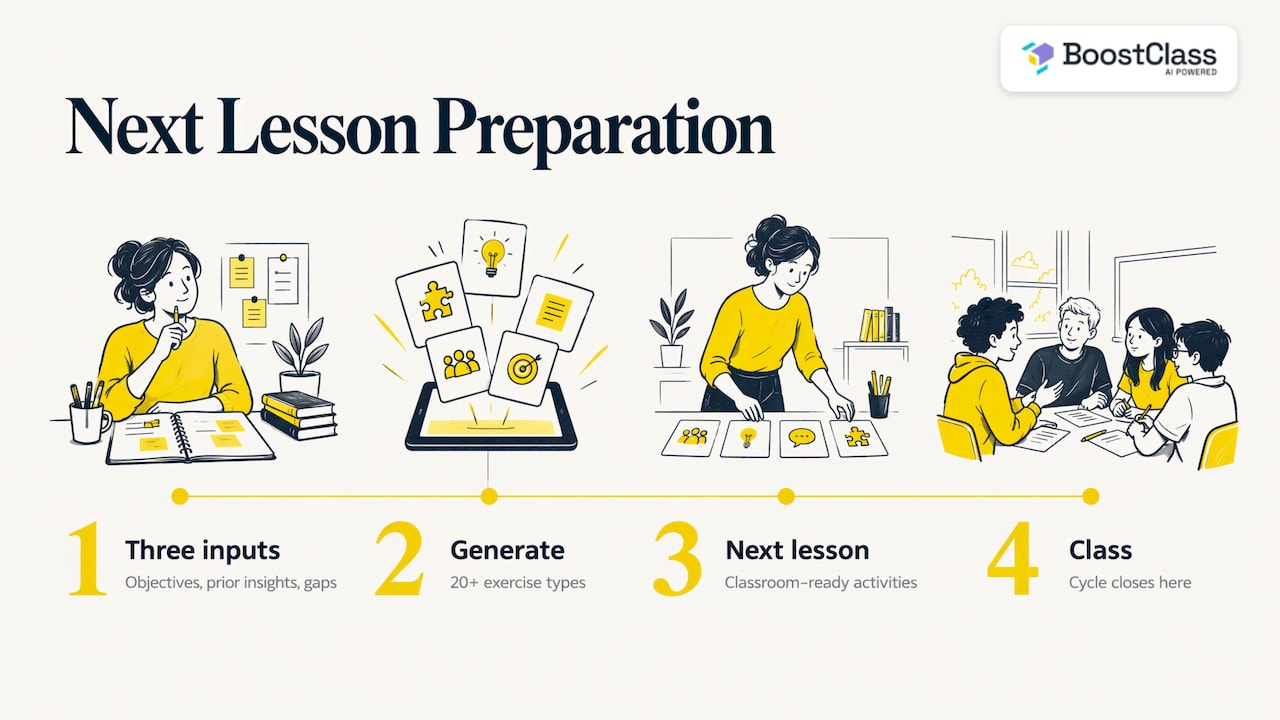
This is where the cycle closes. What the platform learned from the last lesson feeds the next one. BoostClass Connected Activities lets teachers generate more than 20 types of classroom-ready exercises, built from three inputs: the teaching objectives, insights from previous classes and detected learning gaps. Preparation that once took an evening can take minutes, and the activities fit the group in front of the teacher rather than an imagined average one.
Monitoring teaching quality
School owners also need visibility of the teaching itself. BoostClass analyses teacher performance, with a particular focus on Teacher Talk Time and other metrics. It gives owners insight into how classes are run. Used well, these figures start conversations about coaching, not about blame: a teacher who talks for most of a conversation class may simply not know it.
A worked example: one week in a small online school
Imagine a school with eight teachers and 90 students, mostly adults taking weekly Zoom classes. This is an illustration, not a client case study.
- Monday, before class. A teacher is preparing an intermediate group. She opens the previous lesson’s insights, sees that three students keep dropping the third-person s and that the group’s objective is talking about future plans. She generates a short set of activities from those inputs and adapts two of them.
- Monday, in class. The lesson runs on Zoom as usual. She uses her own materials and her own style. Nobody installs anything.
- Monday evening, after class. Each student receives individual feedback and practice based on what they said. The teacher reviews rather than writes it.
- Friday. The academic director opens progress views for the group. One student has had no practice activity for two weeks, so the coordinator sends a friendly message before that student drifts away.
- Month end. Parents or corporate clients receive progress evidence that shows what changed, not just attendance.
No single step is dramatic. Together they remove the hours of unpaid admin and make quiet disengagement visible early.
AI empowers teachers, it does not replace them
School owners often worry that adopting AI tells teachers they are replaceable, or tells parents they are paying for software. The research points the other way. The British Council stresses that AI’s benefits are strongest when it complements rather than substitutes human interaction, and that teachers remain essential guides, mentors and motivators. A 2025 qualitative study found that instructors using AI take on roles such as evolving facilitators and flexible material designers.
A study of AI-enhanced IELTS tasks in Vietnam found that learners frequently relied on teacher explanations to interpret and apply AI feedback, particularly in writing and speaking. The practical lesson for owners is to present AI to your team as an assistant that removes the tedious parts of the job. For a fuller discussion, read will AI replace language teachers and our view on a human future for English language academies.
Other fields show the same direction. An AI-powered tutoring platform that turns study material into step-by-step spoken explanations is built to support a learner’s own study, not to remove the instructor. Language schools can apply the same thinking to their own context.
How to choose AI tools for your school
Before you commit, check the following. They draw on the NEA’s guidance on vetting AI resources, which recommends human-centred tools backed by independent research, transparent data practices, equitable access, staff training and compliance with student privacy laws, and on the British Council’s school leaders guide.
| Question | Why it matters to a language school |
|---|---|
| Does it work with the lesson your teachers already deliver? | Tools that need a new classroom routine meet resistance. Check support for your video platform and for in-person groups. |
| Do teachers stay in control? | Teachers should be able to edit, approve and adapt anything students see. |
| Is feedback tied to each learner’s own mistakes? | Generic practice does not fix individual gaps. |
| What does reporting show you? | Owners need progress, engagement and teaching-quality views, not only usage counts. |
| How is student data handled? | The British Council lists data privacy and surveillance among the main risks for schools. Ask for clear policies. |
| Will your team be trained and supported? | Research stresses teacher readiness and professional development. |
Two further points make adoption safer. First, treat AI feedback as a draft for the teacher to check: the Frontiers review lists feedback quality, over-reliance and bias among recurring challenges, and the British Council notes that tools may treat some accents or ways of expressing ideas as more “correct” than others. Teacher review is the natural safeguard. Second, start with one level or one group, agree what you will measure, such as preparation time, practice completion and learner feedback, and expand once the team is comfortable.
For a comparison of the main approaches schools take, see AI for language schools: three models compared.
Perspective: why the real class should be the centre
We built BoostClass on one conviction: the most valuable data in a language school is the lesson itself. A real teacher, real students, real mistakes and real hesitation. Most AI tools ignore that and ask the student to start from scratch with a chatbot.
When AI captures insight from the real class, three things change. The teacher prepares from what students actually need. The student receives feedback and practice that reflects what they actually said. The owner sees progress and teaching quality without sitting in every lesson.
We also think teachers should keep their style and their materials. Our job is to take the tedious admin off their desk, not to change how they teach. That is how a school can offer a premium experience without burning out its team.
Cesar
See it in practice: BoostClass for schools
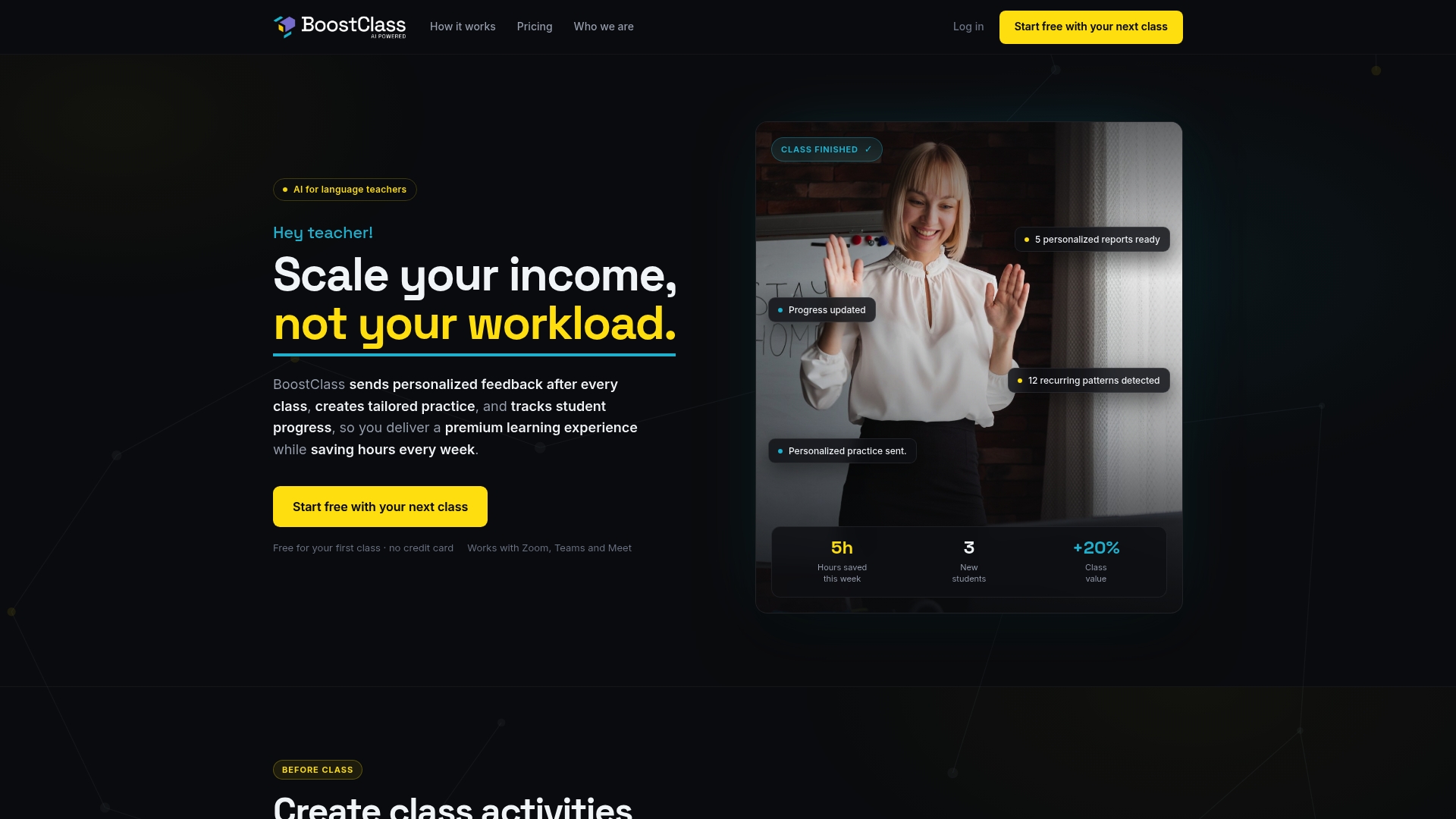
BoostClass is an AI-powered platform for language teachers and schools. It connects lesson preparation, classroom performance and continuous practice. Before class, Connected Activities generates classroom-ready exercises in minutes. After class, it produces individual student feedback, progress tracking and personalised practice.
Plans on the pricing page, as read on 30 October 2026, start at €5 per month for Activities. Student Intelligence is €19 per month for up to 10 students and €34 per month for up to 20 students, and the student feedback plan for up to 30 students is €49 per month. You can discover BoostClass or try the AI classroom activities directly.
FAQ
Will AI replace teachers in a language school?
The evidence points to AI redistributing teachers’ time, not removing their role. The British Council describes teachers as essential guides, mentors and motivators whose empathy and judgement AI cannot supply. Schools that use AI to reduce admin let teachers spend more time on exactly those roles.
What can AI do for a language school today?
The most common uses are creating materials, lesson plans and practice, and correcting learner language. Beyond that, platforms can analyse classes, detect learning gaps, generate individual feedback and show progress to owners. The strongest results come when these steps are connected rather than used separately.
Does the AI tool work with Zoom, Teams, Google Meet and in-person classes?
BoostClass connects with Zoom, Microsoft Teams and Google Meet, and it supports in-person teaching. Students do not need to install anything. Teachers keep their own style and materials.
How can AI help with student retention?
Retention improves when students feel progress and receive attention that fits them. Personalised practice between lessons keeps learners engaged, and progress tracking lets staff notice students who are drifting early. Reports also give you clear evidence to share with learners and parents.
What should we check about data and bias?
Ask how student data is stored and used, and keep teachers in the loop to review feedback. The British Council points to privacy, surveillance and bias towards certain accents or dialects as risks to manage, which is why human review and clear policies belong in any rollout.
Sources
- British Council: Artificial intelligence and English language teaching (July 2024)
- British Council TeachingEnglish: Artificial intelligence and English language teaching
- Frontiers in Education: From tools to pedagogical ecologies
- TechTrends: Applying Generative Artificial Intelligence to Task-based Language Teaching
- Oxford University Press ELT: Useful prompts for AI lesson planning
- University of Texas at Austin English Language Center: instructors and AI
- British Council Future of English: AI in language learning, lessons for school leaders
- British Council Voices: Putting language learners first in the age of AI
- PMC: AI powered ELT, instructors’ transformative roles
- TESOL Communications: AI-enhanced IELTS task delivery in Vietnam
- NEA: Vetting AI Resources, a guide for educators
