

The best ESL warm-up is short, needs almost no materials and gets every learner speaking English in the first few minutes. Below are twelve activities that fit that description, with how to run each one, which level suits it and how to connect it to the rest of your lesson so the first five minutes are not wasted.
TL;DR
- A warmer is a short activity that demands active involvement and switches students on to using English, so keep it to roughly three to seven minutes.
- Speaking-heavy warmers (speed interview, two truths and a lie, what’s the question?) work best when learners already know each other. Vocabulary and grammar warmers work best when they preview the lesson.
- Change the language, not the game: simplify instructions and sentence length for lower levels, ask for longer answers at higher levels.
- Do not correct errors during the warm-up. Save any language you notice for the main stage.
- Preparing a warmer that matches last lesson’s gaps is where time disappears, and that is the step worth automating.
Table of Contents
- What a good ESL warmer actually does
- Speaking warmers that need no preparation
- Vocabulary warmers
- Grammar and focus warmers
- Quick comparison
- Running a warmer without losing the first five minutes
- Adapting warm-ups for level, age and class size
- The hidden cost: choosing a warmer that fits the lesson
- Try it with your next class
- FAQ
- Sources
What a good ESL warmer actually does
The British Council’s Action Plan for Teachers describes a warmer as a short activity that demands active student involvement, used at the start of a lesson to get students going and switch them on to using English. The author compares it to an athlete’s warm-up: the aim is to prepare the brain to work in another language.
That description gives you three tests for any activity you choose:
- Is it active? If learners sit and listen for the first five minutes, it is not a warmer.
- Is it short? ESL Info suggests three to seven minutes at most, so you energise students without eating into teaching time. If only a few minutes remain, English No Kidding advises picking a shorter activity rather than rushing a longer one.
- Does it point at the lesson? A warmer that previews the target vocabulary or structure, without teaching it explicitly, does double duty. A pure icebreaker has its place, especially in a new class, but a connected warmer saves you a transition.
One more rule from Oxford University Press: avoid error correction during warm-ups. Focus on fluency and rapport, and note mistakes to use later.
Speaking warmers that need no preparation
These suit adults and teens, work online and in the classroom, and need nothing more than a topic.
1. Speed interview
Give pairs a topic, such as weekend plans or a job they would never do. Each pair writes a few questions, then interviews each other for one minute each. Change partners and repeat. Bridge recommends it for intermediate to advanced learners, and it builds fluency and question formation. The partner rotation is what makes it repeatable: the same activity feels new with each new partner.
Example: for a lesson on the present perfect, set the topic “things you have never done”. Learners practise the form without you naming it.
2. What’s the question?
Reverse the normal quiz. Show an answer, for example “Seventeen”, and learners invent a question that fits (“How old is your sister?”). The online trivia game What’s the question? uses the same idea: players see answers first and pick the matching question from four options. In class, you can drop the options and ask for open questions. Question formation is a weak point for many learners, so this is a quick way to see who still struggles with auxiliaries and word order.
3. Two truths and a lie
Each learner writes two true statements and one false one. Others vote on the lie, then the writer reveals the answer. Ask learners to add a follow-up question for each statement and you get past tense, present perfect or “used to” practice for free. It works well in small classes, where everyone gets a turn within five minutes.
4. Who am I?
Each participant puts a name card where they cannot see it, such as on the forehead or the back of a chair on a video call held up to the camera, and asks yes/no questions to find out whose name it is. The British Council’s trainer notes on fluency describe the activity. Use famous people for beginners and classmates’ favourite characters for higher levels.
Vocabulary warmers
5. Name ten
In pairs or small groups, learners write ten words that match a category, such as ball sports. The Cambridge University Press blog lists it among five quick and effective warmers. Choose a category from the unit you are about to teach (“things you pack for a trip” before a travel lesson) and you have a built-in preview.
6. The fly swatter game
Stick description cards on the board. Show a picture, and two students race to swat the card that fits best. The same Cambridge post notes that it energises the class. It needs a little preparation, but the cards can be reused and the activity suits younger learners and tired groups.
7. Word association chain
One learner says a word, the next says a word associated with it, and so on round the group. Tahric Teaches suggests three to five minutes, and the point is helping students shift into thinking in English. Start with a seed word from the lesson topic and the chain naturally circles the vocabulary you need.
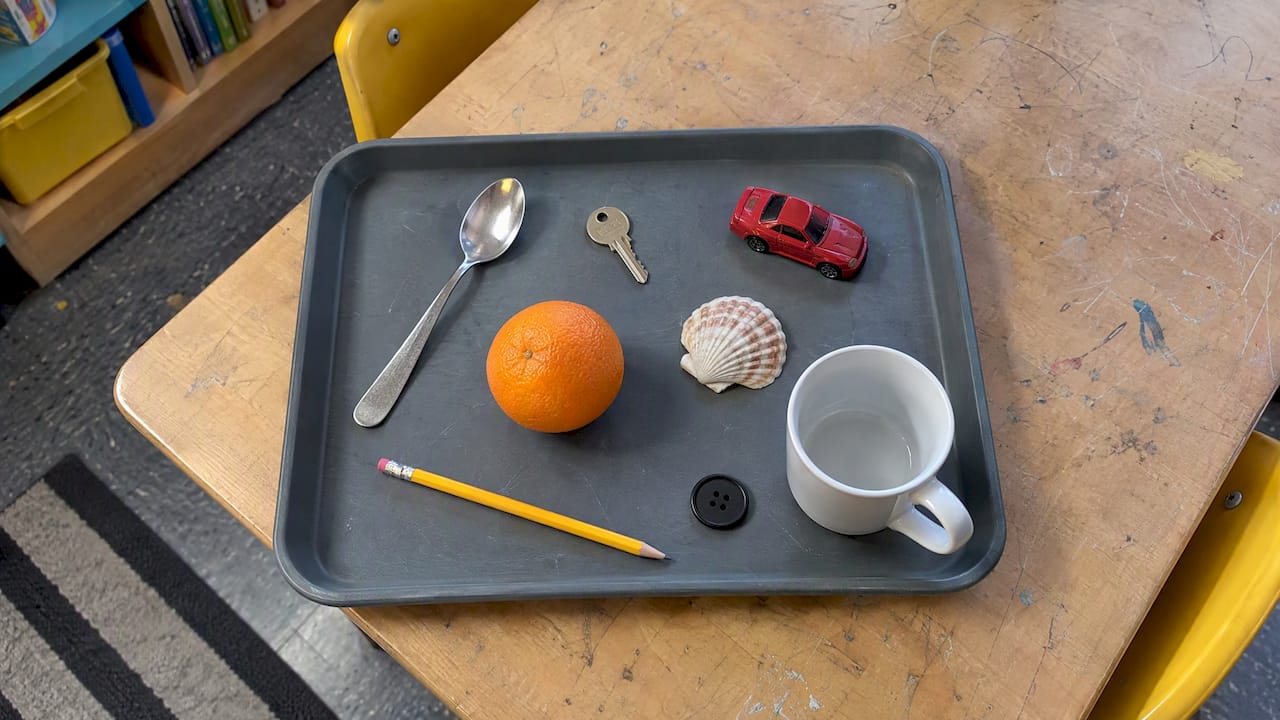
8. Memory tray
Show five to ten objects for ten to fifteen seconds, cover them, and learners list what they remember. ESL Info gives it as a five-minute vocabulary recall activity. Online, show a slide of pictures instead of real objects and collect answers in the chat.
9. Backs to the board
Write a vocabulary word on the board behind one student. Teammates describe it without saying the word. Tahric Teaches notes it builds circumlocution, the skill of explaining a word you do not know in other words, which is exactly what learners need when they get stuck in real conversations. Five minutes is enough for two or three rounds.
Grammar and focus warmers
10. Sentence scramble
Randomise the words of prepared sentences. Individuals, pairs or groups race to restore the order and read the sentence aloud correctly. Bridge points out that the sentences can use target language or review a grammar point from a previous lesson, which makes this a natural bridge between two classes. Three or four sentences are plenty.
11. Guess the number
Think of a number and learners guess, hearing only “higher” or “lower”. The free daily game Guess The Number offers ranges from 1 to 10 up to 1 to 10,000, and a larger range gives advanced learners practice with big numbers. Ask learners to say the number in full, and they practise numbers, comparatives and polite guessing language without a worksheet.
12. Show and tell, or a mini story
Let a learner present an object for one to two minutes. The Cambridge post says it builds self-confidence and is highly adaptable across ages and proficiency levels. For a storytelling variant, each learner adds one sentence to a shared story. A 2023 academic discussion lists storytelling alongside sentence scramble and speed interview as warm-up examples for teens and adults.
Quick comparison
| Activity | Skill | Time | Best level | Materials |
|---|---|---|---|---|
| Speed interview | Speaking, questions | 5 min | B1 and above | None |
| What’s the question? | Question forms | 5 min | A2 and above | Answer prompts |
| Two truths and a lie | Speaking, past tenses | 5 min | A2 and above | Paper |
| Who am I? | Questions, fluency | 5 min | A1 and above | Name cards |
| Name ten | Vocabulary | 3–5 min | All levels | Paper |
| Fly swatter | Vocabulary | 5 min | Young learners | Cards, swatters |
| Word association chain | Vocabulary, fluency | 3–5 min | A2 and above | None |
| Memory tray | Vocabulary recall | 5 min | All levels | Objects or slide |
| Backs to the board | Vocabulary, description | 5 min | A2 and above | Board |
| Sentence scramble | Grammar, word order | 5 min | A1 and above | Prepared sentences |
| Guess the number | Numbers, comparatives | 3–5 min | All levels | None |
| Show and tell | Speaking | 5–10 min | All levels | An object |
Running a warmer without losing the first five minutes
Most warmers fail in the instructions, not the idea. Three habits help.
- Set a hard time limit and say it out loud. English No Kidding recommends this, and it keeps a five-minute activity at five minutes.
- Model unusual mechanics first. Run one round with a volunteer, or with yourself and a strong student, before starting with the whole class. The same source puts it neatly: 30 seconds of modelling saves five minutes of confused instructions.
- Match the energy of the room. Tahric Teaches recommends physical activities for tired students and focused ones for over-excited groups. A Monday-morning adult class and a Friday-afternoon teen group need different warmers.
If the room is cramped, adapt the space rather than dropping the game. The Action Plan for Teachers notes that you can play seated when there is no room for a circle.
Adapting warm-ups for level, age and class size
Keep the game and change the language. ESL Info says teachers can adapt warmers by changing vocabulary, sentence complexity and instructions to suit proficiency, and by choosing activities suited to age and class size. For beginners, that means simple words and gestures. For advanced learners, ask for longer, more creative sentences.
Some practical adjustments:
- Lower levels: give planning time before speaking. The British Council reports that planning time during speaking warmers helps lower-level learners increase production and confidence. Thirty seconds to jot down notes in speed interview makes a visible difference.
- Large classes: switch whole-group games for pairs or small groups, as in Name ten.
- Small classes or one-to-one: swap competition for conversation. Two truths and a lie works with a single learner if you play along.
- Mixed levels: let stronger learners add a follow-up question to every answer, while others only need to answer.
- Teens and adults with real-world interests: link the warmer to something they already watch or follow. If your learners enjoy series and films, learning English through streaming gives you ideas for turning screen time into short speaking prompts.
To check understanding after a vocabulary or grammar warmer, ESL Info suggests a mini pop quiz answered verbally, on mini whiteboards or through the chat.
The hidden cost: choosing a warmer that fits the lesson
Finding twelve ideas is easy. The hard part is picking, each lesson, the one that previews today’s target language, revisits what this particular group got wrong last time, and suits their level. For a teacher with fifteen classes a week, or an academic director who wants warmers to be consistent across a school, that choice is a real part of the lesson preparation workload.
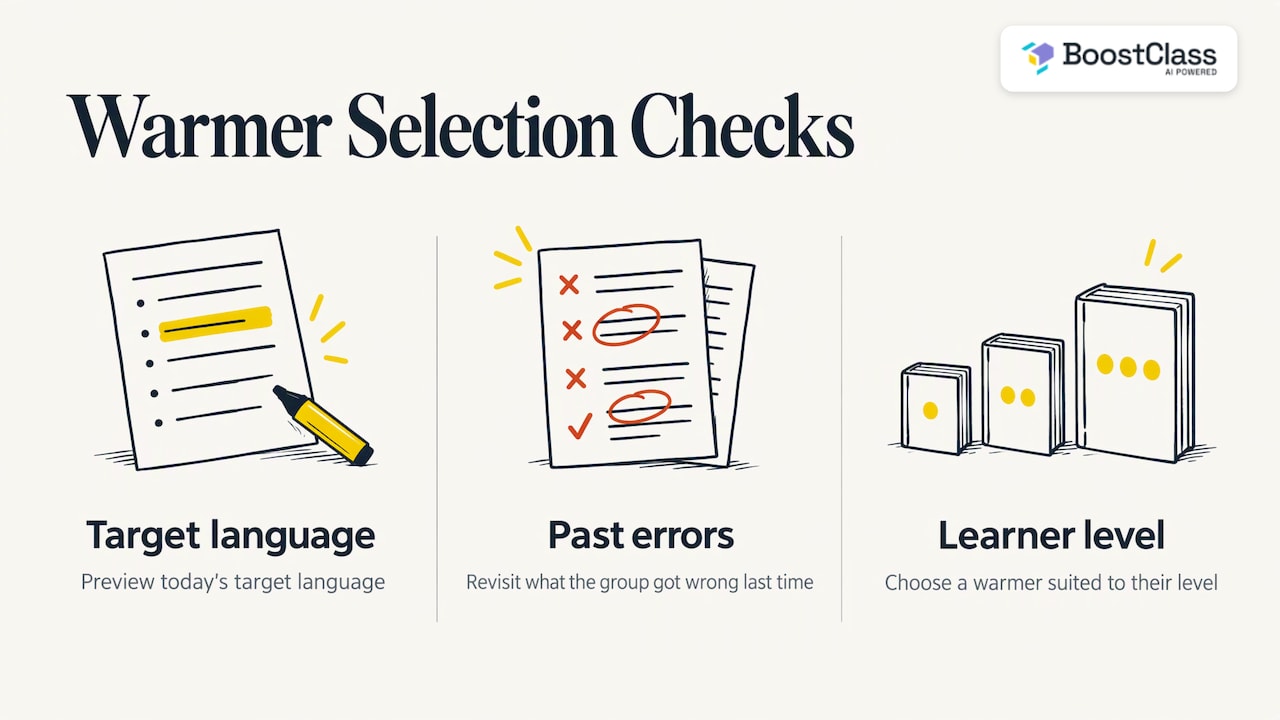
It is also where a warmer becomes more than filler. A sentence scramble built from last week’s actual errors, or a “name ten” on vocabulary a group failed to recall, does more than a generic icebreaker. For more on planning the full lesson around that start, see our guides on AI lesson planning and lesson time management, and our examples of task-based language teaching for what can follow the warmer.
How Connected Activities fit in
BoostClass Connected Activities lets teachers generate over 20 types of classroom-ready exercises. Lessons can be prepared from your teaching objectives, insights from previous classes and the learning gaps BoostClass has detected for your students. In practice, that means you can ask for a short opener based on what a group actually struggled with, instead of searching for an idea from scratch. It works with online lessons on Zoom, Microsoft Teams and Google Meet, and with in-person teaching.
Our perspective
We think a warm-up is the cheapest moment in a lesson to get personalisation right and the one most teachers have the least time to plan. The first five minutes set the tone: they decide whether learners start speaking or start waiting.
Most teachers pick a warmer from memory or from a list like this one, and that is fine. But a list cannot know that your Tuesday group confuses past simple and present perfect, or that two learners never ask questions. A lesson that begins with the language this group needs is more engaging, and engaged learners stay longer. For a school, that is a retention question as much as a teaching one.
That is why we built BoostClass around the real class with a real teacher. Teachers keep their own style and materials. We automate the preparation, feedback, practice and progress tracking around them, so that the time saved goes back into teaching.
Cesar
Try it with your next class
If you want the warmer to come from your last lesson rather than from a list, BoostClass can generate it for you. Connected Activities builds exercises from your objectives, previous class insights and detected learning gaps, and the same platform handles student feedback, personalised practice and progress tracking.
Plans start at €5 per month for Activities. Student Intelligence plans cost €19 per month for up to 10 students and €34 per month for up to 20 students, and a student feedback plan for up to 30 students costs €49 per month. See the BoostClass pricing page, discover BoostClass or try the AI classroom activities directly.
FAQ
How long should an ESL warm-up last?
Aim for roughly three to seven minutes. ESL Info recommends that range so the activity energises learners without using up instructional time. If the lesson is already short, choose a three-minute game such as Guess the number rather than shortening a longer one.
Do I need materials for ESL warm-ups?
Not for most of them. Speed interview, word association chain, two truths and a lie and Guess the number need nothing but learners and a topic. Name ten needs paper, and the fly swatter game and memory tray need a few cards or objects, or a slide when you teach online.
Should I correct mistakes during a warm-up?
Generally no. Oxford University Press advises focusing on fluency and rapport at this stage. Note recurring errors and bring them into the main part of the lesson, where learners can work on them.
Can I use the same warm-ups online and in person?
Yes, with small changes. Replace physical objects with slides, use breakout rooms for pair work and collect quick answers in the chat. BoostClass works with Zoom, Microsoft Teams and Google Meet, and also supports in-person teaching, so the same preparation can serve both formats.
How do I make a warm-up lead into the lesson?
Choose an activity that previews the target vocabulary or grammar without teaching it. For example, “things you have never done” before the present perfect, or a category from the unit in Name ten. Sentence scramble can also review a point from the previous lesson.
Sources
- Action Plan for Teachers, British Council
- No-Prep & Low-Prep ESL Warm-Ups, ESL Info
- 20 No-Prep ESL Speaking Activities, English No Kidding
- Warm-Up Activities For New Classes, Oxford University Press
- 12 ESL Warm-Up Activities for English Classes at Every Age, Bridge
- What’s the question? trivia quiz game
- Teaching Speaking trainer notes, British Council
- 5 quick and effective warm-up activities, Cambridge University Press
- ESL Warm Up Activities: 15 No-Prep Games, Tahric Teaches
- Guess The Number
- The Discussion of the Importance of Warm-up Activities
- Motivating speaking activities for lower levels, British Council
- Learning English through streaming
