

Blended learning in ESL means planning one course in which live lessons and online work are designed together, so each does what it does best. Live time goes on introducing language and real communication. Online time goes on preparation, practice and consolidation. Below you will find how to split the work, how to integrate the four skills, what a week looks like in practice, and how to keep feedback and progress tracking from swallowing your evenings.
TL;DR
- Blended learning is a single, designed course, not a classroom plus a pile of apps. Start from learning aims and learner needs, then decide what belongs in class and what belongs online.
- Use live lessons for introducing topics, explaining language and meaningful communication. Use online work for preparation, practice and consolidation.
- Integrate listening, speaking, reading and writing around one task or topic rather than teaching them in isolation.
- Feedback and progress tracking decide whether a blended course keeps learners. Automate the routine parts and keep the human judgement.
- BoostClass works with Zoom, Microsoft Teams and Google Meet, and also supports in-person teaching, so the same workflow covers online, face-to-face and mixed groups.
Table of Contents
- What blended learning means in ESL
- Deciding what goes in class and what goes online
- Integrating listening, speaking, reading and writing
- A worked example: one week of a B1 blended course
- Adapting blended activities to level
- Feedback and progress tracking in a blended course
- What research says about engagement and results
- Where BoostClass fits: Connected Activities
- Using AI in a blended course responsibly
- Our perspective
- Try Connected Activities with your next class
- FAQ
- Sources
What blended learning means in ESL
Cambridge English Language Teaching describes blended learning as an integrated programme that combines face-to-face and online environments in a complementary way. The key word is integrated. Giving learners a homework website that has nothing to do with Tuesday’s lesson is digital tool use, not blended learning.
Flipped learning is a close relative. It typically moves work traditionally done in class to home, and homework into class, and the Cambridge mini-paper on the subject says it may be considered a form of blended learning. So the relationship is simple: all flipped courses are blended, but a blended course does not have to flip anything.
The British Council’s guidance adds the principle that matters most for school owners and academic directors: technology should complement, not replace, teachers’ efforts, and it should be used for pedagogical reasons. If a tool exists in your course only because it was available, it is a candidate for removal.
Deciding what goes in class and what goes online
Cambridge recommends starting course design with learning aims, learner needs, assessment requirements and institutional constraints, and only then deciding which work belongs online and which in class. A Springer chapter on blended language learning strategies makes the same point: design should be driven by aims and assessment rather than by whatever tools are to hand.
A practical split, following the Cambridge advice to use class time for introducing topics, explaining language and meaningful communication, and online time for preparation, practice and consolidation:
| Stage | Best place | Typical work |
|---|---|---|
| Introduce the topic and language | Live lesson | Teacher-led presentation, questions, clarification |
| Communicate meaningfully | Live lesson | Pair and group speaking, role play, discussion |
| Prepare for the next lesson | Online | Short reading or listening, vocabulary preview |
| Practise and consolidate | Online | Targeted exercises on the language that went wrong in class |
| Show what you can do | Both | A task that combines skills, finished in class |
The row that most courses neglect is the fourth. Generic online practice gives every learner the same ten gap-fills. Practice is far more useful when it targets what each learner actually got wrong in the live lesson, which is where a platform that captures the real class earns its place.
A quick audit for your own course
For each online task you currently set, ask three questions. Does it follow from a specific lesson? Does the next lesson use its result? Does the learner get feedback on it? If the answer to any is no, the task is floating free of the course, and learners notice quickly.
Integrating listening, speaking, reading and writing
Learners searching for integrated skills in ESL are usually asking how to stop teaching the four skills as separate boxes. The UCLA high-leverage instruction guide recommends integrating listening, speaking, reading and writing around meaningful content rather than teaching the domains in isolation. Blended courses make this easier, because the online part can carry the receptive work and the live part the productive work.
The same guide lists scaffolds that suit both modes: visuals, multimedia, diagrams, graphic organisers, models, varied texts and talk, sentence frames and strategic questioning. Choose them by learner progress and by the language domain you are working on.
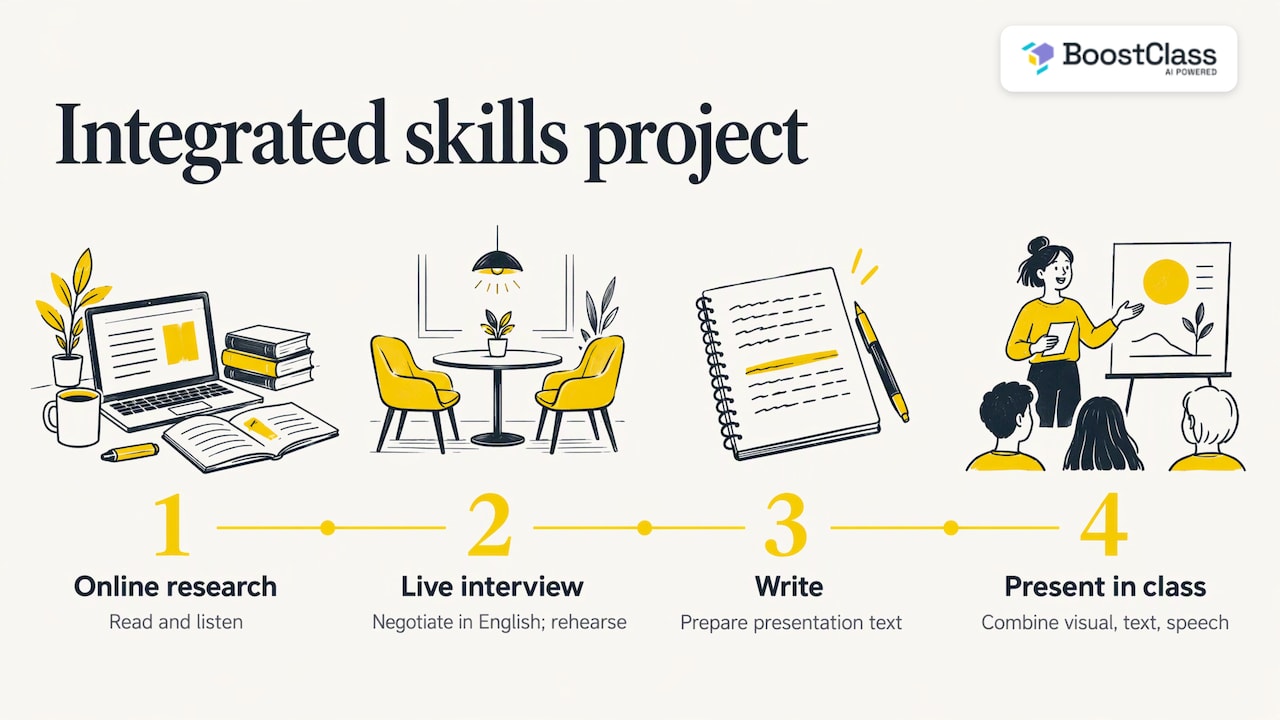
For a project-based model, a classic multimedia project design has learners research a topic by reading and listening, interview and negotiate in English, write, and combine visual, textual and spoken elements in a presentation. That sequence maps neatly onto a blended course: research online, interview and rehearse live, present in class.
If you like this task-led approach, our task-based language teaching examples show how to build the tasks, and our ESL role play scenarios give you ready live-lesson material for the speaking stage.
A worked example: one week of a B1 blended course
Take a group of adult B1 learners meeting twice a week, with the topic “Complaining politely about a service”.
- Before lesson one (online, 15 minutes). Learners listen to two short customer-service calls and read a sample complaint email. They note the phrases that soften a complaint.
- Lesson one (live). The teacher checks understanding, clarifies the softening language, then learners role-play a hotel complaint in pairs. The teacher notes recurring errors: for example, word order in indirect questions and the present perfect with “since”.
- Between lessons (online, 15 to 20 minutes). Each learner gets practice on their own errors, not the group’s average errors. The learner who confused “since” and “for” works on that; the learner who struggled with indirect questions works on those.
- Lesson two (live). Learners write and then perform a complaint conversation using the language they practised, and the teacher gives focused feedback on the combined task.
- After lesson two. A short summary of each learner’s progress goes to the learner, and the teacher or academic director sees who is falling behind.
Every online step is linked to a live step, and every live step uses the online result. That is the integration Cambridge describes.
Adapting blended activities to level
The same topic needs different handling at different levels. The University of Mainz foreign-language teaching guide provides blended activities and integrated scripts across CEFR levels A1 to B2, and it sequences receptive skills before productive skills. That order is a sound default: let learners hear and read the language before you ask them to produce it.
In practice:
- A1 to A2: short online inputs with visuals, sentence frames in live speaking, very small writing tasks.
- B1: longer listening, a purposeful task with a real-world outcome, error-targeted practice between lessons.
- B2 and above: learners choose sources, give opinions and defend them, and take part in writing that is revised after feedback.
Younger learners need an even more concrete approach. If you want to see how a school builds English into everyday routines for small children, this overview of English in the early years shows how language exposure can be structured around the child’s stage rather than a one-size syllabus.
For more on building individual routes through a course, see our guide to personalised learning pathways.
Feedback and progress tracking in a blended course
Timely feedback is where blended courses win or lose. A 2025 quasi-experimental study of Malaysian ESL writers found that blended learning with task-supported teaching enabled timely feedback and revision beyond class through tools such as Google Docs, and students valued that immediacy over conventional feedback.
For monitoring, Education Scotland’s 2022 guidance says staff should use digital solutions for monitoring and tracking that include analysis, graphical presentation and summary of data, and that learners should be able to see progress over time.
The obstacle is the teacher’s time. Writing individual feedback for 25 learners after a full teaching day is the point at which good blended courses quietly turn back into ordinary classes. Our guides on real-time feedback for language students and lesson time management cover the habits that keep this manageable.
What research says about engagement and results
The evidence is encouraging but context-dependent. Recent studies report improvements in writing, reading, speaking, listening and vocabulary in particular interventions, with stronger behavioural, cognitive and social engagement often reported. Emotional engagement is less consistently affected, and study length, setting and design limit broad generalisation.
Some examples:
- In a 2025 Malaysian study, 69 intermediate ESL learners in a six-week blended course improved their total writing scores from a mean of 51.29 to 77.09. The authors caution that the short duration and single institution limit what can be concluded.
- A 2025 systematic review of 20 EFL studies found that blended task-based teaching can improve speaking, writing and vocabulary, with outcomes depending on alignment, authentic tasks and teacher facilitation.
- A 2026 Iraqi study of 120 EFL learners found that blended learning was more effective than virtual learning for oral proficiency.
The common thread is the teacher. Blended courses work when tools line up with objectives, tasks are authentic and the teacher actively facilitates, not when online work is merely assigned.
Where BoostClass fits: Connected Activities
School owners and academic directors tend to describe the same six pressures: lesson preparation, teacher workload, student engagement, personalised learning, retention and teaching quality. A blended course multiplies the first two, because the teacher now prepares two connected halves.
BoostClass is an AI-powered platform for language education that connects lesson preparation, classroom performance and continuous practice. It works with Zoom, Microsoft Teams and Google Meet, and it supports in-person teaching too, so the same approach covers online, face-to-face and mixed groups.
On the preparation side, BoostClass Connected Activities lets a teacher generate over 20 types of classroom-ready activities. Lessons can be prepared from three inputs: your teaching objectives, insights from previous classes and the learning gaps detected in your students. That is what makes preparation faster and more personalised: instead of searching for a worksheet that roughly fits, you start from what your group actually struggled with last time.
After class, BoostClass generates individual student feedback, tracks progress and delivers personalised practice aimed at each learner’s actual mistakes. In the worked example above, that is the step where each learner practises their own errors between lessons. Students do not need to install anything, and teachers keep their own teaching style and materials.
For the challenges owners worry about most:
- Teacher workload: less time preparing and writing up feedback by hand.
- Student engagement and retention: learners get practice that is relevant to them, and schools gain visibility into engagement and outcomes.
- Teaching quality: BoostClass also analyses teacher performance, with a focus on Teacher Talk Time and other metrics, giving owners insight into how lessons are going.
For a wider view, read AI for language teachers and virtual classroom routines.
Using AI in a blended course responsibly
AI belongs in a blended course as support for teachers, not a substitute. The British Council’s guidance for teachers advises checking AI outputs for accuracy, inclusion and appropriateness, combining AI in assessment and feedback with ethical human oversight and transparency, removing personal information before using AI tools and considering how tools use and store data.
For school leaders, the British Council’s guide also points to risks such as algorithmic bias against non-standard English varieties, data privacy and digital inequality, while recognising AI’s potential for personalised learning pathways through adaptive diagnostic assessment and timely, focused feedback. Put these checks in your school’s tool policy, and keep a teacher in charge of every decision that affects a learner. If your staff are anxious about the technology, our article on whether AI will replace language teachers speaks to that directly.
Our perspective
We built BoostClass on a simple observation: the best part of a language course is the live lesson with a real teacher, and most of what goes wrong in a blended course happens around it. Preparation is rushed, feedback arrives late, and online practice has nothing to do with what the learner struggled with on Tuesday.
That is why we think the real class should be the source of everything else. When practice, reports and next-lesson activities come from what actually happened between the teacher and the students, the online half stops being an add-on and becomes the second half of the same lesson.
We also believe teachers should keep their style and their materials. Our job is to take the tedious administration off their plate, and to give school owners a clear view of engagement and outcomes, so that teachers can spend their energy on the human work that no tool replaces.
Cesar
Try Connected Activities with your next class
If you want to see how this works with your own group, you can try AI classroom activities and build your next blended lesson from your objectives and your students’ gaps. Activities are €5 per month. Student Intelligence plans cost €19 per month for up to 10 students and €34 per month for up to 20 students, and the student feedback plan for up to 30 students is €49 per month. See the current details on the BoostClass pricing page, or discover the full platform at BoostClass.
FAQ
Is blended learning the same as hybrid or online teaching?
Not quite. Blended learning combines face-to-face teaching with online activities in one planned course. Fully online teaching has no in-person component, and the term hybrid is often used loosely for either. In a blended ESL course, the live part can itself take place on Zoom, Microsoft Teams or Google Meet, with online practice between sessions.
How much of an ESL course should be online?
There is no fixed ratio. Cambridge advises starting from learning aims, learner needs, assessment requirements and your institution’s constraints, then deciding what suits each mode. A useful rule is to keep communication and explanation live, and put preparation and practice online.
How do I give personalised feedback to a large group?
Capture what happens in the live lesson, note each learner’s recurring errors and give practice that targets them. Doing this by hand is time-consuming. BoostClass automates individual student feedback and personalised practice from the real class, so you review and guide rather than write everything from scratch.
Does blended learning improve ESL results?
Studies generally report positive but context-dependent effects on writing, reading, speaking, listening and vocabulary, and on engagement. Results depend on aligning tools with objectives, using authentic tasks and active teacher facilitation, so course design matters more than the technology itself.
Sources
- Blended language learning, Cambridge Papers in ELT (2016)
- Flipped learning, Cambridge Papers in ELT (2020)
- Blended Learning in English Language Teaching: Course Design and Implementation, British Council (2013)
- Strategies for Blended Language Learning, Springer (2018)
- High-Leverage Principles of Effective Instruction, UCLA (2016)
- Student-Produced Multimedia Projects: Pedagogy and Practice, JALT
- A Guide to Teaching Foreign Languages, University of Mainz (2023)
- Features of Highly Effective Digital Learning, Teaching and Assessment, Education Scotland (2022)
- Task-supported Language Teaching in Blended Learning (2025)
- Integrating Blended Learning and Task-Based Language Teaching, systematic review (2025)
- The Impact of Blended and Virtual Learning on Willingness to Communicate (2026)
- British Council AI guidelines for teachers
- AI in language learning: lessons for school leaders, British Council
- English in the early years
