

The best ESL role plays give each student a clear role, a small problem to solve and just enough language to start. This guide gives you twelve scenarios from beginner to advanced, with business, meeting and customer service options, a sample role card, and a way to give feedback without stopping the conversation every ten seconds.
TL;DR
- A good role play has three parts: a situation, two or more distinct roles with different goals, and a time limit.
- Beginners need cards with numbered steps and useful phrases. Advanced learners need a problem and a character, with the solution left open.
- Business, meeting and customer service role plays work best when roles want different things, such as a customer who wants a refund and a manager who dislikes giving them.
- Do not interrupt to correct every mistake. Note common errors while you monitor and use them in a correction slot afterwards.
- Connected Activities in BoostClass can help you turn a previous lesson’s learning gaps into a role play in minutes.
Table of Contents
- Why role play works when other speaking tasks stall
- How to run a role play in six steps
- What to put on a role card
- Everyday scenarios for A1 to B1
- Travel and problem-solving scenarios for B1 to B2
- Business role plays for ESL
- Meeting role plays
- Customer service role plays
- Adapting role plays to level, age and class size
- Giving feedback after a role play
- Planning role plays without spending your evening on cards
- Build your next role play with BoostClass
- FAQ
- Sources
Why role play works when other speaking tasks stall
Most speaking tasks ask students to talk about themselves. Role play asks them to do something with language: complain, persuade, negotiate, apologise, ask for help. That is closer to what they will need outside the classroom, and it takes the pressure off, because the words belong to a character.
The British Council’s TeachingEnglish notes that role play offers opportunities for language production, and that preparation can include presenting the language students will need. That second point is where most weak role plays fail. A scenario with no language support produces silence at A2 and the same three safe sentences at B2.
For school owners and academic directors there is a second reason to care. Role plays are a visible, repeatable way to raise student engagement, and engaged students tend to stay. The catch is the preparation: building cards for every level and every group takes time that teachers rarely have. We come back to that below.
How to run a role play in six steps
The sequence below follows the structure the British Council describes, adapted for a typical 60-minute lesson.
- Set the context. Say where the students are and who they are. Ask what experiences they have of the situation, such as returning something to a shop, and collect the language they already know.
- Present the language. Put useful phrases on the board. Keep it short: six to eight expressions, not twenty.
- Demonstrate. Perform the scenario with a stronger student so that everyone sees what is expected.
- Hand out the cards and set a time limit. Three to five minutes is enough for a first round. Short rounds keep energy up.
- Monitor. Listen, help when asked, and write down common mistakes. Rarely interrupt.
- Close the loop. Run a correction slot with the errors you noted, then swap roles or partners and go again.
The British Council’s guidance on using cards, setting a time limit and swapping roles or partners covers the same flow. The second round is where learning happens: students apply the corrections immediately, with a new partner and a slightly changed card.
What to put on a role card
Role cards give each learner information to give or find out, and the answers they will give. Kodotchigova’s article on role play in teaching culture adds that cards should provide concrete information and clear role descriptions. Vague cards produce vague conversations.
Here is a sample pair for a B1 class.
Card A: Customer
- You bought a jacket last week. The zip is broken.
- You also bought trousers in the wrong size.
- You want a refund for the jacket and an exchange for the trousers.
- You have the receipt, but you do not have the packaging.
Card B: Shop assistant
- Your manager does not like giving refunds.
- You can offer an exchange or a credit note.
- You may give a refund only if the item is clearly faulty.
- Be polite, but do not agree too quickly.
Notice that the two cards want different things. That gap is what makes students negotiate instead of reading out lines.
Everyday scenarios for A1 to B1
Low levels need familiar situations and plenty of support. Pictures, sentence frames and numbered steps all help.
1. Meeting a new classmate (A1 to A2)
One student is new to the school and the other is showing them around. Practise greetings, questions about home and work, and directions. Give a card with five question prompts and a model answer for each.
The British Council has a new student role play for A2+ learners that suggests using props. It notes that cardboard phones can help students get into their roles, perform better and have more fun in telephone role plays. It is a cheap trick that works.
2. Ordering in a café (A1 to A2)
One student is the waiter and the other is the customer. The customer has an allergy, a budget and a friend who is late. Practise polite requests, menu vocabulary and numbers.
3. Asking for directions (A2)
Give one student a map with the destination hidden and the other a map with the route. They must exchange information to complete it. This is a small information gap, which means both students have to speak.
4. Returning faulty goods (A2 to B1)
The sample cards above come from this scenario. The British Council’s shop service role play has a customer return two items, one broken and one the wrong size or colour, while the shop assistant’s manager dislikes refunds. Learners use the information on their cards to resolve the situation.
5. Booking a doctor’s appointment by phone (B1)
Students sit back to back, which removes gestures and forces clear speech. The caller has symptoms and only two free slots; the receptionist has a different set of free times. Practise describing symptoms, negotiating times and spelling a name.
Travel and problem-solving scenarios for B1 to B2
At low-intermediate level and above, problems or conflicts can motivate learners to talk. So add friction.
6. Lost luggage at the airport (B1)
The passenger has a connecting flight in two hours and an important item in the bag. The airline agent has a form with eleven questions and no information about where the bag is. Practise describing objects, polite insistence and asking for confirmation.
7. A noisy hotel room (B1 to B2)
A guest complains at reception at 11 p.m. The receptionist has no free rooms. The guest wants compensation and the receptionist can only offer a late checkout. Practise complaints, softening language and compromise.
8. Flatmates disagree (B2)
Three students share a flat. One wants a cleaning rota, one wants to invite friends every weekend and one is moving out in a month. Each must get one thing from the discussion. Give the cards only the problem and the character, and let students find their own solutions.
Business role plays for ESL
For professional learners, the best scenarios match what they actually do at work. Ask students in the first lesson what situations worry them most, and build role plays from the answers.
9. Asking for a deadline extension (B1 to B2)
A team member needs three more days on a report. The manager has a client presentation on Friday. Practise explaining reasons, making offers (‘If I send the draft by Wednesday…’) and diplomatic refusal.
10. A job interview with a twist (B2 to C1)
The candidate has a gap in their CV and the interviewer has been told to ask about it. For extra pressure, the interviewer receives a note halfway through telling them to change the subject to salary. Unexpected updates like this are a good way to stretch advanced students.
11. Negotiating a supplier contract (C1)
Two sides, each with a bottom line they must not reveal. Practise hedging, conceding, summarising and closing a deal. Give each side a numbered list of priorities with a different order of importance.
Meeting role plays
Meetings are where many adult learners feel most exposed, because they must interrupt, disagree and keep up with several speakers at once. A simple structure works well:
- One student is the chair who follows a short agenda and keeps time.
- Three or four students are participants, each with a private goal and one thing they disagree with.
- One student is the language monitor who notes useful phrases and errors for the debrief.
Try an agenda about moving to a four-day week, or choosing a new office. Add small complications: one participant keeps talking, another never speaks, and one proposal has a hidden cost. The chair must handle each. Learners practise raising concerns, making proposals, inviting quieter people in and moving the discussion forward.
For the language, pre-teach three groups of phrases: opening and moving on (‘Shall we move on to…?’), proposing and responding (‘How about…?’, ‘I see your point, but…’), and summarising (‘So, to sum up…’). A function menu like this on the board is enough support for B1 and B2 learners.
Customer service role plays
Customer service scenarios practise requests, complaints, polite language and register. The shop role play described above is a good start. Other options:
- Broken internet connection: a customer calls a helpline and an agent follows a troubleshooting script. The customer is frustrated and has already called twice.
- Wrong order delivered: the customer wants a replacement today and the agent can only offer tomorrow.
- Upset customer in person: the agent must calm the customer, repeat the problem back, offer a solution and check the customer is satisfied.
In each, give the customer and the agent different register targets. The customer can be direct, then the second time through, polite and firm. The agent practises empathy phrases (‘I completely understand why you’re frustrated’). Comparing the two rounds teaches register better than any grammar explanation.
If you run in-person classes, a counter, a few props and a bell make this scenario memorable. If you teach online, a phone-call set-up with cameras off works well.
Adapting role plays to level, age and class size
By level. Support decreases as proficiency rises. For beginners, cards can include detailed, numbered instructions and useful language. For advanced learners, give only the problem and the character’s background, interests or constraints, and leave them to improvise. Kodotchigova’s advice is to state a problem without supplying its solution.
| Level | Card content | Support | Example |
|---|---|---|---|
| A1 to A2 | Numbered steps, model sentences | Pictures, sentence frames | Café order |
| B1 | Goals and key facts | Function menu on board | Returning goods |
| B2 | Character and problem | Few phrases, a time limit | Flatmates disagree |
| C1 | Hidden bottom lines, surprise update | None | Supplier negotiation |
By age. With teenagers, choose situations they care about: ordering at a festival, disputing a phone repair, a group chat argument. With adults, use their working lives. With young learners, short rounds, props and puppets beat long scripts.
By class size. In large classes, run all pairs at once and monitor in zones. In small one-to-one lessons, the teacher is the second role, which means you must play a real character with real objections, not an easy partner. In mixed-ability groups, give roles that spread the language load: a chair, a reporter who summarises the outcome, and a language monitor who notes phrases.
Giving feedback after a role play
The temptation is to correct on the spot. The British Council advises the opposite: teachers can monitor and offer help, but should rarely interrupt to correct every mistake, and can note common mistakes for future classes.
A practical routine:
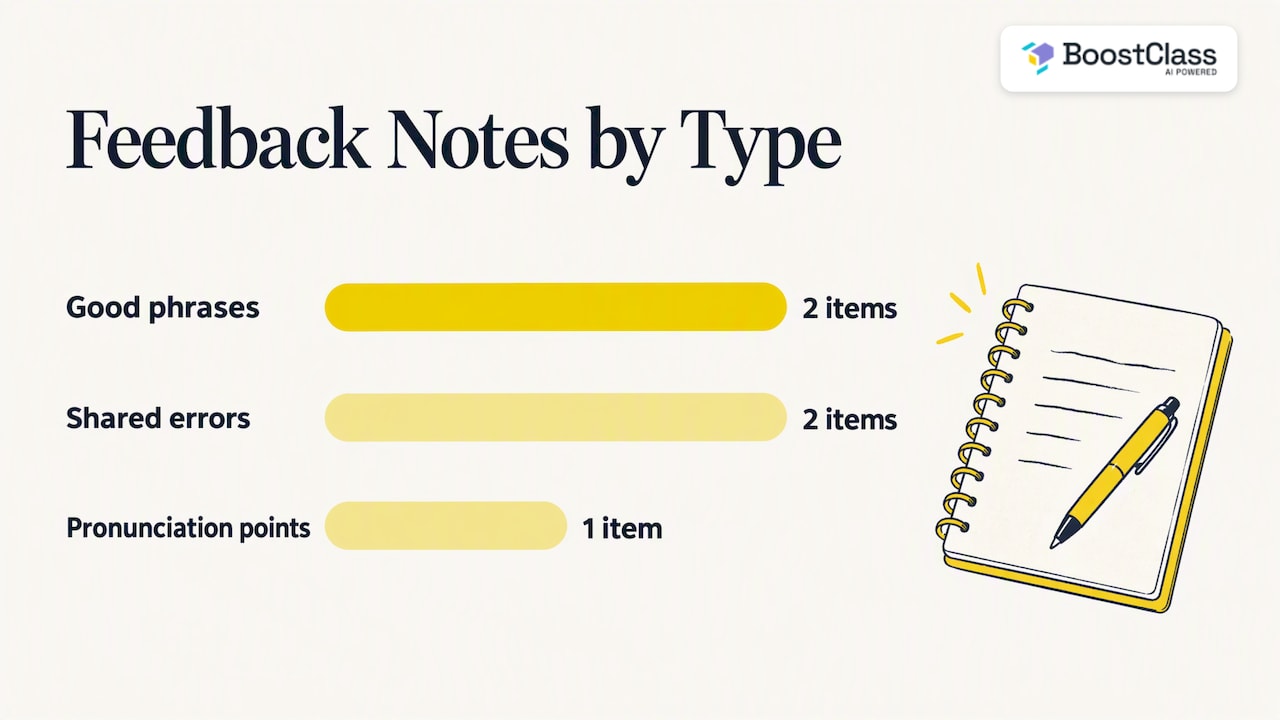
- While students speak, write down five items: two good phrases, two errors shared by several students and one pronunciation point.
- Put the errors on the board anonymously and ask the class to fix them.
- Praise the good phrases by name.
- Ask students how it went. Kodotchigova suggests that after the role play you debrief what happened and what learners learned, invite opinions, or use an evaluation questionnaire.
- Run the scenario again with a changed card.
The weak point is the written record. Handwritten notes from a 12-student class rarely become individual feedback, and the errors you noticed on Tuesday are forgotten by Thursday. That is why we built BoostClass to generate individual student feedback and personalised practice from what happened in class. Our approach to this is explained in our guide to real-time feedback for language students.
AI can also play a part inside the role play itself. The British Council notes that AI can act as a role-play partner when learners prompt it with a specific role and situation, such as a waiter in a restaurant. That is useful for extra practice between lessons, though it does not replace the teacher and classmates in the room.
Planning role plays without spending your evening on cards
The real challenge is not ideas. It is the time it takes to turn an idea into cards at the right level for each group, with language that matches what those students got wrong last week. For teachers with many groups, and for academic directors who want consistent quality across teachers, this is where preparation time disappears.
A workable shortcut is to build role plays from three inputs: your teaching objective (for example, polite complaints), the previous lesson’s content, and the gaps you saw (for example, learners avoiding the past simple when describing a problem). If you want more on this approach, see our guides on AI lesson planning for language teachers and task-based language teaching examples. For how this fits a wider plan for each learner, read about personalised learning pathways.
Our view: role play should answer what happened in the last lesson
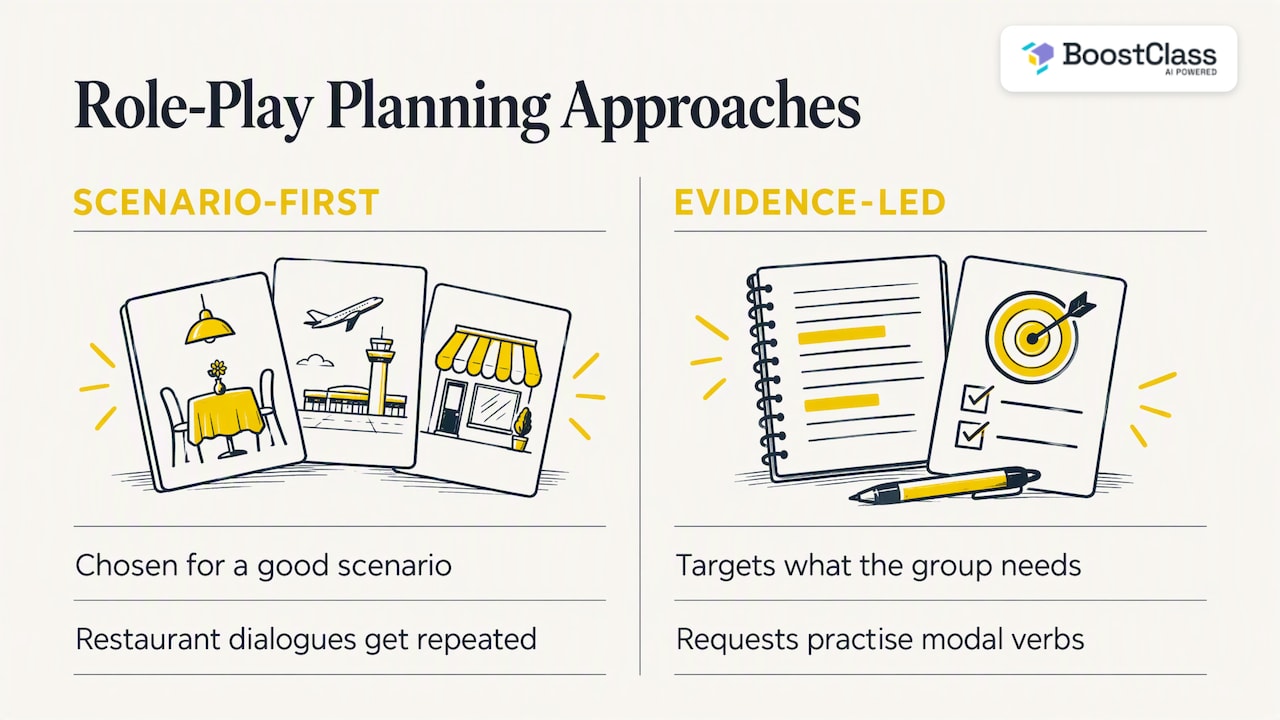
We talk to many teachers and school owners, and the same pattern comes up. A role play is chosen because it is a good scenario, not because it targets what the group needs. Restaurant dialogues get repeated while the class keeps making the same tense error.
We think the scenario should follow the evidence. If the last lesson showed that learners avoid modal verbs when making requests, the next role play should force them to make requests. That is the idea behind BoostClass: it connects lesson preparation, classroom performance and continuous practice, so the next activity starts from what happened in the real class with a real teacher.
Teachers keep their own style and materials. We automate the admin around them: preparation, feedback, practice and progress tracking. For school owners, the result is clearer visibility of engagement and learning outcomes, which helps with retention and with teaching quality across the whole team.
Cesar
Build your next role play with BoostClass
BoostClass is an AI-powered platform for language education. With Connected Activities, teachers can generate over 20 types of classroom-ready activities, prepared from teaching objectives, insights from previous classes and detected student learning gaps. It connects with Zoom, Microsoft Teams and Google Meet, supports in-person teaching, and students do not need to install anything.
The Activities plan costs €5 per month. Student Intelligence, which adds individual feedback, personalised practice and progress tracking, costs €19 per month for up to 10 students, €34 per month for up to 20 and €49 per month for up to 30; see the pricing page for the full details. You can also discover BoostClass or try the AI classroom activities directly.
FAQ
How long should an ESL role play last?
A single round should run for three to five minutes, which keeps energy high and gives you time to swap roles or partners. A full lesson sequence, including context, language presentation, two or three rounds and a correction slot, typically fills 45 to 60 minutes.
Can I run role plays with beginners?
Yes, with more support. Give beginner cards numbered steps and model sentences, use pictures, and start with familiar situations such as ordering food or meeting someone. Demonstrate the first round with a stronger student so everyone can see what is expected.
How do I run role plays in an online class?
Pair students in breakout rooms with a card each, shared as a message or on screen, and keep rounds short. Phone-call scenarios suit video platforms well, because students can turn cameras off and rely on voice alone. BoostClass works with Zoom, Microsoft Teams and Google Meet.
What should I do when students finish too quickly?
Add an unexpected update, such as a changed deadline or a new complaint, or swap partners and give a new card. For advanced learners, this kind of surprise stretches their language more than a longer scenario.
Sources
- Role-play | TeachingEnglish | British Council
- Kodotchigova: Role Play in Teaching Culture
- Role play activity for A2+ level learners | TeachingEnglish
- Shop service role-play | TeachingEnglish
- Getting started with AI in the language classroom | TeachingEnglish
