

Adaptive learning in ESL means the learning path changes according to what each student actually does: what they get right, what they get wrong and how quickly they move. Adaptive teaching is the teacher’s side of the same idea: planning tasks, support and feedback so that learners of different levels can all work productively in one class. The best results come when the two meet. Data about each learner tells the teacher what to prepare, and the teacher’s judgement decides what to do with it.
This guide is for language school owners, academic directors and teachers who run mixed-level classes and want personalised learning without doubling their preparation time.
TL;DR
- Adaptive learning uses learner data to set the next task. Adaptive teaching uses the teacher’s judgement to differentiate tasks, support and feedback within one class.
- Mixed-ability classes work best with a shared goal, tiered tasks and scaffolding such as sentence frames and vocabulary banks, not with separate lessons for each level.
- The real constraint is teacher time. Preparation and follow-up are where adaptive approaches usually break down, and where AI can take on the repetitive work.
- Keep the teacher in charge: AI proposes exercises and practice from real class evidence, and the teacher chooses and adjusts.
- Watch equity, data privacy and bias, and check that technology changes the pedagogy rather than repackaging explanations.
Table of Contents
- What adaptive learning means in ESL
- Why mixed-level classes are the real test
- Adaptive teaching strategies for mixed-ability ESL classes
- Using assessment and feedback to adapt as you go
- Where AI fits in adaptive ESL teaching
- How BoostClass supports adaptive teaching
- Safeguards: equity, privacy and pedagogy
- A simple rollout for a language school
- Try it with your own class
- FAQ
- Sources
What adaptive learning means in ESL
A university teaching-development page describes adaptive learning as a technology-led approach that aims to personalise learning using factors drawn from the student, such as ability, learning preferences and aspirations. In language education that usually means a system that notices what a learner can already do and chooses the next item accordingly.
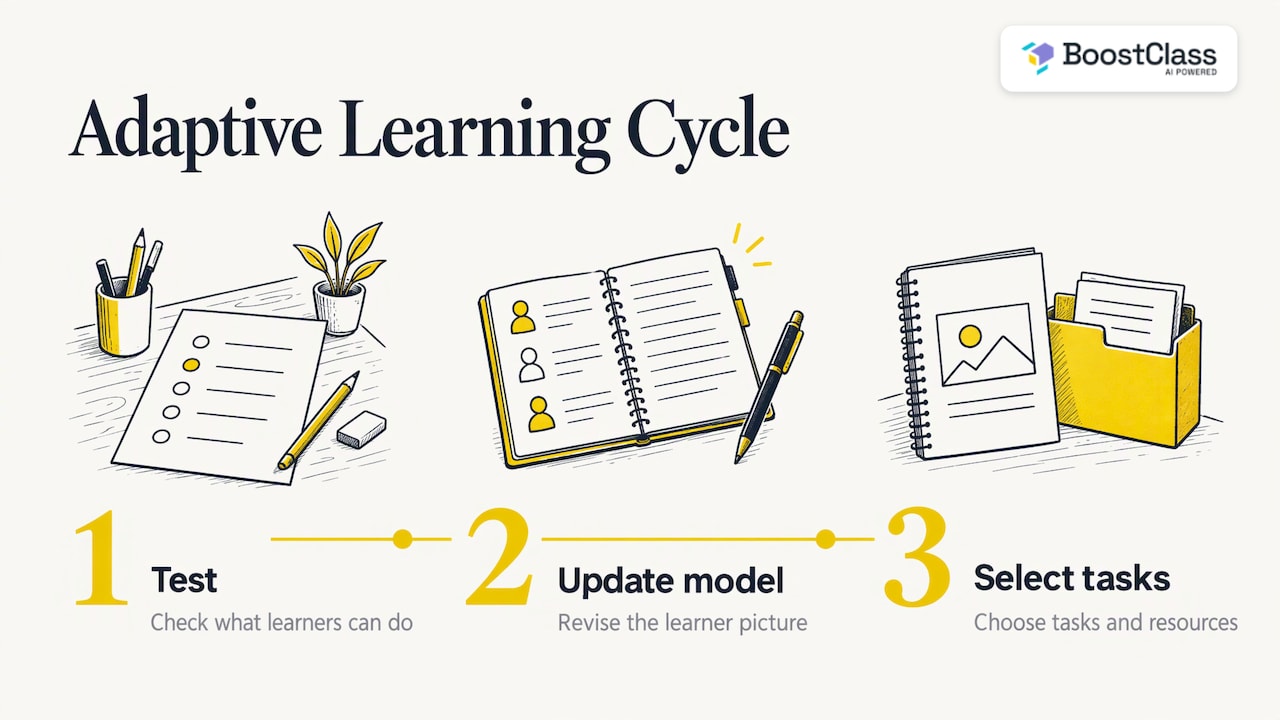
A 2023 academic paper on adaptive English learning, citing the Horizon Report, describes a cycle of three processes: adaptive testing, updating the learner model, and selecting the next suitable tasks and resources. That cycle is worth remembering because it applies equally to software and to a good teacher with a notebook. You check, you update your picture of the learner, you choose what comes next.
Cambridge’s paper on adaptive technology in language learning explains that simple systems fix the rules in advance, deciding how an individual’s data leads to a recommendation, while more complex systems use AI and machine learning to find patterns in large amounts of data. For a school, the practical point is that “adaptive” covers a wide range, from a quiz that repeats missed items to a system that builds practice from your own lessons.
Individualisation and differentiation
The same paper separates two ideas teachers often blur. Individualisation tailors the pace: more repetition for one learner, less for another. Differentiation tailors pace and order, and some learners benefit from scaffolding that breaks items into smaller parts. Both are useful in a classroom, but they call for different decisions. Pace is a matter of how many examples you give. Differentiation is a matter of what route you ask a learner to take.
Adaptive learning versus adaptive teaching
Adaptive learning is usually a feature of a platform. Adaptive teaching is a habit of the teacher. A platform can tell you that three students keep dropping the third-person -s. It cannot decide that this is the moment to stop the lesson, put two stronger students in front of the others and let them explain it. A literacy-education article makes a related point: a truly adaptive course must be modified according to student development throughout the process, not simply the same course with a few adjustments.
Why mixed-level classes are the real test
Most language schools do not have the luxury of perfectly levelled groups. A new student joins in week six. A teenager is stronger at speaking than writing. An adult returning to English after ten years is slow to start and quick to recover. Owners and academic directors feel the effects in four places:
- Lesson preparation: a teacher who prepares for three levels is preparing three lessons.
- Teacher workload: feedback and follow-up happen in unpaid evenings.
- Student engagement: the strongest learners drift when tasks are too easy, and the weakest go quiet when tasks are too hard.
- Retention: learners who feel the class is not for them are the ones who do not renew.
Teaching quality sits under all four. If quality depends on how much spare time each teacher has, it will vary from class to class. Adaptive approaches matter because they make personalisation repeatable rather than heroic.
Adaptive teaching strategies for mixed-ability ESL classes
Two studies give useful evidence on what works in practice. Both come from university settings, so adapt the ideas to your own learners rather than expecting identical results.
A 2021 study of online EFL writing classes at a Saudi university found that differentiated instruction was the most successful strategy because it allowed materials, teaching practices and assessment tools to be adapted to motivate lower achievers.
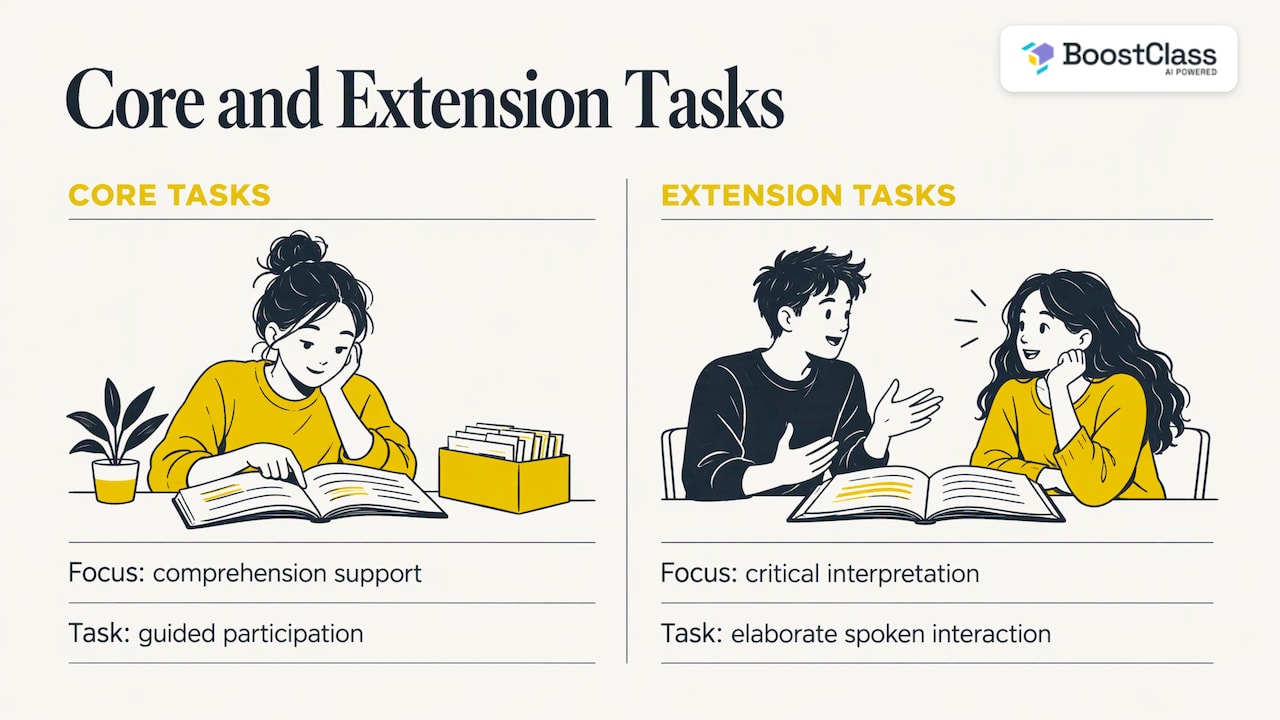
A 2026 study of a mixed-ability integrated English course at a Chinese private university used what it called a Core + Extension model. Foundational tasks focused on guided participation and comprehension support, while extension tasks asked for critical interpretation and more elaborate spoken interaction. Scaffolding came from vocabulary banks, sentence frames, discourse prompts and graphic organisers. The researchers also found that scaffolded support gave lower-proficiency learners more chances to take part by reducing immediate linguistic pressure in group discussion, although participation stayed uneven across groups. That last detail is a useful warning: differentiation reduces the gap but does not remove the need to monitor who is actually speaking.
Tiered and multi-level activities you can use tomorrow
The pattern is the same each time: one topic, one outcome, different routes to it.
| Activity | Support tier | Core tier | Extension tier |
|---|---|---|---|
| Describing a weekend | Sentence frames with a word bank | Free speaking with three prompt questions | Compare two weekends and justify a preference |
| Reading a short article | Gap-fill summary and picture matching | True/false plus open comprehension questions | Write a reply to the author with an opposing view |
| Role-play: booking a hotel | Scripted dialogue with options to choose | Role cards with a problem to solve | Handle a complaint with no script |
| Vocabulary review | Matching with images | Sentences using the words | Explain the difference between near-synonyms |
A few rules keep this manageable:
- Share the goal, not the task. Everyone is working towards the same outcome, such as booking the room, so the lesson still feels like one class.
- Let learners move between tiers. Tiers are starting points, not labels. Offer the extension to anyone who finishes.
- Mix groups on purpose. Use similar-level pairs for practice and mixed-level pairs for explanation tasks.
- Scaffold, then remove. Start with the sentence frame and retire it as the learner stops needing it.
- Track who spoke. A quick tally of speaking turns shows whether your tiers are really giving everyone a voice.
For ready-made starting points, our guide to task-based language teaching examples shows how a single task can be pitched at several levels, and the warm-up ideas for ESL classes work well as an easy first step because each can be run at two levels at once.
Using assessment and feedback to adapt as you go
Adaptation only works if you know what learners cannot yet do. That means short checks inside the lesson and a record of the results afterwards. Three habits cover most of it:
- Check during the task, not after it. Listen to pairs, note two or three recurring errors and decide which one to address with the whole class.
- Separate the error from the learner. Writing “article use, present perfect” next to a name is more useful than a mark out of ten.
- Feed the result into the next plan. A learning gap that is noticed on Tuesday and not planned for until the following month has not been adapted to.
The weak link is usually the record. Notes made in the moment are rarely collected, so the next lesson is planned from memory. Our guides on real-time feedback for language students and what to include in language progress reports cover how to turn those observations into something a teacher, a student and a parent can all use.
Feedback loops are also the idea behind adaptive study tools more broadly. If you want to see how a feedback loop for AI-assisted study works from the learner’s side, the same cycle applies: practise, get feedback, adjust, practise again.
Where AI fits in adaptive ESL teaching
The British Council’s 2024 report on AI and English language teaching identified five areas where AI is used in ELT: speaking, writing and reading skills, support for pedagogy, and self-regulation. It also noted that AI is used to offer a more personalised approach through adaptive learning.
A 2026 systematic review in Frontiers in Education found that AI systems in EFL and ESL increasingly act in several roles at once. The most common were teacher support, content and materials generation, assessment or diagnosis, and practice or tutoring. The same review reported benefits including more practice opportunities, faster feedback cycles and redistributed instructional work. For a school owner, the last point is the commercially important one: some of the repetitive work moves off the teacher’s desk.
On learner outcomes, a US Institute of Education Sciences project on AI-personalised English lessons for adults reported that in its first phase average vocabulary and comprehension scores rose by 6%, with more engaged learners gaining more, and that 73% of students rated the tool effective or very effective. These are results for one specific project, not a promise for every tool, but they point the same way as the wider literature.
A systematic review of 22 selected studies of AI in English as a foreign language reached a similar conclusion: AI tools enable personalised teaching, adaptive assessment and feedback and can promote more authentic interactions. Our own overview, AI for language teachers, looks at what this means day to day.
A worked example: one class, three levels
Take an evening class of eight adults preparing for travel. Three learners are around A2, three around B1 and two nearer B2. Last week the teacher noticed that the A2 group struggled with past simple questions, the B1 group overused very and the B2 learners avoided conditionals.
Without support, the teacher spends the weekend building three versions of a role-play. With a tool that holds the evidence from last week’s class, the planning starts from those gaps instead: an A2 task with question frames, a B1 task that rewards precise adjectives, and a B2 task that needs if sentences to resolve the problem. The lesson goal is still one shared outcome, planning a trip together. The teacher’s judgement shapes the result, and the repetitive drafting is done in minutes.
How BoostClass supports adaptive teaching
BoostClass is an AI-powered platform for language education built around this loop of preparing, teaching and practising. It connects with Zoom, Microsoft Teams and Google Meet, and it also supports in-person teaching, so the approach is not tied to one format. Students do not need to install anything.
Before class, BoostClass Connected Activities lets teachers generate over 20 types of classroom-ready activities. Lessons can be prepared from teaching objectives, insights from previous classes and detected student learning gaps. That is what makes preparation both faster and more personal: the starting point is what your learners actually did, not a generic worksheet. Teachers keep their own teaching style and materials.
After class, BoostClass generates individual student feedback, tracks progress and delivers personalised practice aimed at each learner’s actual mistakes. For academic directors, the reports give visibility into learning outcomes and engagement. The platform also analyses teacher performance, with a particular focus on Teacher Talk Time, which gives owners a view of how lessons are being delivered. For related reading, see our guides to AI lesson planning for language teachers and personalised learning pathways.
Our perspective
Most conversations about adaptive learning start with software and forget the classroom. We start from the opposite end. The richest evidence about a language learner is what happens in a real class with a real teacher: the hesitation before a past tense, the word a student reaches for and misses, the question nobody dared to ask.
That is why we built BoostClass to capture insight from the lesson itself and turn it into personalised practice, feedback and reports, rather than asking students to learn alone on a separate platform. Teachers keep their style and their materials. What changes is that preparation starts from evidence, and follow-up happens without evenings of admin.
For school owners, we think this is what makes personalisation sustainable. It stops depending on one exceptional teacher with spare time and becomes part of how the school works.
Cesar
Safeguards: equity, privacy and pedagogy
Adaptive technology deserves careful use, and a good school plan names the risks.
- Equity. A 2026 systematic review of 27 studies on AI in inclusive and differentiated EFL teaching found persistent disparities for learners from lower socioeconomic backgrounds, and raised concerns about algorithmic bias, data privacy and linguistic hegemony. Practically, check that every learner can access practice on the devices they have, and review whether some groups are getting less from it.
- Privacy. Know what learner data is stored, who can see it and for how long, and tell students and parents plainly. For minors, follow your local data protection rules.
- Pedagogy. The British Council notes that many conventional forms of teaching, such as lectures and explanations, persist inside AI-powered tools. Adaptive technology should change what learners do, not just who explains.
- Training. The authors of the 2025 review stress the need for comprehensive teacher training and further research into good practice. Give teachers time to learn the tools and decide together how to use them.
If your staff are worried about being replaced, our article on whether AI will replace language teachers addresses that concern directly from a school owner’s point of view.
A simple rollout for a language school
You do not need to change everything at once. A sensible sequence looks like this:
- Pick one mixed-level class where preparation is currently heaviest.
- Define the shared outcome for the next four lessons, for example giving a short presentation.
- Prepare two tiers for each task, then add a third when the routine is comfortable.
- Record recurring errors after each lesson and use them to plan the next one.
- Review with the teacher after a month: preparation time, student participation, and whether learners are staying.
- Extend to other classes once the routine is working.
This keeps the focus on the outcomes owners care about: teacher workload, engagement, retention and consistent teaching quality. For the school-level view, see AI for language schools: a practical guide for owners.
Try it with your own class
BoostClass pricing is published on our pricing page. Activities costs €5 per month. Student Intelligence is €19 per month for up to 10 students and €34 per month for up to 20 students, and the student feedback plan for up to 30 students is €49 per month. If you want to see how Connected Activities turns your last lesson into tiered exercises, try the AI classroom activities or discover BoostClass.
FAQ
What is adaptive learning in ESL?
It is an approach where the next learning task is chosen according to the individual learner’s performance, strengths, weaknesses and pace. It can be done by software, by a teacher, or by both. In the best cases the learner’s path is updated continuously as they progress.
What is the difference between adaptive learning and personalised learning?
Personalised learning is the broad goal of fitting learning to the individual. Adaptive learning is one way to reach it, using data to adjust the path. A teacher who differentiates tasks by level is also personalising, even without technology.
How do I run a mixed-ability ESL class without three lesson plans?
Plan one shared outcome and give it tiers: a supported version, a core version and an extension. Use sentence frames and word banks for the support tier, and let learners move up when they are ready. This keeps the class together while meeting different levels.
Can AI help with multi-level ESL activities?
Yes. Research reviews describe AI as useful for generating materials, diagnosing gaps and providing faster feedback. With BoostClass Connected Activities, teachers can generate over 20 types of activities from teaching objectives, previous class insights and detected learning gaps, then choose and adjust what suits each group.
Sources
- Personalised Learning, University of London teaching development
- Exploring Adaptive Learning of English as a Foreign Language, SHS Web of Conferences (2023)
- Respecting Student Development, Differences Through Adaptive Language Classes, Literacy Worldwide (2016)
- Personalization of language learning through adaptive technology, Cambridge (2017)
- Technological Affordances and Teaching in EFL Mixed-ability Classes, The SAI Journal
- Teaching the Margins: Addressing Within-Class Proficiency, IntechOpen (2026)
- Artificial intelligence and English language teaching: Preparing for the future, British Council (2024)
- From tools to pedagogical ecologies, Frontiers in Education (2026)
- Personalized and Context-relevant English lessons with AI, Institute of Education Sciences
- Aprendizaje adaptativo del inglés como lengua extranjera, Profesorado (2025)
- AI in Inclusive EFL Instruction: A Systematic Review, ERL Journal
- 4 Step Study Feedback Loop to Learn Faster With AI Guardrails
