

A good ESL feedback comment does three things: it says what the learner did well, names the one thing to fix next, and tells them how to fix it. “Good job” does none of that. This guide gives you a formula, ready-to-adapt examples for listening, speaking, reading and writing, report card wording by proficiency level, and a way to keep the quality high when you have thirty reports due.
It is written for teachers, academic directors and school owners who want comments that students act on, parents understand and the school can stand behind.
TL;DR
- Use a three-part comment: a specific strength, one priority to improve, and a concrete next step.
- Replace praise-only remarks with evidence of what the learner can now do, taken from real lessons.
- Limit each comment to one to three points. Students act on a few ideas, not a list of ten.
- Report and parent comments follow the same logic, with a plain-language line on how families can help.
- Comment quality drops under time pressure, so build a system that captures evidence during lessons rather than from memory.
Table of Contents
- What makes an ESL feedback comment work
- A three-part formula you can reuse
- ESL feedback comment examples by skill
- ESL report card comments by proficiency level
- Writing ESL parent reports that families understand
- Keeping comments personal when workload is the real problem
- Our perspective
- See it in your own classes
- FAQ
- Sources
What makes an ESL feedback comment work
Professional guidance on language feedback agrees on a handful of points. ACTFL’s guidance on effective feedback says feedback should be tied to learning goals and the learner’s current proficiency, and should be specific, timely, descriptive and student-friendly. It should also help learners move forward without overwhelming them, and invite them to reflect on their own work.
Three habits follow from that.
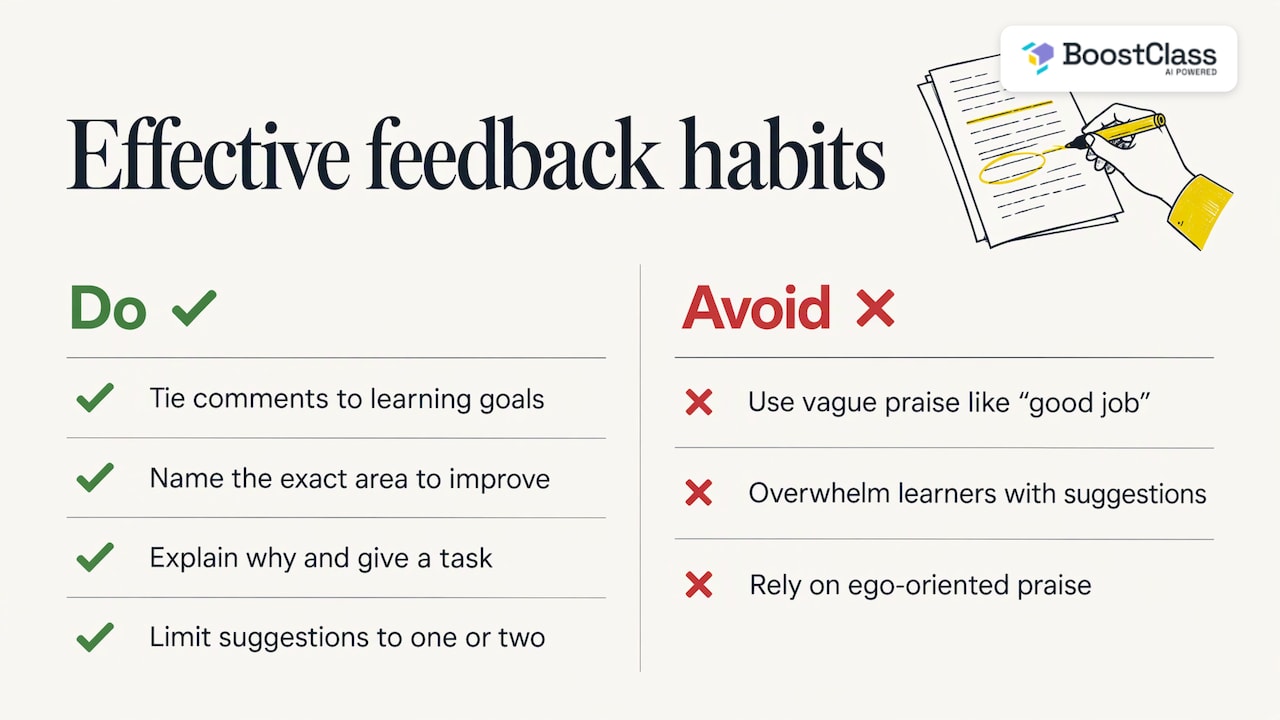
Be specific. TESOL’s 2024 advice on writing feedback is to replace vague remarks such as “good job” with precise comments about the exact area that needs work. A learner cannot do anything with “nice effort”. They can do something with “your past tense is accurate in the first paragraph, but the second drifts into present”.
Explain the why, then give a task. The same TESOL guidance recommends saying why a form is wrong and giving a usable revision prompt, for example asking the learner to add a topic sentence or join a fragment to the sentence before it. OnTESOL makes the same point: a comment such as “participation was good” is too vague, whereas explaining countable and uncountable nouns after a learner writes “many informations” gives them a rule to apply.
Do not bury them. The Portfolio-Based Language Assessment best practices guide recommends addressing the most critical needs first and limiting suggestions to one or two ideas, with three as the most students can realistically act on. It also notes that ego-oriented feedback such as “Good job!” may encourage students but does not move their learning forward.
A three-part formula you can reuse
The Integrating CLB Assessment guide describes a two-stage, action-oriented comment: identify the area needing improvement, then give concrete steps. Adding a strength at the front, as TESOL suggests, gives you a three-part structure:
- Strength with evidence: what the learner can do, and where you saw it.
- Priority: the one issue that matters most now.
- Next step: an action verb and a task they can complete.
Here is how that changes everyday comments.
| Vague comment | Formula comment |
|---|---|
| Good speaking today. | You kept the conversation going for two minutes without switching to your first language. Next time, try adding a follow-up question after each answer, such as “And what about you?” |
| Watch your grammar. | Your sentences about last weekend are clear. Check the verbs: “I go to the park” should be “I went” because it already happened. Rewrite your first paragraph with five past simple verbs. |
| Needs to improve writing. | Your email has a clear request in the first line. Add a greeting and a closing phrase. Use the model email from today’s lesson to rewrite it. |
| Participation was good. | You answered every question in the role play. Work on the pronunciation of “th” in “think” and “three”: put your tongue between your teeth and record yourself saying five words. |
Notice the pattern: each comment contains something the student can see, something they can change and something they can do before the next lesson.
ESL feedback comment examples by skill
Adapt these to your learners, and always swap in the real evidence from your own class. The wording is deliberately plain so students at lower levels can read it.
Speaking
- “You spoke for a full minute about your job and used three linking words (and, but, because). Next, try giving one reason for each opinion.”
- “Your answers are clear, but they are very short. In the next lesson, add one detail to every answer: when, where or why.”
- “You said ‘I am agree’ twice. We say ‘I agree’. Try using ‘I agree’ and ‘I don’t agree’ in three sentences tonight.”
Listening
- “You found the time and the place in the voicemail task. Next, listen for numbers: replay the recording and write down every number you hear.”
- “You asked me to repeat the question, which is exactly the right strategy. Practise one phrase: ‘Could you say that more slowly, please?’”
Reading
- “You found the main idea of the article quickly. Now underline two words you do not know and guess their meaning from the sentence before checking.”
- “You understood the menu and the short notice. For the next level, read one short news story a week and write one sentence summarising it.”
Writing
- “Your paragraph has a clear opening sentence. Add one example to support your idea, then check that every sentence starts with a capital letter.”
- “The ideas are interesting, but two sentences run together. Split them with a full stop or join them with ‘and’ or ‘but’.”
If you want to go deeper on written work, our guide to writing feedback with AI covers how to give corrections without rewriting the learner’s text for them. For feedback during the lesson itself, see real-time feedback for language students.
ESL report card comments by proficiency level
Report card comments are a different job. They summarise feedback given over time, so they should reflect recent evidence. The Ontario Ministry of Education guide to reporting says effective comments are personalised, clear and precise, and focus on significant strengths and key next steps. The New Brunswick guidelines add practical rules: short sentences, simple words, no jargon, and no absolutes such as “always” or “never”.
One way to anchor wording is a proficiency framework. The WIDA Can Do Booklet describes six levels, from Entering (pictorial or graphic support) through Beginning (phrases or short sentences), Developing (expanded sentences) and Expanding (varied sentence lengths) to Bridging (extended discourse) and Reaching. Its companion for older learners stresses that descriptors must be interpreted for age and experience: extended discourse looks very different for a six-year-old and a teenager. If you teach adults, treat the levels as a guide and use your own course objectives or CEFR-style descriptors instead.
Here are sample comments written for adults and teenagers.
Beginner
- “Maria can introduce herself and answer simple questions about her family using short sentences. This term she should practise asking questions, for example ‘Where do you live?’”
- “Kenji reads short signs and menus with the help of pictures. Reading one short text each week will help him recognise more common words.”
Intermediate
- “Anna takes part in discussions and gives opinions with simple reasons. To move forward, she should use linking words such as ‘however’ and ‘so’ to connect her ideas.”
- “Tomás writes clear emails and short paragraphs. Past tense accuracy is his next target: he will rewrite one weekly diary entry and check each verb.”
Advanced
- “Lena speaks with confidence in group discussion and adapts her language to the topic. Her next challenge is more precise vocabulary: she will keep a list of useful collocations from each lesson.”
- “Omar writes well-organised essays. To reach the next level, he should vary his sentence openings and reduce repetition of ‘also’ and ‘because’.”
Notice what these comments avoid. They contain no “excellent student” or “hard-working” without evidence, and each one ends with a next step.
The UGDSB language comments guide suggests one more habit: describe what the learner can do, then personalise with an example of where they showed it. “Follows classroom routines” becomes “follows classroom routines, as shown when she opens her notebook as soon as the activity is announced”.
Writing ESL parent reports that families understand
Parents of language learners are not always teachers, and some read English as a second language themselves. Keep reports short, free of jargon and specific. The Surrey School District guidance on written learning updates gives a useful skeleton:
- An opening sentence about overall progress.
- What the student has learned.
- What they are working towards.
- How the family can support learning.
A sample for a parent of a 12-year-old intermediate learner:
“Sofia has made steady progress this term. She now gives short presentations about her hobbies and answers follow-up questions without translating. She is still working on using past tenses when she tells stories. At home, you could ask her to tell you about her day in English for two minutes, and let her correct herself before you help.”
The home suggestion should be small and realistic. Asking parents to “practise English daily” helps nobody; asking them to listen to one two-minute story does. For more on structure, our guide to language progress reports shows what to include and how to keep the format consistent across a whole school.
If you check your wording before sending, a report comment checker can help you catch unclear phrasing and inconsistent tone.
Keeping comments personal when workload is the real problem
Most teachers know what a good comment looks like. The obstacle is time. Writing individual, evidence-based feedback for 30 learners after a full teaching day leads to copy-and-paste comments, and learners notice. Parents notice too, and retention suffers when families feel their child is just a name on a list.
The fix is to capture evidence while teaching, not afterwards. Practical habits that help:
- Note one observation per learner per lesson. One error pattern, one success, thirty seconds each.
- Keep a bank of strengths and next steps per skill and level, and personalise each with a real example from the learner’s work.
- Batch the work. Draft feedback straight after each lesson, when memory is fresh, instead of leaving it all until the end of term.
- Standardise the structure, not the content. Every comment follows the same three parts, but the evidence is individual.
- Review as a school. Academic directors can sample comments each term against a short checklist: specific, one priority, one action, plain language.
This is where technology can take the repetitive part off your plate. BoostClass is an AI-powered platform for language education that connects with Zoom, Microsoft Teams and Google Meet, and also supports in-person teaching. After class it generates individual student feedback, tracks progress and creates personalised practice aimed at each learner’s actual mistakes. Because the feedback is based on what happened in the real lesson, comments can reflect real evidence rather than a generic template. For a wider view of how this fits into a school’s operations, see how AI is transforming English language centres, or read our overview of AI for language teachers.
Preparation matters here too. BoostClass Connected Activities lets teachers generate over 20 types of ready-to-use classroom activities from teaching objectives, insights from previous classes and detected learning gaps. If feedback shows a learner keeps confusing past simple and present perfect, the next lesson can include practice targeted at exactly that gap, so feedback and lesson planning feed each other. Our guide to AI lesson planning walks through the process, and personalised learning pathways explains how to link feedback to what students practise next.
A worked example: from lesson to comment
Suppose a teacher runs a 45-minute online lesson on making complaints with a group of B1 adults. During the role play she notices that one learner, Pavel, uses polite structures well but keeps saying “I want a refund” in a blunt way. A good follow-up looks like this:
- Strength: “You opened the call politely and explained the problem clearly.”
- Priority: “Your request sounded very direct: ‘I want a refund’.”
- Next step: “Use ‘I would like to ask for a refund’ or ‘Could you give me a refund?’ in the practice activity below.”
That took thirty seconds to notice. Writing it up for every learner is where the hours go, and it is the step that benefits most from automation.
Our perspective
We built BoostClass around one belief: the best feedback comes from what actually happens in the lesson, with a real teacher in the room or on the call. Generic comment banks save time, but they cannot tell a student what they said last Tuesday or which mistake keeps coming back.
Teachers should keep their own style and materials. What they should not have to do is spend their evenings turning memory into paragraphs. When feedback, practice and progress tracking come from the same lesson, teachers get time back, students get comments that feel written for them, and school owners can see engagement and learning outcomes clearly enough to improve teaching quality and keep families enrolled.
A comment is only as good as the evidence behind it. We think the lesson itself should supply that evidence.
Cesar
See it in your own classes
BoostClass helps language teachers and schools automate student feedback, personalised practice, progress tracking and lesson preparation, in one workflow. Plans start at €5 per month for Activities, with Student Intelligence at €19 per month for up to 10 students and €34 per month for up to 20 students, and a student feedback plan at €49 per month for up to 30 students. You can discover BoostClass and see the full pricing, or try the AI classroom activities directly.
If you are setting up a school-wide approach, our comparison of AI for language schools can help you choose.
FAQ
How do you write good ESL feedback for a student?
Name something specific the student did well, pick the single most important thing to improve, and give a task they can do next. Keep it to one to three points and use words they can read easily. For example: “Your story is easy to follow. Check the past tense of three verbs and rewrite the first paragraph.”
What are some short ESL report card comments?
Short comments still need evidence and a next step. Try: “Takes part in class discussions and uses simple linking words. Next, practise giving reasons for opinions.” Avoid vague phrases such as “good effort” on their own, and avoid absolutes like “always” or “never”.
How long should a report card comment be?
For most learners, two to four sentences is enough: one on strengths, one on the main area for growth, and one on a next step or how families can help. Surrey’s guidance, for example, suggests one to three sentences describing strengths per area, with one sentence on growth and one on home support.
Should ESL feedback include grades or marks?
Marks have their place for formal assessment, but the PBLA guide notes that research suggests marks and grades do not enhance learning and recommends comment-only, action-oriented feedback on classwork. Pair any grade with a written next step so students know what to do with it.
Can AI help write ESL feedback comments?
Yes, when it works from real lesson evidence and the teacher stays in charge of the final message. BoostClass generates individual student feedback and personalised practice based on actual class interactions, so teachers review and send comments instead of writing each from scratch.
Sources
- ACTFL: Provide Effective Feedback
- TESOL: 6 Strategies for Effective Writing Feedback in ELT
- OnTESOL: Giving Effective Feedback in The Online ESL Classroom
- Portfolio-Based Language Assessment (PBLA) Best Practices Guide
- Integrating CLB Assessment: Making Professional Judgements and Providing Feedback
- Ontario Ministry of Education: Reporting Student Learning
- New Brunswick: Assessing, Evaluating and Reporting Grades K-8
- WIDA Can Do Booklet, Grades K-12
- WIDA Can Do Booklet, Grades 9-12
- UGDSB: ESL Language Comments
- Surrey School District: Written Learning Updates Support Documents
