

A good language progress report tells a learner three things: what they can do now, what evidence shows it, and what to do next. Most reports fail on the third. They list marks and attendance, then close with a vague line such as “keep up the good work”. This guide covers the structure that works, the wording for each skill and level, example comments you can adapt, and how to build reports without losing your evenings.
TL;DR
- Keep each report to a few parts: context, attendance, skills evidence, strengths, next steps. Short and specific beats long and generic.
- Describe listening, speaking, reading and writing separately, and say what the learner can do, not only a grade.
- Base every comment on comparable evidence from real lessons, and always end with an action the learner can take.
- AI can draft and spot patterns, but the teacher checks every line and stays responsible for it.
- Reports are far easier to write when feedback and mistakes are captured during lessons, not reconstructed at the end of term.
Table of Contents
- What a language progress report is for
- What to include: a structure that holds up
- Describing speaking, listening, reading and writing
- Progress report comments that work at different levels
- Evidence: what to base the report on
- A worked example, start to finish
- Why reports take so long, and where the time goes
- Using AI for progress reports, carefully
- Our perspective: reports should come from the real lesson
- From report to next lesson
- Try it with your own learners
- A checklist before you send a report
- FAQ
- Sources
What a language progress report is for
A progress report has more than one reader. The learner wants to know whether the effort is paying off. A parent or an employer paying the bill wants proof of value. The academic director wants consistency between teachers, and the school owner wants to see why a student should renew.
That last point matters more than it looks. A learner who can see their own progress in plain terms is more likely to carry on. A learner who receives a grid of numbers with no story behind it has little reason to believe the course is working. So the report is a teaching tool and a retention tool at once, and it should be written as both.
What to include: a structure that holds up
The research behind most report templates points to the same core elements: learner and course details, attendance, assessment evidence, the teacher’s observations on strengths and areas for growth, and recommendations for the future. The useful ones separate current achievement from actionable next steps, so the reader can see where the learner stands and what happens next.
Here is a layout that works for adult, teen and business learners alike.
| Part | What goes in it | Length |
|---|---|---|
| Learner and period | Name, course, teacher, dates covered | 1 to 2 lines |
| Level now and goal | Current level and the goal the learner actually has (exam, promotion, travel) | 2 to 3 lines |
| Attendance and participation | Lessons attended, homework completion, engagement | 2 to 3 lines |
| Skills | Listening, speaking, reading, writing, each with evidence | 2 to 3 lines each |
| Strengths | What improved, with an example | 3 to 4 lines |
| Next steps | Two or three actions, with a time frame | 3 to 4 lines |
Keep length under control. The Canadian Language Benchmarks learner progress report, for example, limits its summary to about 200 words covering strengths, progress and suggestions for learning. That discipline is worth borrowing. A short report that gets read beats a long one that gets filed.
Add a block that depends on the learner
A general English student, an IELTS candidate and a sales manager learning business English need different things on the page. The IELTS candidate needs a band-style view of each skill and the weakest task type. The sales manager needs a line on meetings, emails or calls. Add one flexible block that reflects the learner’s stated goal, and the report stops feeling like a template.
Describing speaking, listening, reading and writing
A single overall level hides what a teacher actually sees. Learners are rarely even across skills: a student may follow a film comfortably and freeze in a conversation. Report the four skills separately.
Two well-known systems do this. WIDA’s 2025 to 2026 interpretive guide reports a proficiency level and scale score separately for each domain, and its domain descriptions explain what students can typically do at the level they reached. In its scoring, the whole number gives the level and the decimal shows progress within it, so a 3.7 means level 3 and more than halfway to level 4. Hong Kong’s Learning Progression Framework takes a similar view, using eight attainment milestones across the four skills, with general outcome statements and specific pointers about what students can do.
You do not need to adopt either framework. Take the principle: pair a level with a plain “can do” statement.
Example skill statements
- Speaking, intermediate: “Maria now keeps a two-minute conversation going about her work without switching to Spanish. She still drops the third-person -s, so we are practising it through short role-plays.”
- Listening, elementary: “Tomasz follows slow, clear instructions and can pick out times and prices in short recordings. Fast, connected speech is still difficult, so he will do a short listening task twice a week.”
- Reading, upper-intermediate: “Aisha reads articles for gist confidently. Her next step is inferring attitude and tone, which matters for the exam texts she is preparing.”
- Writing, any level: “Your emails are clear and well organised. The main pattern to fix is article use, which we found in four of the last five tasks.”
Each one names something observed, says what is still developing, and points to an action.
Progress report comments that work at different levels
Comments should change with the learner’s level. Beginners benefit from comments about basic vocabulary and phrases, intermediate learners from sentence complexity and conversation, and advanced learners from nuance, rhythm, flow and complex discussion. One ESL comment bank follows that logic, with beginner reading comments about using pictures and context and intermediate ones about summarising passages in the learner’s own words.
Treat any comment bank as raw material, though. The Canadian guidance goes further and deliberately provides no drop-down menu for the strengths section, because a menu cannot be comprehensive enough to capture each learner’s situation. That is a fair warning: copied phrases make every learner sound the same, and parents notice.
Wording that separates stages
The same Canadian guidance suggests using “beginning” and “developing” for learners who have progressed but not completed a level. It also asks for comments that are specific, objective, succinct and learner-friendly. Compare:
| Vague | Specific and useful |
|---|---|
| Speaking has improved. | Jun now answers follow-up questions without long pauses and uses past simple correctly in most sentences. |
| Needs to work on writing. | Paragraphs are clear. Linking words are still limited to “and” and “but”, so we will practise “however” and “although”. |
| Good effort this term. | Jun completed 9 of 10 homework tasks and asked for extra vocabulary practice, which shows in his improved range. |
Strengths first, then growth
British Columbia’s 2023 reporting guidelines ask for descriptive feedback that is simple, concise and strengths-based, aligned with learning standards, and identifies specific areas for future growth. Their example of an area for growth is useful: say what the student can currently do, such as a good grasp of sentence structure, and then name the next target, such as punctuation accuracy. The learner reads progress and direction in the same sentence.
Evidence: what to base the report on
A comment is only as good as the evidence behind it. Two habits make reports defensible.
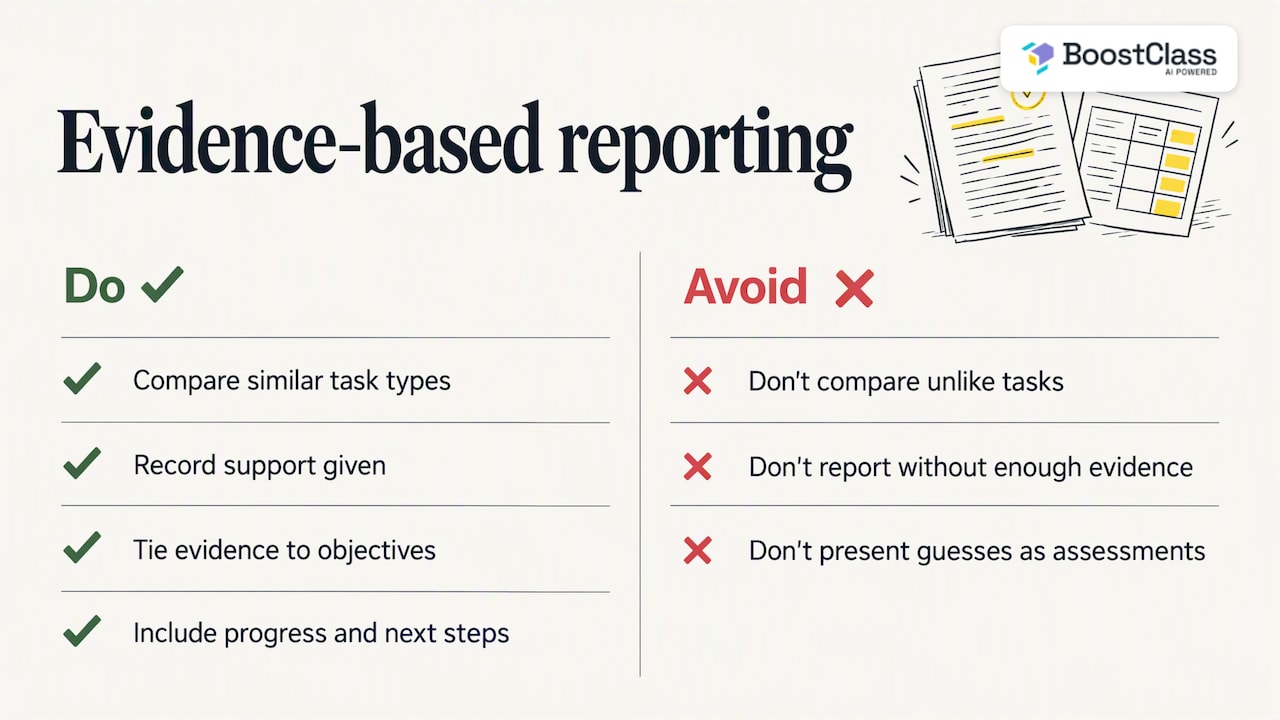
Compare like with like. If you judge writing in September from a free email and in December from a timed essay, the change tells you nothing. Choose samples of similar task type and note the support given, such as whether the learner worked alone or with prompting. For learners preparing for school exams, working from official past exam papers with their marking memos gives you comparable tasks and a marking standard that is not yours alone.
Do not report without enough evidence. The Canadian guidance compares benchmarks at the start of a period with those completed at the end, based on portfolio evaluation. If there is not enough evidence, it says not to issue a report. That is a sensible rule for any school. A guess dressed as an assessment damages trust faster than a short delay.
Cambridge English makes the same point from the learning side. Its guide to integrating learning and assessment says that classroom evidence tied to learning objectives and success criteria helps learners see their progress, and that feedback should include positive evidence of progress as well as actionable ways to improve. Timely feedback, immediate or delayed, shows learners what to do next. If you want more on the in-lesson side, our guide to real-time feedback for language students covers it.
A worked example, start to finish
Imagine Elena, a B1 learner in a small group class, who wants to move from understanding meetings to speaking in them. Over a term you have these notes: attended 11 of 12 lessons, completed most homework, recorded errors with tense choice in speaking, a strong improvement in listening, and two writing tasks of the same type.
A concise report might read:
Level and goal: B1, working towards confident participation in team meetings.
Attendance: 11 of 12 lessons, homework mostly complete.
Listening: Elena follows the main points and detail of a clear business conversation. She needs more exposure to fast speech.
Speaking: She contributes ideas readily. The recurring error is mixing present perfect and past simple when giving updates. We will use short “status update” role-plays.
Writing: Both emails were clear and polite. Her second one had fewer errors in word order than her first.
Next steps: Two ten-minute practice tasks a week on past tenses, and one recorded one-minute update to review together.
It is under 150 words, it names evidence, and the next steps are things Elena can actually do. The skill is in the selection, not the length.
Why reports take so long, and where the time goes
Most teachers do not struggle with the writing. They struggle with remembering. By the end of term, the detail of who made which mistake in week three has gone. Teachers then either scribble generic comments or spend hours rereading notes. For a school owner, that creates workload problems, inconsistent quality between teachers, and reports that arrive late or not at all.
The answer is to capture evidence as you teach, so the report becomes an assembly job. That might be a shared notes template, a short post-lesson routine, or a tool that does the capturing for you. Our piece on lesson time management covers how to find the minutes for a routine like that.
Using AI for progress reports, carefully
AI can help, within limits. The University of Notre Dame’s 2026 guidance says AI may help identify technical errors or patterns and draft general comments, but instructors must remain the final decision-makers and be able to verify, explain and justify the observations and grades. The British Council gives similar advice to English teachers: combine AI with human oversight, check outputs for accuracy, inclusiveness and appropriateness, protect personal data, consider bias and be open about using it.
In practice, before a report goes out:
- Read every comment against what you saw in class. If it says something you did not observe, remove it.
- Check that the next steps match the learner’s goal, not a generic one.
- Keep learner data inside tools your school has approved.
- Tell learners and parents when AI helped draft the feedback, if your school’s policy requires it.
- Sign off yourself. The report carries your name.
The quality of an AI draft depends on what it is fed. A tool that only sees a learner’s homework answers will write generic comments. A tool that sees what happened in the lesson can write specific ones. For more on writing-specific feedback, see writing feedback with AI.
Our perspective: reports should come from the real lesson
We built BoostClass around a simple observation: the best evidence of a learner’s progress is the lesson itself, with a real teacher and real interaction. Most reporting tools ask teachers to enter data after the fact. We think that is backwards. If evidence is captured during the class, the report, the practice and the next lesson plan can all draw on it.
That is why BoostClass connects with Zoom, Microsoft Teams and Google Meet, and also supports in-person teaching. Students do not need to install anything, and teachers keep their own teaching style and materials. What changes is the admin: individual student feedback, progress tracking and personalised practice based on each learner’s actual mistakes are generated automatically, and the teacher reviews them.
We also believe the teacher stays in charge. A report should say what a teacher would say, only faster and with better recall. For school owners and academic directors, the same data gives visibility into learning outcomes and student engagement, which is what makes retention conversations factual rather than hopeful. Our view on keeping teaching human is set out in AI in English language academies.
— Cesar
From report to next lesson
A report that ends in a list of weak points is wasted if nothing in the next lesson changes. The most useful loop looks like this: lesson, evidence, report, targeted practice, next lesson. When the report says “past tenses in speaking”, the next class should contain a past-tense speaking activity.
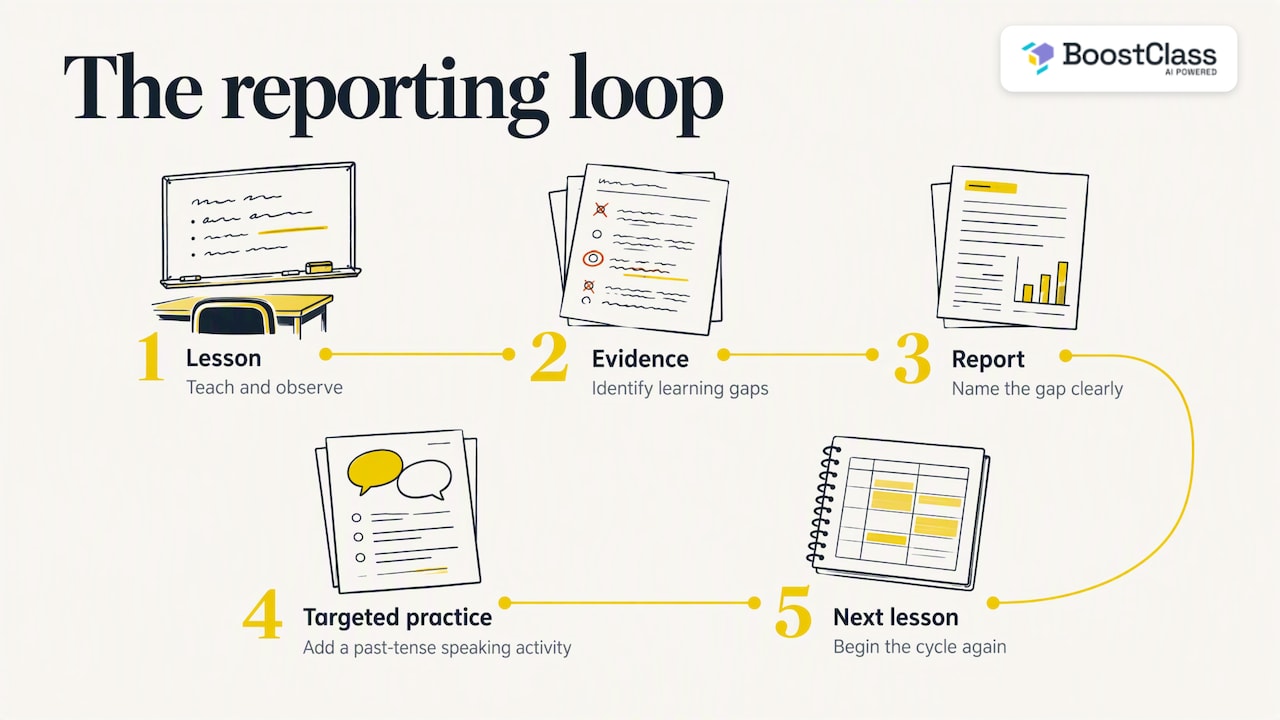
This is where preparation time disappears. Building a fresh activity for each learner’s gap is slow. BoostClass Connected Activities generates over 20 types of ready-to-use exercises, built from your teaching objectives, previous class insights and the learning gaps detected in your students. A gap named in a report can become a classroom-ready activity in minutes, and the lesson stays personal without costing you an evening. For the bigger picture of how this fits across a course, see personalised learning pathways.
Try it with your own learners
If you want progress reports that write themselves from real lessons, BoostClass is built for that. Plans are month-to-month. Activities costs €5 per month, and Student Intelligence, which covers individual feedback, progress tracking and personalised practice, starts at €19 per month for up to 10 students, €34 for up to 20 and €49 for up to 30. You can look at the full BoostClass plans or try the AI classroom activities at app.boostclass.net/activities.
School owners can start from the BoostClass home page to see how it works across a team of teachers.
A checklist before you send a report
- Does every comment refer to something the learner actually did?
- Are listening, speaking, reading and writing reported separately?
- Is the evidence comparable between the start and end of the period?
- Is there at least one strength with an example?
- Are the next steps two or three concrete actions, not a general instruction?
- Is the language simple enough for the learner or parent to understand?
- If AI helped, has a teacher checked and approved the final text?
FAQ
How long should a language progress report be?
As short as it can be while staying specific. The Canadian Language Benchmarks report limits its summary to about 200 words, which is a good benchmark. For most learners, one page is enough, with two or three lines per skill.
How often should I write progress reports?
That depends on the course length and the learner’s goal. Many schools report once a term, with a short check-in at the midpoint for longer courses. Business clients often prefer a baseline, a mid-point and a final report, so match the rhythm to what the person paying needs to decide.
What should I write if a student has made little progress?
Describe what the learner can currently do, name the specific area that is holding progress back, and set a small, concrete next step. Use wording such as “developing” rather than judgemental language. If the cause is attendance or low practice time, say so factually and offer a plan.
Can I use AI to write report comments?
Yes, as a drafting aid. Review every comment against your own observations and the learner’s goals, keep student data in approved tools, and take final responsibility for what is sent. Guidance from the British Council and the University of Notre Dame both stress human oversight.
Sources
- Instructions for completing the Learner Progress Report (Centre for Canadian Language Benchmarks)
- WIDA ACCESS Interpretive Guide for Student Score Reports
- Learning Progression Framework (Hong Kong Education Bureau)
- 210 Free Report Card Comments for ESL Students (TeacherVision)
- K-12 Student Reporting Policy: Communicating Student Learning (British Columbia)
- Guide to integrating learning and assessment in your teaching (Cambridge English)
- Guidance on the Use of Artificial Intelligence for Assessment (University of Notre Dame)
- British Council AI guidelines for teachers
- English Paper 2 literature past papers
