

Retrieval practice means getting learners to pull words, phrases and grammar out of memory, without notes, instead of showing them the material again. In a language lesson that can be a two-minute brain dump, a quick quiz or a role-play that forces students to use last month’s vocabulary. It works best when it is low-stakes, repeated over weeks, and followed by feedback. This guide covers the activities, the spacing, the feedback and the planning, with examples you can run in your next class.
TL;DR
- Retrieval practice is the act of recalling language from long-term memory without support, then checking the answer. It is a learning tool, not a test.
- Short, frequent, low-stakes tasks (brain dumps, quick quizzes, exit tickets) are enough. Nobody needs a big exam.
- Return to key vocabulary at widening intervals, for example after a day, a week and a month, and reactivate essential items every three to four weeks.
- Feedback closes the loop: learners need to see what they missed, and you need to see which items the whole group forgot.
- Planning is the real obstacle. Tools that build the tasks from your previous lessons and learners’ actual mistakes remove most of the burden.
Table of Contents
- What retrieval practice means in a language classroom
- What the research says
- Retrieval practice strategies you can run tomorrow
- Spaced repetition for vocabulary: when to come back
- Interleaving: mixing it up
- Feedback: closing the loop
- Perspective
- Using AI to prepare retrieval practice well
- Where BoostClass fits
- A four-week retrieval plan to copy
- FAQ
- Sources
What retrieval practice means in a language classroom
The British Council’s TeachingEnglish database describes retrieval as recalling and using language stored in long-term memory. It can only happen once learners have retained the words, which is why teachers build in revision and recycling: language is forgotten quickly if nobody returns to it.
That gives a useful distinction. Re-reading a vocabulary list, or watching you explain the present perfect for a second time, is passive review. Writing down everything you remember about the present perfect, with the page closed, is retrieval. Oxford University Press makes the same point in its principles of language learning: active recall is more effective than passive review because learners have to reconstruct knowledge themselves.
Two details matter in practice:
- No notes. The attempt to recall is what does the work. If students copy from the board, you are testing eyesight.
- Feedback afterwards. Answers are checked, corrected or compared with a model so that errors do not get rehearsed.
Researcher Pooja Agarwal and colleagues argue that it is better to talk about “retrieval practice” than the “testing effect”, because the active attempt to recall is what shapes learning, not the test itself. That is good news for teachers who dislike grading: most of the activities below are never marked for a grade.
What the research says
You do not need to take this on trust. A 2021 systematic review of 50 classroom experiments found that 57% of the studies showed medium or large benefits from retrieval practice in real educational settings. The activities in those studies included free recall, short-answer quizzes and multiple-choice quizzes, and they were seldom high-stakes tests.
On forgetting, a 2021 review by Kathleen McDermott in the Annual Review of Psychology explains that practising retrieval soon after learning slows forgetting across a range of materials and learner abilities. For a language school, that is the case for the five-minute review at the start of a lesson, run on what was taught last time, not on what is convenient.
None of this makes retrieval practice a silver bullet. It does mean that a small, consistent habit tends to beat an occasional long revision lesson.
Retrieval practice strategies you can run tomorrow
The TESOL blog lists nine retrieval ideas for the classroom, including Two Things, Quick Quizzes, Brain Dumps, Cops and Robbers, Walkabout Bingo, List It!, Retrieval Role-Play, Translated Dictation and Sticky Note Quizzing. The shared rule: students retrieve without books or notes, then receive feedback. Here is how several of them look in a language lesson, with a few of my own adaptations.
| Activity | How it runs | Best for | Time |
|---|---|---|---|
| Brain dump | Students write everything they remember about a topic or last lesson, then compare with a partner and add missing items | Start of lesson, all levels | 3 to 5 minutes |
| Quick quiz | Five short questions read aloud or shown one at a time, answered on paper or mini-whiteboards | Vocabulary and grammar forms | 3 minutes |
| Cops and Robbers | Students write what they remember alone, then circulate and “steal” extra items from classmates | Larger groups, lively classes | 8 to 10 minutes |
| Translated dictation | You read sentences in the learner’s first language, students write them in the target language | Grammar in context | 5 minutes |
| Retrieval role-play | Students act out a scenario that needs vocabulary from a previous unit, with no cue cards | Speaking, bridging into fluency | 10 minutes |
| Translation tennis | Pairs rally back and forth with translations between English and the target language | Vocabulary, pair work | 5 minutes |
| Exit ticket | Two or three questions on the lesson just finished, answered before leaving | End of lesson | 2 minutes |
The translation tennis idea comes from a secondary MFL teaching blog. It shows how readily these tasks move across languages, whether the target is English, Spanish or Mandarin.
A worked example: B1 adult class, travel vocabulary
Suppose your group learned travel vocabulary three weeks ago (check-in, delay, luggage allowance, boarding gate). Today’s lesson is on complaints and polite requests.
- Minute 0 to 4: Brain dump. “Write every airport word you remember. Pens down when I say.” No notes.
- Minute 4 to 6: Pairs merge their lists and count items. Circulate and note which words nobody wrote. Those are your forgotten items.
- Minute 6 to 8: Show the missing words and have students say them in a sentence.
- Minute 8 onwards: Move to the lesson’s main task, a role-play of a delayed flight complaint, where students must use at least four of the airport words.
The whole retrieval segment costs about eight minutes, produces a diagnostic for free, and feeds directly into the new material. That last link matters: retrieved vocabulary is most useful when it is used straight away in role-plays or discussions, so it becomes fluent, not just recognised.
Moving beyond the single quiz
The Education Endowment Foundation’s piece on refining retrieval practice warns against the same quiz format every week. Vary the format, balance challenge with success, and do not treat retrieval as a one-off. Teachers can also ask students to explain why a rule works (“why do we say I have lived here for ten years and not I live here for ten years?”), which pushes thinking beyond rote recall.
Spaced repetition for vocabulary: when to come back
Retrieval practice tells you how to practise. Spacing tells you when. The principle is simple: the same number of exposures, spread out, tends to produce better long-term retention than the same exposures crammed together. A 2021 paper in the journal Lexis on the distributed practice effect finds that spaced learning generally improves long-term retention over massed or narrowly spaced episodes, and that the best interval depends on how long you need learners to remember.
What this means in a timetable
The same authors suggest teachers plan progressions over long timescales and identify the essential lexical items to reactivate every three to four weeks. A common rule of thumb, from a language teaching blog on memory, is to have students retrieve the same content one day, one week and one month after first meeting it. Treat that as a starting point and adjust to your learners.
A simple schedule for a new set of ten words taught on Monday:
- Tuesday: a three-minute quick quiz at the start of class.
- The following Monday: a brain dump on the topic.
- Three to four weeks later: a role-play or writing task that needs the words.
Spaced repetition in ESL and EFL classes
The practical shift is to treat units as connected parts of a long game, not self-contained blocks. That is the mindset the Lexis authors recommend: revisit vocabulary across weeks and months, and keep a calendar or learning management system record of when each set is due back. Many ESL classes lose vocabulary at exactly the point where the course book moves to the next unit and never returns.
Two habits help:
- Keep a running “must-keep” list of the 30 to 50 items each group most needs, and draw quiz questions from it.
- Mark credit for effort and regularity, not accuracy. The Lexis authors advise this to reduce learner frustration, which matters when adults fear looking foolish in front of classmates.
Interleaving: mixing it up
Interleaving means mixing different topics or skills in one practice session instead of finishing one before starting the next. In a language class, that might be a quiz that jumps between past tenses, travel vocabulary and polite requests, in place of ten questions on the past simple. It feels harder, and that is partly the point: learners must decide which form fits the situation, which is what real conversation demands.
A workable way to start is to take your spaced review tasks and shuffle them. Instead of a Unit 4 quiz and then a Unit 5 quiz, build one five-question quiz with items from Units 2, 4 and 5. Keep it low-stakes, and expect learners to make more errors at first. Those errors are useful information.
Feedback: closing the loop
Retrieval without feedback risks fixing mistakes in memory. The feedback can be a model answer that students use to diagnose and revise their own responses, or a teacher-led correction round. Retrieval also works as a diagnostic: it helps learners identify gaps in their knowledge and adjust how they study.
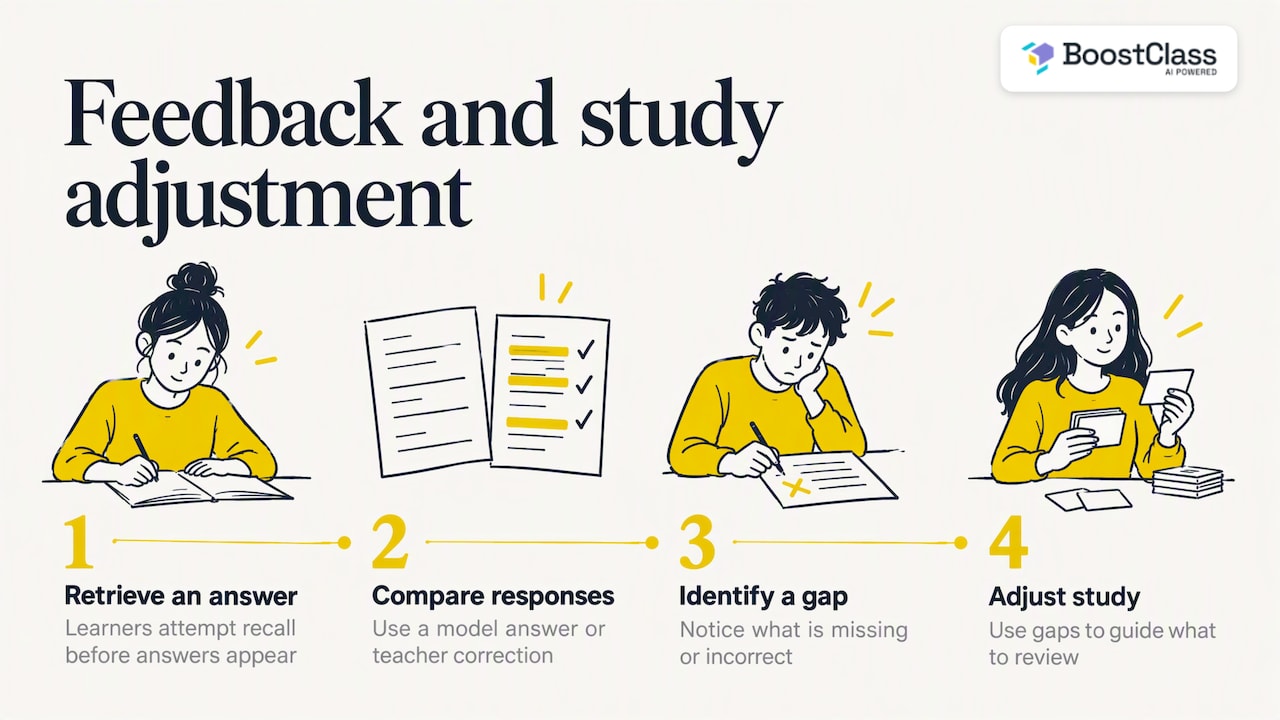
Timing is worth a thought. One study on initial test interval and feedback timing found that delayed feedback produced better results on the final test than immediate feedback, with a short-interval initial test as the best schedule. This was one study, so it is a reason to experiment, not a rule. A sensible classroom approach is to let students struggle briefly and finish their attempts before you reveal answers, instead of correcting each item as it is produced.
For more on this, see our guide to real-time feedback for language students, and for written work, writing feedback with AI.
Perspective
Most teachers we speak to already believe in retrieval practice. What stops them is not belief, it is time. To do it well you need to know what each learner has forgotten, build a task that targets it, and then check the answers. Multiply that by a timetable of groups and it is easy to see why a lot of revision ends up generic.
This is where we think a tool should earn its place. We built BoostClass around the idea that the real class, with a real teacher, is the best source of information about what learners need. Our aim is that the mistakes made in a lesson become the raw material for the next retrieval task, so that practice is personal, not a worksheet handed to everyone.
We also think teachers should keep their own style and materials. Retrieval practice works because of the teacher’s judgement about when to push and when to support. Our job is to take the administration off their desk, not to replace that judgement.
Cesar
Using AI to prepare retrieval practice well
AI can shorten the preparation of retrieval tasks, but it needs good inputs and a teacher’s eye. A few principles to apply whatever tool you use:
- Start from real gaps. Generic quizzes test what the course book covered. The best retrieval tasks target what your learners got wrong or avoided last week.
- Check every item. Read generated questions before class. A wrongly keyed answer defeats the purpose, since learners will retrieve and then reinforce an error.
- Keep the no-notes rule. Whatever generates the task, the learner still has to answer from memory before seeing the answer.
- Vary formats. Rotate between recall, gap-fill, translation and speaking tasks so learners do not just learn the quiz.
- Keep the teacher in the lesson. The valuable part, noticing hesitation and adjusting on the spot, stays human.
We look at the wider picture in AI for language teachers: what works in the classroom, and at how it fits academies in AI in English language academies.
Planning for retention across a whole school
For academic directors, retrieval practice is also a retention question. Learners who feel they are remembering and using what they study are more likely to feel progress, and progress is what keeps people enrolled. A few school-level habits make it systematic:
- Agree a shared “must-keep” vocabulary list per level, so cover teachers can run the same review.
- Build a five-minute retrieval slot into the lesson template, not left to individual choice.
- Share short progress reports with learners or parents showing what has been retained. Our guide to language progress reports covers what to include.
- Use personalised learning pathways so strong and struggling learners get different practice from the same lesson.
Time is a limit too. If a retrieval slot keeps running over, see our lesson time management guide.
Where BoostClass fits

BoostClass is an AI-powered platform for language education. Before class, BoostClass Connected Activities lets teachers prepare lessons in minutes, generating over 20 types of classroom-ready exercises from teaching objectives, previous class insights and detected learning gaps. That means a review quiz or recall task can be built from what your group actually struggled with last time.
After class, BoostClass generates individual student feedback, tracks progress and delivers personalised practice aimed at each learner’s mistakes. It connects with Zoom, Microsoft Teams and Google Meet, supports in-person teaching too, and students do not need to install anything.

Published plans start with Activities at €5 per month, and Student Intelligence plans at €19 per month for up to 10 students and €34 per month for up to 20 students. A plan for up to 30 students is €49 per month. See the current plans and pricing, or try the AI classroom activities yourself. You can also discover BoostClass to see how the pieces fit together.
A four-week retrieval plan to copy
Here is a plan for one weekly adult group, 60 minutes per lesson. It uses spacing, mixed practice and feedback without adding a marking pile.
| Week | Retrieval slot (5 to 8 min) | Feedback step |
|---|---|---|
| 1 | Brain dump on last unit’s topic; pairs merge lists | Teacher notes words nobody recalled |
| 2 | Quick quiz of eight items: four from last week, four from two weeks ago | Answers revealed after everyone finishes |
| 3 | Translated dictation of five sentences using must-keep items | Pairs compare and self-correct against a model |
| 4 | Retrieval role-play using vocabulary from weeks 1 to 3 | Teacher gives group feedback on missed items; those return in week 5 |
The pattern: each slot draws on older material, never just last week’s, and anything forgotten goes back into the pool. Online, the same plan works with a shared document for brain dumps and breakout rooms for pairs.
Adapting for different learners
- Beginners: use recognition first (matching, picking from options), then move to written recall. Keep slots to three minutes.
- Teenagers: turn quizzes into team games, but keep the no-notes rule. Effort-based credit lowers the fear of getting it wrong.
- Exam classes: use past questions as retrieval prompts, but keep them short and frequent instead of full practice papers every week.
- Mixed-level groups: let stronger learners retrieve in full sentences while others give single words. Everyone still recalls from memory.
FAQ
What is an example of retrieval practice in a language class?
A brain dump is the simplest. Students close their books and write every word or phrase they remember from a topic, then compare lists with a partner. You then show what was missed and learners use those items in speaking.
How often should I use retrieval practice?
Short and often beats long and rare. A few minutes at the start of most lessons works well, with key vocabulary returning every three to four weeks, as the Lexis research suggests. Vary the format so it does not feel repetitive.
Is retrieval practice the same as spaced repetition?
No. Retrieval practice is the act of recalling something from memory. Spaced repetition is the scheduling of those recall attempts over increasing intervals. The two work best together: recall the item, and come back to it later.
Does retrieval practice mean more testing and marking?
Not necessarily. Most activities are low-stakes and ungraded, and credit can be based on effort and regularity. The checking can be done by students against a model answer or by pairs, with you scanning for common gaps.
Can AI help me plan retrieval practice?
Yes, mainly with preparation: building varied tasks from your previous lessons and learners’ mistakes. Check every generated item before using it, and keep students answering from memory first. The teacher still decides what to push and when.
Sources
- Retrieval | TeachingEnglish | British Council
- Key Concepts, Oxford Principles of Language Learning
- Retrieval Practice Consistently Benefits Student Learning (Agarwal et al., 2021)
- Practicing Retrieval Facilitates Learning, Annual Reviews (2021)
- 9 Ways to Do Retrieval Practice in the Classroom, TESOL
- 5 Low-Prep Retrieval Practice Strategies for MFL
- Not another quiz! Refining retrieval practice, EEF
- Understanding the distributed practice effect, Lexis (2021)
- Forgetting to Remember: Three Research-Based Strategies Applied to Language Teaching
- Instructor Guidelines: Using Retrieval Practice to Improve Learning
- Effects of the initial test interval and feedback timing
