
Synchronous language teaching happens in real time: you and your students are together, in a classroom or on a video call, at the same moment. Asynchronous teaching happens on the learner’s own schedule: tasks, recordings, forums or exercises that students complete at different times. Neither is better in general. Live lessons give you interaction, speaking practice and community, while asynchronous work gives you flexibility, reflection and room for personalisation. The strongest language programmes use the live lesson for what only a live lesson can do, and push everything else into well-designed work between lessons.
If you run a language school or teach online, the real question is not which side to pick. It is how to split your time, your teachers’ energy and your students’ attention so that both halves feed each other.
TL;DR
- Synchronous means everyone is present at the same time (in person or on Zoom, Teams or Meet). Asynchronous means students work at different times on tasks you set.
- Live lessons are best for spontaneous speaking, immediate clarification and building a group. Asynchronous work is best for flexibility, deeper reflection and individual practice.
- Research on feedback in second language learning supports blending the two rather than choosing one.
- The cost of blending is teacher workload: preparing live lessons, creating follow-up tasks and giving individual feedback. That is where automation helps most.
- BoostClass connects lesson preparation, the live class and personalised practice afterwards, so the two modes stay linked.
Table of Contents
- What synchronous and asynchronous mean in language learning
- Examples of synchronous and asynchronous activities in an ESL class
- What each mode does well, and where it needs support
- How the two modes affect feedback and progress
- How to choose: a practical decision guide
- Blending both: a weekly pattern that works
- The real constraint: teacher workload
- Where BoostClass fits
- Perspective: the live lesson deserves a connected afterlife
- Try it in your own classes
- FAQ
- Sources
What synchronous and asynchronous mean in language learning
The British Council’s TeachingEnglish site describes synchronous learning as learner and teacher being in the same place at the same time. In online learning, videoconferencing, chat and VOIP count as synchronous tools because people interact in real time. Asynchronous learning is the opposite: learner and teacher need not be in the same place, or online, at the same time.
Three clarifications save a lot of confusion:
- Asynchronous does not mean online. A homework worksheet, a graded reader chapter or a recorded voice note is asynchronous even if nobody touches a computer. Equally, an IATEFL special interest group blog points out that a live lesson can be taught in real time to an online or a face-to-face class, so synchronous does not mean online either.
- Synchronous does not mean face to face. A Zoom lesson is synchronous. So is a classroom lesson. What matters is the shared moment.
- Most real courses are both. A student who attends a Tuesday lesson and does vocabulary practice on Thursday has had one synchronous and one asynchronous experience in the same week.
An ESL evidence summary from Switchboard puts it in terms of timing: synchronous means all class members meet at a set time, asynchronous means the instructor provides recordings or materials that students access in their own time.
Examples of synchronous and asynchronous activities in an ESL class
TeachingEnglish’s getting started guide for online teaching gives the simplest split. Live lessons on a platform such as Zoom are synchronous. Forums, social media discussions or working on downloaded tasks are asynchronous.
Here is how that looks across the skills.
| Skill | Synchronous example | Asynchronous example |
|---|---|---|
| Speaking | Pair discussion in breakout rooms, role play, live error correction | Recording a one-minute answer to a prompt and sending it to the teacher |
| Listening | Teacher-led listening with immediate checking and replaying on request | A short recording with comprehension questions to finish before the next lesson |
| Writing | Shared document written together during the lesson | A paragraph submitted by a deadline with comments returned later |
| Vocabulary and grammar | Quick-fire concept checking, live games | Personalised practice sets, spaced review of previous mistakes |
| Community | Warm-ups, group projects, live Q&A | Discussion board posts, peer comments |
The Berkeley Language Center offers a neat pairing in its guide to online and blended teaching practices: student-to-student interviews can happen asynchronously with a tool like Padlet, while synchronous student dialogue works well in Zoom breakout rooms.
If you create self-paced material for learners in several countries, remember that the content itself may need adapting. A guide to e-learning translation and localisation shows what is involved in making course content work for another language audience.
What each mode does well, and where it needs support
Synchronous: presence, spontaneity and community
The University of Guelph’s Office of Teaching and Learning notes that synchronous sessions allow real-time interaction and responsiveness, and give structure to both students and teachers. For a language class, that translates into things a recording cannot do: a student tries a sentence, you hear the error, you reshape it, they try again.
Princeton’s L2 remote instruction guide says sharing ideas and information in real time is a mainstay of communicative language courses and a primary component in building community. For a school owner, that community is also a retention argument: students who know their group and their teacher have more reasons to stay.
To get the most from live time, plan for the usual friction points. The same Guelph guidance mentions technical and connectivity problems, students’ other responsibilities, and the difficulty of holding attention without active participation. Good live lessons therefore keep students talking, not watching. Our guide to virtual classroom routines covers routines that keep online lessons moving.
Asynchronous: flexibility, reflection and individual pace
The Guelph guidance also highlights that asynchronous opportunities let learners digest material, reflect more deeply and work around illness or emergencies. Princeton adds that delayed communication can support more thoughtful, complex and creative language use, because students have time to plan what they say or write.
The Berkeley Language Center notes that an asynchronous model allows individualisation through personalisation and customisation, and can ease some learners’ anxiety. Anyone who has taught a shy student knows the value of that: the learner who stays silent in a group may produce a confident voice recording alone.
The same source is candid about what needs design attention: spontaneous speaking practice is harder to provide, and teachers need to know the platforms and apps well. Guelph’s guidance adds that asynchronous learners can feel isolated without interaction and need structure and guidance. In other words, asynchronous work works when someone has built it carefully and followed it up.
How the two modes affect feedback and progress
Feedback is where the two modes interact most clearly, and where research gives practical direction.
- Writing feedback. A study of second language writing by Ene and Upton, published in ScienceDirect, looked at teacher electronic feedback given asynchronously (comments in a document) and in synchronous text chats. It found that electronic feedback was effective and that synchronous feedback reinforced the asynchronous kind.
- Peer feedback. A 2023 study published through ERIC found asynchronous peer comments were more accurate (87.1%) than synchronous ones (72.63%). The authors suggest asynchronous design when accuracy matters, while combining both can help less linguistically competent students through interactive discussion.
- Speaking. A TESL Canada Journal study of a voice-based asynchronous system for 14 English for academic purposes students reported gains in fluency, accuracy and intelligibility, and participants linked their increased motivation to personalised feedback. It is a small study, but the pattern is useful: asynchronous speaking tasks are not only for writing and reading.
The Berkeley Language Center’s guide to high-leverage practices says good online and blended design prioritises interaction and immediate, continuous feedback on both product and process. That is the thread running through all three findings: timing matters less than whether feedback is specific, prompt and acted upon.
For more on this, see our guides to real-time feedback for language students and writing feedback with AI.
How to choose: a practical decision guide
Use these questions to decide what belongs in the live lesson and what belongs between lessons.
- Does the task need an instant reaction from another person? Conversation, negotiation, role play and pronunciation correction belong in the live lesson.
- Does the task benefit from thinking time? Extended writing, reflective review, error analysis and reading belong between lessons.
- Is the task the same for everyone, or different for each learner? Shared explanations suit live time. Practice on individual weak points suits self-paced work, because each student needs something different.
- Can your students reliably attend at set times? If your learners are professionals across time zones, more asynchronous work protects attendance and goodwill.
- Will someone look at the result? Any asynchronous task nobody reviews teaches students that the work does not matter. Build in feedback or do not set the task.
TeachingEnglish suggests a lesson structure you can use as a checklist: lead-in, language input, controlled practice, freer practice, error correction and summary, then deciding carefully which stages must be synchronous and which can happen offline. A natural split is lead-in, freer practice and error correction live; controlled practice and summary review in self-paced mode.
The British Council also advises, when moving away from a fully synchronous approach, planning alternative stages, for instance chat as a pre-lesson activity or a videoconference as the final event of a project, because synchronous tools can be costly, awkward to set up and limited by technology.
Blending both: a weekly pattern that works
Shannon Quinn, writing in FLTMAG, suggests mostly asynchronous activities done at the student’s own pace, with occasional live sessions for questions or group work. A once- or twice-weekly session, perhaps in small groups, adds a personal touch and makes questions easier to answer, while asynchronous work eases scheduling and videoconferencing burdens. Quinn also notes that students need self-discipline to complete work without a teacher watching in real time, which is a good reason to keep tasks short and clearly linked to the next lesson.
Princeton’s guide to syllabus workload observes that when a course includes both modes, the line between what happens in class and what students do alone becomes blurred. That is an advantage: the live lesson stops being the only place learning happens.
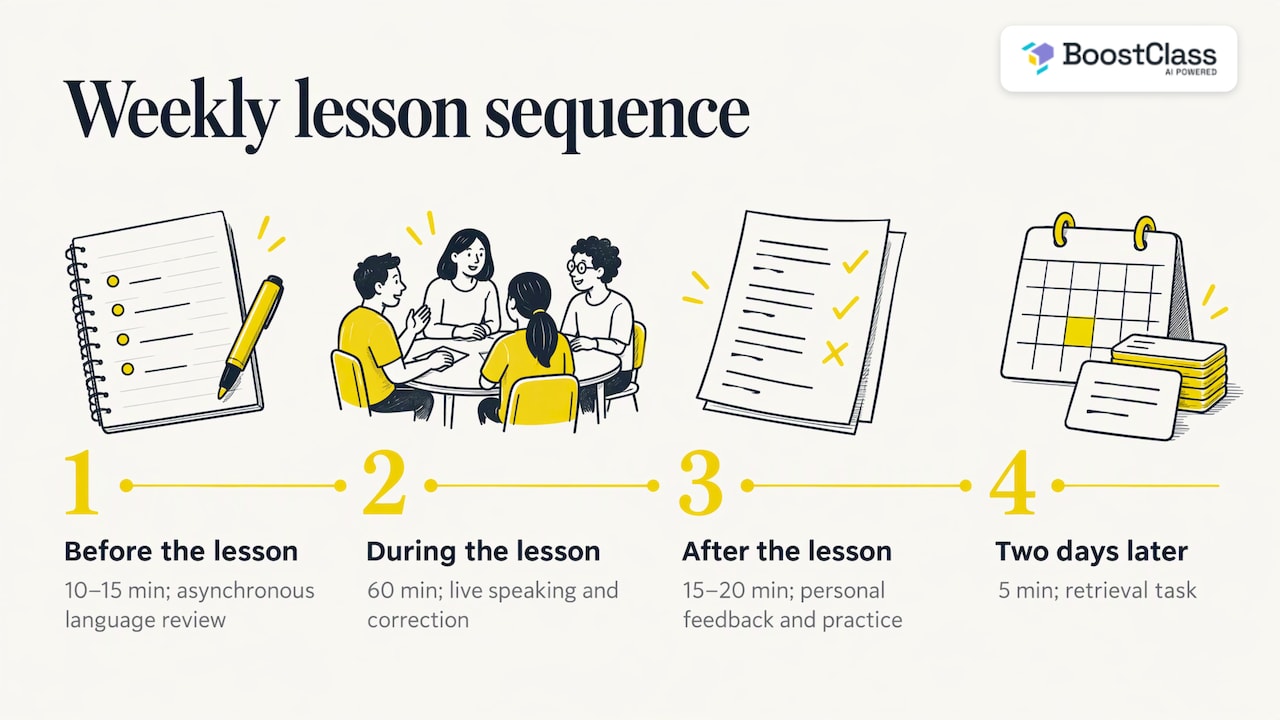
Here is a practical example for a general English adult group meeting once a week.
Before the lesson (asynchronous, 10 to 15 minutes). Students complete a short activity that reactivates last week’s language and the mistakes they actually made. The teacher sees who struggled before walking in.
During the lesson (synchronous, 60 minutes). A warm-up, a speaking task in pairs or small groups, live correction of the most common errors, and a freer task built around the target language.
After the lesson (asynchronous, 15 to 20 minutes). Each student receives feedback on their own performance and practice targeting their own errors. One student drills past tense forms; another works on prepositions.
Two days later (asynchronous, 5 minutes). A short retrieval task. Our guide to retrieval practice in language lessons explains how to schedule it.
For a one-to-one tutor or a school with large groups, the same shape holds. What changes is how much preparation and feedback the teacher can personally produce, which is the practical limit on blending.
The real constraint: teacher workload
On paper, blended teaching is easy to endorse. In practice, it asks teachers to prepare the live lesson, build follow-up tasks, give individual feedback and keep track of who is progressing. The Berkeley Language Center specifically lists greater instructor preparation and platform knowledge as a challenge of asynchronous formats. For a teacher with twenty-five contact hours a week, that is where blended teaching often breaks down.
Two ideas help.
Reuse what you create. Guelph notes that recordings and materials created for remote courses can be reused as primary, supplementary or preparatory content in later remote and face-to-face courses. Build things once.
Keep the toolset small. TeachingEnglish suggests choosing one or two easy platforms and focusing on the basic tools you really need, for example one videoconferencing platform plus one document-sharing platform. Every extra tool is more to learn, and more for students to log into.
For school owners and academic directors, this is also a quality question. If the follow-up depends entirely on how much spare time each teacher has, quality varies from teacher to teacher and class to class. Systems that create consistent preparation and follow-up make quality less dependent on individual stamina. Our guide to reducing teacher workload and the piece on lesson time management go deeper on this.
Where BoostClass fits
BoostClass is an AI-powered platform for language education that links the three parts of a blended course: preparation, the lesson and the practice that follows.
- Before class: BoostClass Connected Activities helps teachers prepare lessons in minutes. Teachers can generate over 20 types of classroom-ready activities, built from teaching objectives, insights from previous classes and detected student learning gaps. A teacher whose last lesson showed trouble with conditionals can get activities aimed at exactly that, instead of searching for a generic worksheet.
- During class: BoostClass connects with Zoom, Microsoft Teams and Google Meet, and also supports in-person teaching. Students do not need to install anything. Teachers keep their own teaching style and materials.
- After class: BoostClass automates student feedback, personalised practice based on each learner’s real mistakes, and progress tracking. The practice is based on what actually happened in the class with the real teacher.
For school owners, there is a management side too: automated performance reports give visibility into student engagement and outcomes, and BoostClass also analyses teacher metrics such as Teacher Talk Time, which shows how much of the lesson time the teacher is speaking compared with the students.
To see how this fits into wider planning, read our pieces on AI for language teachers, personalised learning pathways and task-based language teaching examples.
Perspective: the live lesson deserves a connected afterlife
We talk to teachers and school owners every week, and the pattern is consistent. Nobody argues that live lessons are unimportant. The problem is what happens after the lesson ends. A teacher notices that three students confused the same tense, intends to follow up, and then the next class begins. The insight evaporates.
Our view is that the most valuable material for a student is whatever came from their own real lesson with a real teacher. That is why we built BoostClass to capture what happens in the class and turn it into personalised practice, feedback and reports, rather than offering generic exercises disconnected from the lesson.
The same goes for preparation. With Connected Activities, a teacher can start from objectives, previous class insights and detected learning gaps, and have usable activities in minutes. The teacher stays in charge of the lesson and the materials. We take the repetitive part off their plate.
For school owners, that is how a blended model becomes affordable: not by asking teachers to work evenings, but by connecting the live lesson with what comes before and after it.
Cesar
Try it in your own classes
If you want to see how a connected live-plus-practice approach works, the free trial lets you explore it with your own groups. Plans start at €5 per month for Activities, and the Student Intelligence plans cost €19 per month for up to 10 students and €34 per month for up to 20 students. A plan for up to 30 students costs €49 per month. Full details are on the BoostClass pricing page.
You can discover BoostClass or try the AI classroom activities directly.
FAQ
Is asynchronous the same as online?
No. Asynchronous refers to timing, not technology. A worksheet completed at home is asynchronous, and so is a recorded voice message. Likewise, a live Zoom lesson is online but synchronous. The two terms describe whether participants interact at the same moment.
Is synchronous learning always face to face?
No. Synchronous learning is any learning where teacher and students interact in real time, so it includes classroom lessons and live video lessons on tools like Zoom, Teams or Meet. What defines it is the shared time, not the shared room.
Is email synchronous or asynchronous?
Email is asynchronous, because the sender and receiver do not need to be present at once. Live chat during a lesson is synchronous. In language teaching, email and forums suit tasks where students benefit from time to plan their wording.
Which is better for ESL learners, synchronous or asynchronous?
Neither wins on its own. Live lessons give spontaneous speaking practice, instant correction and community. Self-paced work gives flexibility, reflection and individual practice. Research on feedback suggests combining them works better than treating them as alternatives.
How much of a course should be live?
There is no fixed ratio. One suggestion is mostly self-paced activities with one or two live sessions a week, perhaps in small groups. Choose the live share based on your learners’ availability, their level and how much speaking practice they need.
Sources
- Synchronous learning, TeachingEnglish, British Council
- Getting started with online teaching, TeachingEnglish
- To Sync or Not to Sync, FLTMAG
- ESL evidence summary, Switchboard
- Synchronous and Asynchronous Interactive Tasks for Distance Learning, IATEFL LTsig blog
- L2 Remote Instruction, Princeton University
- L2 Remote syllabus and workload, Princeton University
- High Leverage Online/Blended Teaching Practices, Berkeley Language Center
- Selecting a Language Course Format, Berkeley Language Center
- Balancing Synchronous and Asynchronous Teaching, University of Guelph
- Synchronous and asynchronous teacher electronic feedback, ScienceDirect
- Peer Feedback Accuracy in Synchronous and Asynchronous Settings, ERIC
- The Multimodal Effects of Voice-Based Asynchronous Communication, TESL Canada Journal
