
The best task-based language teaching examples give learners a job to do with a clear outcome: agree a ranking, plan a night out, solve a problem, tell a story. The language they need comes out of the doing, and you teach it afterwards. Below you will find ten tasks you can run this week, how each one fits the stages of a task-based lesson, how to adapt them by level, and how to give feedback without killing the conversation.
TL;DR
- A task has a goal, a purpose and a product others can appreciate, such as a list, a comparison, a solution or a brochure. A gap-fill is an exercise, not a task.
- Six reliable formats cover most classes: listing, ordering and ranking, matching, comparing, problem-solving and storytelling. Information gaps add a seventh.
- Run the lesson as pre-task, task, planning, report, then language analysis and practice. Correct after the communication, not during it.
- Preparation is the real cost. Basing tasks on your last lesson and on actual learner errors makes them land harder and take less time.
Table of Contents
- What counts as a task, and what does not
- Ten task-based language teaching examples
- Where each task sits in the lesson
- Adapting tasks for different levels and formats
- Monitoring and feedback during and after the task
- The hidden cost: preparing and following up
- A note from us: where we see TBLT breaking down
- Preparing tasks faster with BoostClass
- FAQ
- Sources
What counts as a task, and what does not
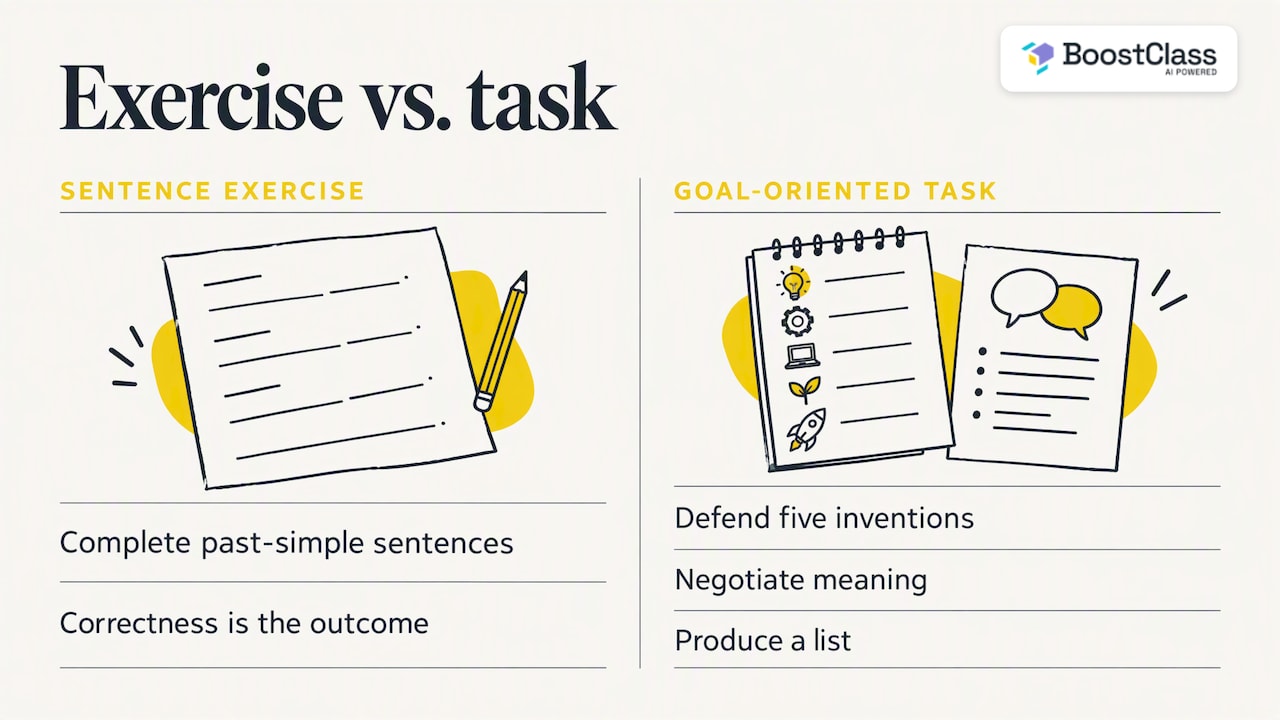
Jane Willis, writing in the Japan Association for Language Teaching journal, describes a task as a goal-oriented activity with a clear purpose and an outcome or final product that others can appreciate, such as a list, a comparison, a solution or a brochure. That definition is a useful filter. “Complete the sentences with the past simple” has no outcome beyond correctness. “Agree on the five most important inventions of the last century and be ready to defend your list” has an outcome, and learners must negotiate meaning to reach it.
The British Council describes task-based learning as giving learners interactive tasks to complete, followed by discussion of the language used. Its own example is planning an itinerary: learners research places and timetables, then produce a written schedule and a short guide. The same page says tasks create meaningful communication and opportunities to acquire language through real use, and adds that the approach may suit higher levels especially well. That caveat matters for the adaptations later in this article.
A 2023 American English webinar from the U.S. Department of State gives a compact case for tasks: they encourage authentic language use, address language needs as they arise and involve all skills.
Ten task-based language teaching examples
The first six follow the task types set out in the British Council’s six types of tasks for TBL. The rest come from information-gap and communicative-task traditions. Each example below is written so you can lift it straight into a lesson plan.
1. Listing: the famous people shortlist
Pairs agree on four or five famous people they would invite to a dinner, and give at least one reason for each choice. The British Council uses exactly this kind of listing task. It pulls out opinion language (“I’d choose… because…”), and the reasons stretch the answers beyond single words.
Product: a shared list. Typical language that emerges: giving reasons, agreeing and disagreeing.
2. Ordering and ranking: the desert island ranking
Give groups eight items and ask them to rank the five most useful on a desert island, then justify the order to another group. Ranking forces comparison and negotiation, because a list is not finished until everyone accepts the order. For business classes, swap the items for office benefits or hiring criteria.
Product: a ranked list. Language: comparatives, superlatives, modals of priority (“should come first”).
3. Sequencing: the mixed-up picture story
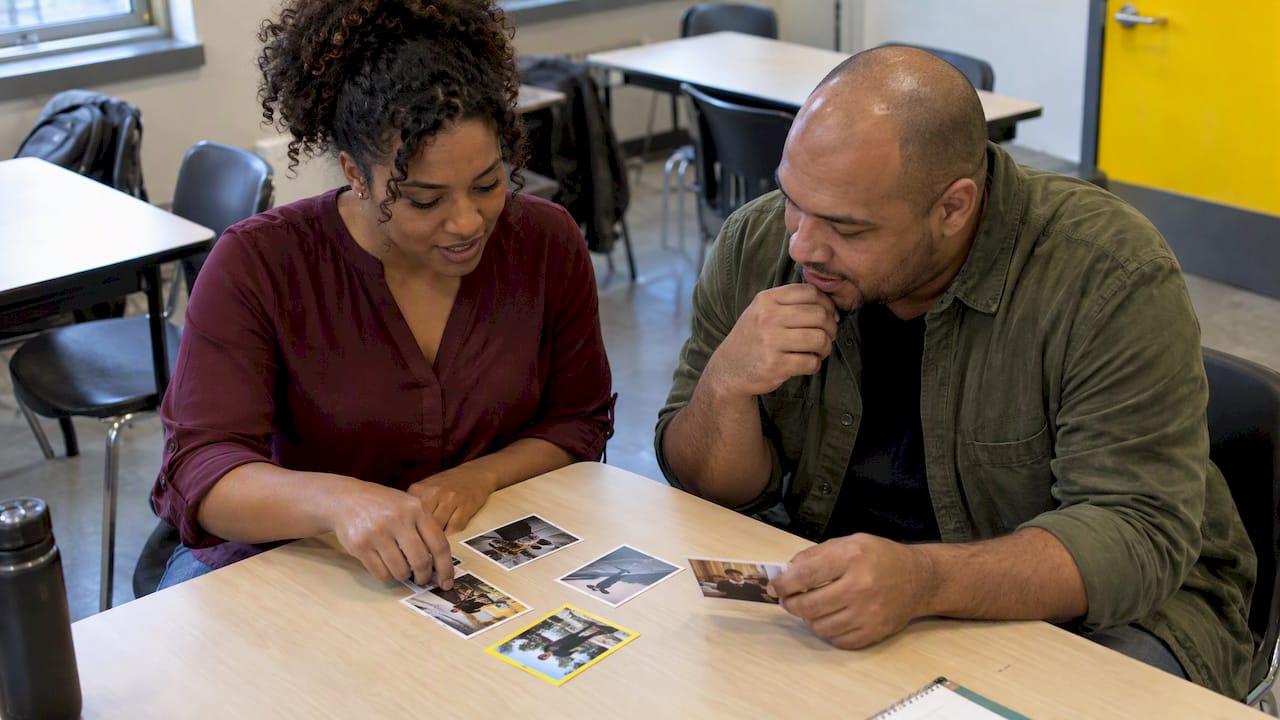
Hand each pair a set of pictures out of order. They put them into a sequence and build the story behind them. The British Council lists sequencing pictures into a story among its core task types. At lower levels it works well because the pictures carry the meaning and learners supply the words.
Product: an agreed order plus a told story. Language: narrative tenses, linkers such as “then” and “after that”.
4. Matching: texts to pictures
Learners match short descriptions, adverts or news headlines to pictures. Because the matching has one right answer, it is easy to check and gives shy learners a reason to talk: “I think this one goes with B because it mentions…”
Product: a matched set. Language: describing, hedging (“it might be”), justifying.
5. Comparing: spot what is different
Pairs compare two lists or two picture stories and find similarities and differences. The University of Texas communicative-task templates include identifying differences as a standard format, alongside assembling objects, drawing and comic-strip stories. A good variant: both learners get a flat-share advert for a different flat and must decide which is better value.
Product: a list of differences or a decision. Language: comparison structures, prepositions of place.
6. Problem-solving: the broken-down tour group
Present a realistic problem: a coach has broken down, twelve guests are waiting and the restaurant booking is in an hour. Groups agree a plan and present it. Problem-solving tasks usually produce longer turns than listing, because learners must propose, object and compromise.
Product: a solution. Language: suggestions, conditionals, polite disagreement.
7. Storytelling and personal anecdotes
The British Council notes that storytelling provides sustained speaking practice. Ask learners to prepare a two-minute story about a time they got lost or a trip that went wrong, then tell it to a new partner, and again to a third. The repeats raise fluency, because the content is already settled.
Product: a told story, optionally recorded. Language: past tenses, sequencing, emotional vocabulary.
8. Information gap: the incomplete biography
In an information-gap task, each learner holds different information needed to complete the job. The British Council gives an example in which one learner’s biography lacks place names and the other’s lacks dates, so they must ask each other questions to fill the gaps. The same page lists describe-and-draw, spot-the-difference, jigsaw reading or listening and split dictation as typical formats. These practise clarifying meaning and rephrasing, which is what real conversations demand.
Product: two complete texts. Language: question forms, checking and clarifying.
9. Planning: the class night out
For intermediate learners, the British Council’s task-based speaking lesson asks groups to plan a class night out. They brainstorm places, time, transport, activities, food and music, compare plans, rehearse and present, answer questions, and vote on the best plan. It is a complete lesson in one task, and it adapts easily to a school trip, a conference dinner or a product launch.
Product: a presented plan and a class vote. Language: suggestions, future forms, persuading.
10. Researching and producing: the itinerary
Back to the British Council’s itinerary example: learners research places and timetables and produce a written schedule and short guide. It joins speaking, reading and writing, and it works well online, where learners can search in breakout rooms and share a document.
Product: a written guide. Language: time expressions, recommendations, formal and informal register.
Where each task sits in the lesson
A task is the centre of a lesson, not the whole lesson. The British Council’s task-based approach sets out the stages like this:
| Stage | What happens | Example using the class night out |
|---|---|---|
| Pre-task | Introduce topic, activate vocabulary | Brainstorm types of evening activity |
| Task | Pairs or groups complete the task while you monitor | Groups plan the evening |
| Planning | Learners prepare and rehearse a report; you give language advice | Groups rehearse a two-minute pitch |
| Report | Groups present to the class | Pitches, questions, a vote |
| Analysis | Look at language from the task and report | Good phrases and errors from the pitches |
| Practice | Practise language chosen from learner needs | Linkers, suggestion phrases |
The rationale is that you do not decide the target language in advance. Learner performance on the central task shows you which language to focus on. This is the biggest difference from a presentation-practice-production lesson, and the reason why a prepared worksheet is not enough: the follow-up has to respond to what actually happened in your room.
The focus on language that emerges from a meaningful task is also where feedback tools for educators become relevant, since the goal is to replace a score with a clear next step for each learner.
Adapting tasks for different levels and formats
The U.S. Department of State webinar recommends adapting task implementation through clear instructions, study of the task materials, key-vocabulary review, deliberate pairing or grouping, planning time, task repetition and a post-task requirement or review. In practice:
- Lower levels: use pictures, reduce the number of items (three people, not five), pre-teach ten key words and give planning time before the speaking. Sequencing and matching are your friends.
- Higher levels: remove the scaffolding. Give the problem with no prompts, add a time limit and require a written product afterwards.
- Mixed ability: assign roles (chair, note-taker, reporter) and pair by role as well as by level, so a quieter learner has a defined job.
- Repetition: run the same task with a different partner or a shorter time limit. The second round is usually fuller and more accurate because the ideas are ready.
ACTFL recommends designing tasks backward from proficiency goals and intended outcomes, then building pair, small-group and whole-class tasks at learners’ current levels. It also notes that performance-based tasks may elicit language at a higher proficiency level than rehearsed question-and-answer drills, because unique, personally generated language is more demanding.
For online classes, the same tasks run in breakout rooms with a shared document as the product. For in-person classes, paper cards and wall posters do the same job.
Monitoring and feedback during and after the task
Task-based lessons fail most often at the feedback stage. Teachers either interrupt to correct, which kills the purpose, or skip analysis, which wastes the evidence the task produced.
The British Council’s model is clear: monitor, record useful and problematic language, then run a focused language review. In the language-focus stage, you put good learner phrases and incorrect sentences from the task on the board, and learners try to correct them. You can also highlight language for suggestions, sequencing linkers and collocations.
A workable routine:
- During the task: walk, listen, encourage. Write down three good phrases and three errors you hear repeatedly.
- During planning: offer language advice when groups ask.
- After reports: give quick content feedback first (“I liked the idea of…”), then move on to language.
- Language review: show anonymised errors and let learners fix them.
- Practice: set targeted practice for the language that came up.
ACTFL’s assessment perspective supports this order. Well-structured interpersonal tasks rely on natural functions such as requesting information and expressing preferences, emphasise meaning-making over accuracy, and can be assessed holistically through comprehension and comprehensibility. Accuracy matters, but it is not the only measure during an interpersonal task.
For more on timing and feedback, see our guides on real-time feedback for language students and lesson time management.
The hidden cost: preparing and following up
TBLT looks cheap, because a task needs no textbook. It is not cheap in teacher time. A good lesson needs a task that fits this group’s goals, a pre-task vocabulary set, notes on errors during the task and a follow-up that targets those errors. Multiply that by twenty teachers and thirty groups and the problem shifts from teaching to workload, and from workload to teaching quality, because the tired teacher cuts the analysis stage first. That is the stage where learners improve most, and it is also the one that drives retention: students stay when they can see their own mistakes shrinking.
A note from us: where we see TBLT breaking down
We build BoostClass for language teachers and schools, so we see the same pattern in the way teachers describe their week. The task goes well. The class is lively. Then the lesson ends, and the evidence that task produced (who struggled with which structure, who said almost nothing) is gone by the next morning.
Our view is that task-based teaching needs a loop. Before class, the task should be built from what happened last time and from the learning gaps you have already seen. After class, each learner needs feedback on their own mistakes and practice that targets them, not a generic worksheet. That loop is what BoostClass Connected Activities is designed to support, without taking over the teaching: teachers keep their style and materials, and automate the tedious parts.
For school owners and academic directors, there is a second benefit. When class interactions turn into reports, you get visibility into learning outcomes and student engagement. BoostClass also analyses teacher performance, with a focus on Teacher Talk Time, which matters a great deal in a method whose whole point is that learners do the talking.
— Cesar
Preparing tasks faster with BoostClass
BoostClass Connected Activities lets teachers generate over 20 types of classroom-ready activities in minutes. You can build them from your teaching objectives, from insights from previous classes and from detected student learning gaps. For a TBLT teacher, that means the pre-task vocabulary, the information-gap cards or the language-focus exercise can reflect what your group actually got wrong last lesson, rather than a generic topic.
After class, BoostClass generates individual student feedback, tracks progress and delivers personalised practice based on each learner’s own mistakes. It connects with Zoom, Microsoft Teams and Google Meet, supports in-person teaching too, and students do not need to install anything.
Published plans, read from our pricing page: Activities costs €5 per month, and Student Intelligence costs €19 per month for up to 10 students, €34 for up to 20 and €49 for up to 30. You can try the AI classroom activities or discover BoostClass first.
If you are weighing up wider options for your school, our comparison of three AI models for language schools is a good next read, and writing feedback with AI covers the written product of tasks.
FAQ
What is a simple example of a task-based activity for ESL?
A ranking task is the easiest to start with. Give pairs a list of items, such as ways to save money, and ask them to agree the top three and give reasons. It needs little preparation, it has a clear product, and it produces opinion language you can analyse afterwards.
How is a task different from a normal speaking activity?
A task has a goal and an outcome that learners must reach, and the language is a means to that end. Many speaking activities only ask learners to practise a given structure. If the learners can finish without needing to communicate, it is probably an exercise rather than a task.
Can task-based learning work with beginners?
Yes, with support. The British Council notes that the approach may suit higher levels especially well, so at lower levels use pictures, short lists, pre-taught vocabulary and planning time. Sequencing a picture story or matching texts to pictures work well at the start.
How do I give feedback without interrupting the task?
Monitor quietly and note good and problematic language as you listen. Give brief content feedback after the reports, then run a language review using examples from the task. Detailed correction comes after the communication, not during it.
Sources
- Jane Willis, Task-Based Learning: What Kind of Adventure?
- British Council, TBL – Task-based Learning
- U.S. Department of State, American English webinar slides, 2023
- British Council, Six types of tasks for TBL
- University of Texas, Communicative Activities
- British Council, What is an information gap activity?
- British Council, Task-based speaking
- British Council, A task-based approach
- ACTFL, Design Communicative Tasks
