

AI will not replace great language teachers. It will replace the parts of the job that never needed a great teacher: the Sunday-night worksheet hunt, the copy-and-paste feedback, the spreadsheet of who struggles with what. The teachers and schools that hand those tasks to software will have more time for the work students actually pay for. Those who refuse will find themselves competing on price against free chatbots.
TL;DR
- The evidence from the British Council, TESOL and the OECD points one way: AI supports teachers and does not replace them, and the human relationship stays central.
- What AI can take over is preparation, drafting feedback, routine reporting and documentation. Judgement, empathy and real conversation stay with the teacher.
- Adult and corporate learners expect personalised, measurable progress, so the schools that deliver it will stand out.
- Used without teaching principles, AI can lift performance without producing real learning, so the tool must sit inside the lesson and not beside it.
- BoostClass is one practical example: it works with Zoom, Microsoft Teams and Google Meet, and with in-person teaching, to turn real lessons into activities, feedback and practice.
Table of Contents
- The question behind the headline
- How the language market is changing
- What AI does well, and what it should not touch
- The evidence for personalisation, and its limits
- The skills gap is your opening
- Risks to manage before you buy anything
- Where AI saves a teacher’s week
- Our perspective: capture the real class
- A practical example: BoostClass in the lesson cycle
- Try it in your own classes
- What to do this term
- FAQ
- Sources
The question behind the headline
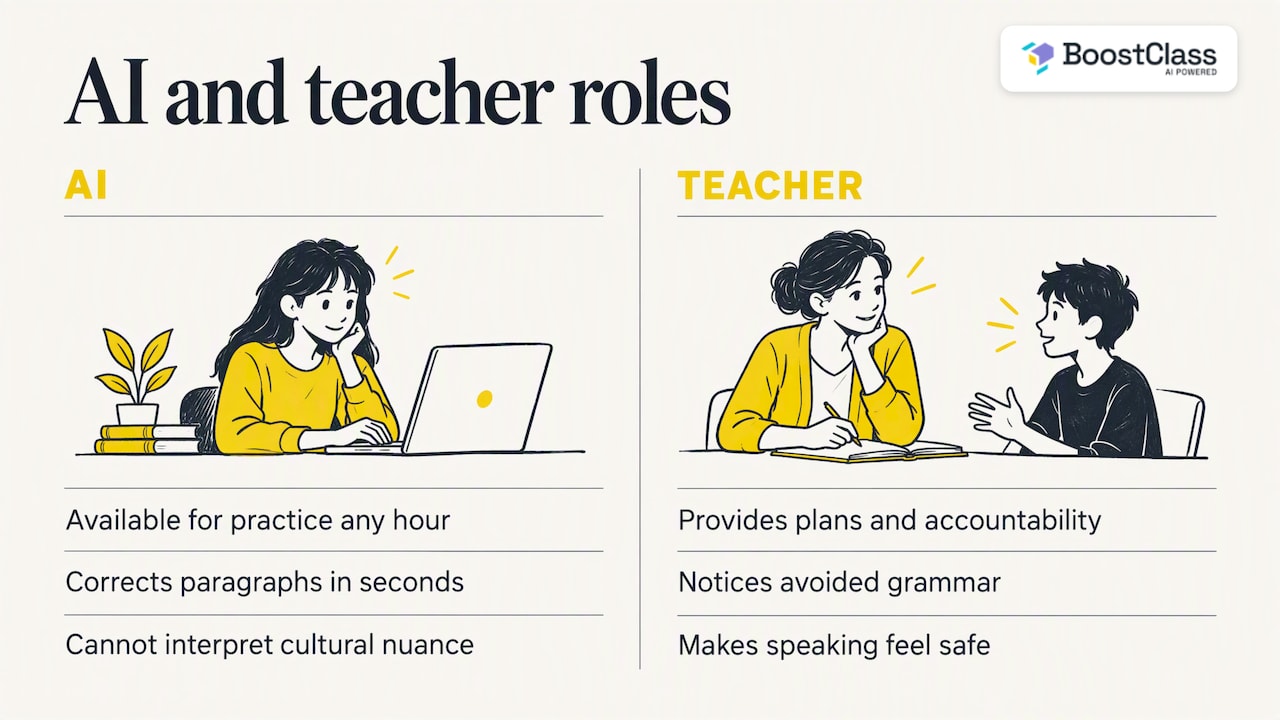
The fear is reasonable. Free chatbots can hold a conversation at any hour, correct a paragraph in seconds and never cancel a lesson. If a learner only wants to practise, why pay a teacher?
Because most of the people who pay for lessons do not only want practice. They want a plan, accountability, someone who notices that they avoid the past perfect, and someone who makes speaking in a second language feel safe enough to try. Research bodies that have looked at this keep arriving at the same place.
The British Council argues that AI can support English learners but cannot replace the teacher’s role in interpreting cultural nuance, offering empathy and judgement, and supporting real-world communication. Its 2024 research found that the majority view among surveyed teachers is that AI will not remove the need for human language teachers in the foreseeable future. In October 2025, TESOL International Association stated its opposition to efforts that devalue, diminish or displace English language teaching professionals.
The US Department of Education reached a similar view in 2023, rejecting the idea that AI could replace teachers and stressing that it may give teachers more support to reach individual students.
That does not mean nothing changes. UNESCO describes AI’s impact on education as complex and contradictory, shaped by choices made in classrooms and organisations. The choice in front of a school owner is not “AI or teachers”. It is whether your teachers get the benefit or someone else’s product does.
How the language market is changing
Children’s language education stays strong, largely because parents and schools value supervised, social learning for young people. The pressure is building elsewhere.
Adult learners and corporate clients buy differently. An adult paying out of their own pocket compares your lesson with an app that costs a few pounds a month. A company training staff asks what changed after ten weeks and who can show it. Both are quick to leave when lessons feel generic, and both increasingly expect something better than “we covered unit six”.
That shifts the competition. A school that sells only hours with a qualified person is exposed. A school that sells a visible, personalised route to a goal, delivered by a person, is much harder to replace with a chatbot. The question is no longer “do we have good teachers?” but “can we prove and personalise what good teachers do?”
For owners and academic directors, that comes down to five pressures:
- Lesson preparation. Tailoring material to each group takes hours that are rarely paid.
- Teacher workload. Admin, feedback and reporting push good teachers towards burnout or the exit.
- Student engagement. Learners disengage when lessons ignore what they already know.
- Personalised learning. In a group of eight, eight different sets of mistakes sit behind the same task.
- Retention and quality. Students stay when they feel progress, and owners can only protect quality they can see.
AI is useful exactly where those pressures sit, provided it is applied with care.
What AI does well, and what it should not touch
The OECD’s 2026 work on teaching describes AI as helpful with repetitive tasks, lesson preparation, grading, documentation, routine reporting and drafting feedback. Relationships, judgement and understanding a student’s context remain human work. The same report says the goal should be to elevate human learning and strengthen human connection, not to weaken the relationships at the heart of education.
A University of Minnesota expert consensus report from October 2026 adds that AI lacks empathy, personal experience and perspective-taking, which authentic educational relationships require. The British Council also notes that AI-generated responses can feel flat or unrealistic, which may hold back natural communication skills compared with teacher-led instruction.
A practical split looks like this:
| Task | Best handled by |
|---|---|
| Drafting exercises from last week’s lesson | AI, reviewed by the teacher |
| Spotting recurring errors across a class | AI, confirmed by the teacher |
| First-draft written feedback | AI, edited by the teacher |
| Deciding what a nervous student needs today | Teacher |
| Negotiating meaning in a live conversation | Teacher |
| Motivating a learner who is about to quit | Teacher |
| Explaining cultural nuance and register | Teacher |
The evidence for personalisation, and its limits
Personalisation is where AI has the strongest research case. A 2024 meta-analysis of 17 research projects found that AI-guided individualised language learning was effective, with a positive treatment effect (d = 0.39) against business-as-usual conditions. Some systems adapt learning paths as learners progress.
The caution matters as much as the result. The OECD Digital Education Outlook 2026 states that generative AI can support learning when guided by clear teaching principles, but without pedagogical guidance it may improve performance without real learning gains. A learner who gets a perfect answer from a chatbot has not necessarily learned anything.
The US Institute of Education Sciences, in an August 2026 blog, points the same way: the most promising results come from teacher-mediated or human-supervised approaches, where teachers review, guide or approve how AI is used. It also warns against using AI to replace the productive struggle that deeper learning needs.
So the winning model is not a student alone with an AI. It is a teacher with better information and less admin.
The skills gap is your opening
The British Council’s 2024 research found that 76% of teachers report using AI tools, while only 20% say they have had enough training to use them in their teaching. Most of your staff are probably experimenting alone, with mixed results and no shared standards.
That gap is the competitive advantage. A school that trains its teachers, chooses a tool that fits its method and sets clear rules will teach better than one where each teacher improvises with a free chatbot. Academic work published in 2025 argues that educators need AI literacy to use these tools as supports, not replacements.
Risks to manage before you buy anything
A sensible school owner asks hard questions first. The British Council’s 2024 report lists algorithmic bias, data privacy, worsening digital divides, academic misconduct and cognitive overload, and warns that AI tools can promote standardised language use while excluding particular dialects or varieties. TESOL adds that AI is only as good as the data or content it is trained on, which puts ethical responsibility on educators and institutions.
Practical checks:
- Ask where student data goes and who can see it before any learner uses a tool.
- Keep the teacher as the reviewer of anything a student receives.
- Check that the tool respects your teaching approach and materials, and does not force a new one.
- Pilot with a few classes and compare against your own lessons. Guidance on testing AI tools properly helps you judge claims with evidence instead of demos.
Where AI saves a teacher’s week
Take a teacher with twenty contact hours and a typical evening of preparation. Three tasks take most of the unpaid time.
Preparing the next lesson. The teacher remembers that two students stumbled on conditionals last week, but turning that into a tailored warm-up takes forty minutes. Our guide to AI lesson planning for language teachers shows how that becomes a few minutes of editing.
Writing feedback. Individual notes after every class are what students value and what teachers drop first when busy. Drafting them with AI, then editing, keeps them alive. See our notes on writing feedback with AI and real-time feedback for language students.
Following up. Homework that targets what each learner got wrong, not a generic page of exercises, is the difference between practice that works and practice that is ignored. More on this in our piece on personalised learning pathways.
None of this removes the teacher. It removes the evening.
Our perspective: capture the real class
We build BoostClass, so we are not neutral, but here is what we have learned from language teaching and from the schools we talk to.
Most AI tools for language learning start with a blank prompt. The teacher or the student types something in, and the AI answers. The trouble is that the most valuable information in language education is not in a prompt. It is in the live lesson: who hesitated, which error came back for the third time, who dominated the conversation, who never spoke.
We believe the useful AI is the one that captures insight from the real class with a real teacher, then feeds it back into preparation, feedback and practice. That keeps the teacher’s style and materials intact. It also gives owners something they rarely have: visibility. BoostClass can analyse teacher performance with a focus on metrics such as Teacher Talk Time, so owners see how lessons run, not only how many were delivered.
Our view on the headline question is simple. AI does not threaten the teacher who listens well, adapts and builds trust. It threatens the model where a teacher is a delivery mechanism for a fixed syllabus, because that is exactly what software does cheaply. The answer is to move your school’s value up to what only people do, and let software handle the rest.
— Cesar
A practical example: BoostClass in the lesson cycle
BoostClass is an AI-powered platform for language education that connects preparation, the lesson and follow-up practice.
Before class: Connected Activities. Teachers can generate over 20 types of classroom-ready activities. Lessons can be built from teaching objectives, insights from previous classes and detected learning gaps. That makes preparation faster, and more personal than a generic worksheet, because the material reflects what this group actually got wrong.
In class. BoostClass integrates with Zoom, Microsoft Teams and Google Meet, and supports in-person teaching. Students do not need to install anything.
After class. It generates individual student feedback, tracks progress and delivers personalised practice aimed at each learner’s actual mistakes. Teachers keep their own style and materials.
For owners. Progress tracking and automated reports give a clearer view of engagement and outcomes, which supports retention conversations and corporate client reporting.
A worked example: an online teacher runs a Tuesday business English group of six on Google Meet. After the lesson, the platform flags that three learners struggled with prepositions of time and that one barely spoke. The teacher prepares Thursday’s lesson using those gaps as input, and each student receives practice on their own errors. The teacher decides what to do about the quiet student, which is where the human judgement belongs.
For a wider look at how this plays out across a centre, read how AI is transforming English language centres, a human future with AI in English language academies and three AI models for language schools compared.
Try it in your own classes
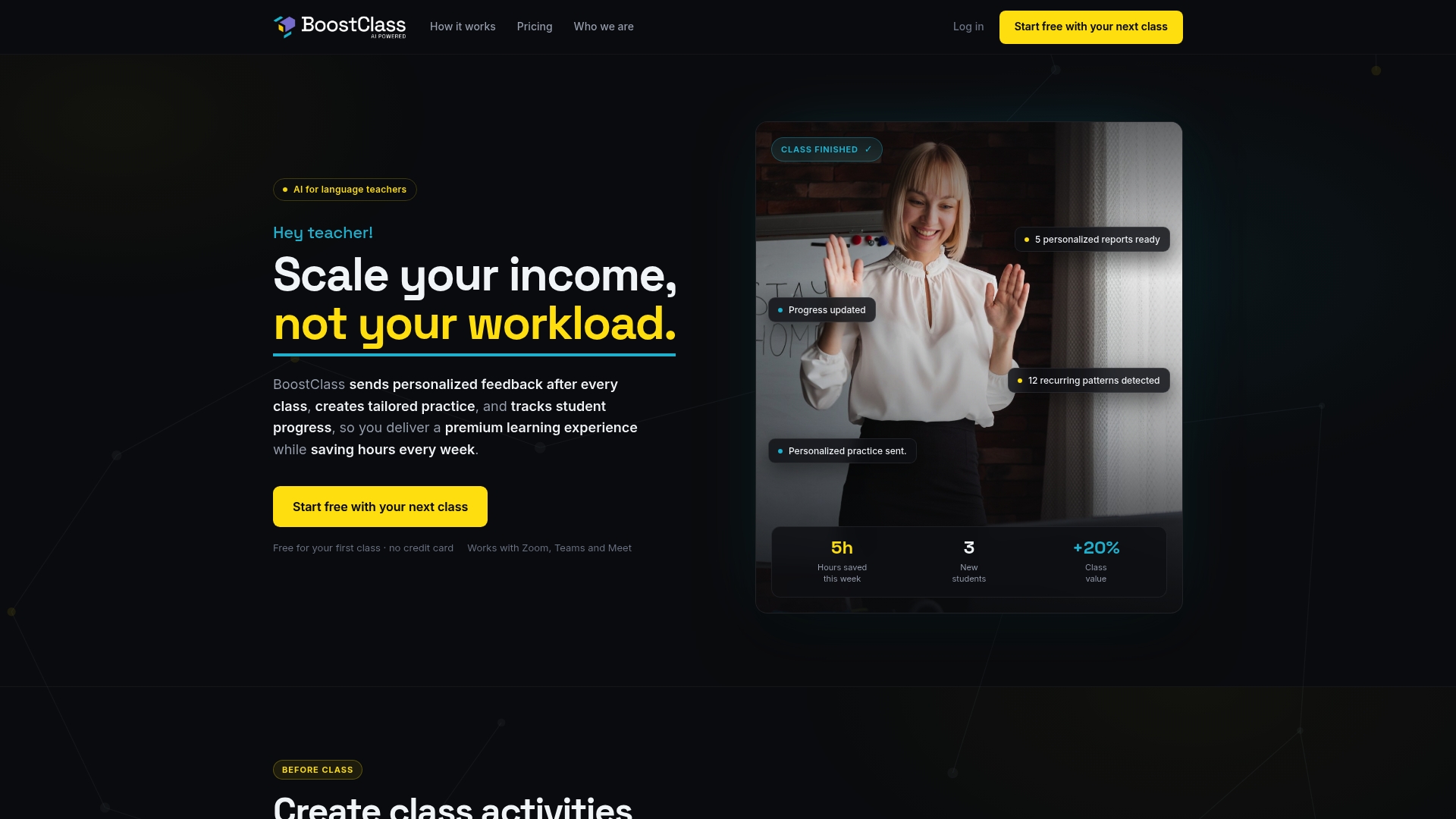
If you want to see how this works with your lessons, you can start with BoostClass Connected Activities at app.boostclass.net/activities, or look at the whole platform at boostclass.net.
The published plans are Activities at €5 per month, and Student Intelligence at €19 per month for up to 10 students, €34 per month for up to 20 students and €49 per month for up to 30 students. Full details are on the pricing page.
What to do this term
You do not need a grand strategy. A sensible sequence for an owner or academic director:
- Name the bottleneck. Is it preparation time, feedback, retention or quality visibility? Pick one.
- Train before you tool. Given that most teachers use AI with little training, a one-hour session on shared rules will pay back quickly.
- Pilot with willing teachers. Two or three classes for a few weeks, with a clear measure such as time saved or student attendance.
- Keep humans in the loop. Teachers review what students see.
- Tell your clients. Corporate buyers and adult learners respond to evidence of personalised progress, so make it part of how you sell.
For teachers working alone, the same logic applies at smaller scale. Our guides on AI for language teachers and lesson time management are a good place to start.
FAQ
Will AI replace English teachers?
No, not according to the main professional and research bodies. The British Council and TESOL both say AI should support teachers, and surveyed teachers largely expect to remain needed. What changes is the work: less repetitive admin, more focus on relationships and judgement.
Which parts of language teaching can AI take over?
Repetitive and administrative work: drafting exercises, preparing lessons, first-draft feedback, grading support and routine reporting. Teachers should still review the output. Empathy, cultural nuance and live conversation remain human work.
Can AI personalise learning better than a teacher?
It can process more data about each student’s errors than a teacher can hold in their head, and a 2024 meta-analysis found positive effects for AI-guided individualised learning. But results are strongest when teachers supervise and guide the AI, so the best personalisation combines both.
What should a language school check before adopting AI?
Check data privacy, whether the tool fits your teaching method, how it handles bias and varieties of English, and whether teachers stay in control of what students receive. Run a small pilot before rolling it out across the school.
Sources
- AI will never replace English teachers – it needs them (British Council)
- Artificial intelligence and English language teaching (British Council, 2024)
- TESOL Position Statement: AI for the ELT Profession (October 2025)
- Artificial Intelligence and the Future of Teaching and Learning (US Department of Education, 2023)
- AI and the future of education: disruptions, dilemmas and directions (UNESCO)
- Embracing the opportunities of artificial intelligence and teaching (OECD, 2026)
- Expert consensus report: Ways generative AI can support education (University of Minnesota)
- The effects of AI-guided individualized language learning (meta-analysis, 2024)
- OECD Digital Education Outlook 2026
- AI in K–12 Education: The Good, the Bad, and the Guardrails (NCES, August 2026)
- From revolution to evolution: What generative AI really means for language learning (Language Teaching, 2025)
