
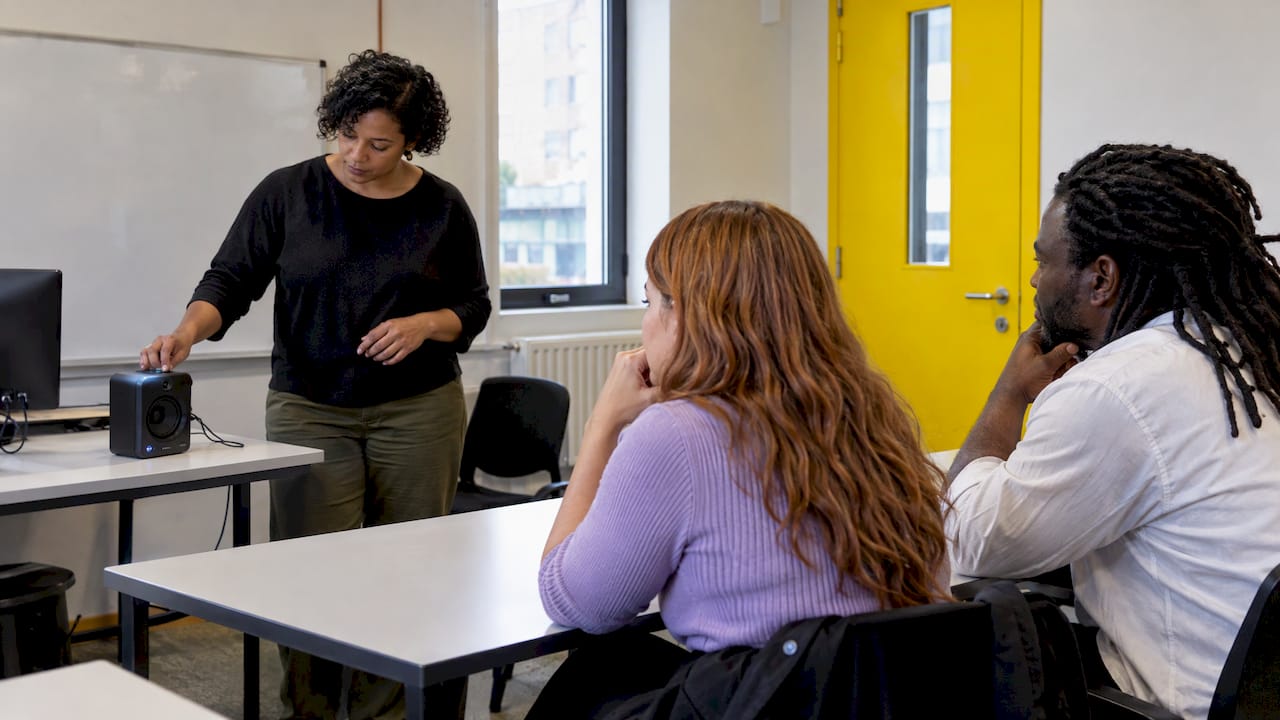
The listening activities that work best share one habit: they give learners a reason to listen before the audio starts, and they follow it with practice aimed at what each learner missed. Plan the lesson in three phases (before, during and after the audio), match the task to the level, and make the follow-up personal. This guide gives you activities for each phase, a way to adapt them for mixed groups, and a realistic view of where AI saves preparation time for teachers and language schools.
TL;DR
- Structure every listening lesson as pre-listening, while-listening and post-listening. Most weak listening lessons skip the first and last phases.
- Replace “listen and answer the questions” with purposeful tasks: draw, follow directions, predict, summarise.
- Adapt difficulty by changing the task, the pace and the support, not by hunting for a new recording every time.
- Personalised follow-up is where the biggest gains are reported in AI-supported listening studies, and it is the part teachers have least time for.
- BoostClass Connected Activities can generate over 20 types of exercises from your teaching objectives, previous lessons and detected learning gaps, in minutes.
Table of Contents
- Why listening lessons so often fall flat
- The three-phase framework
- Ten listening comprehension activities by purpose
- Adapting listening tasks for mixed levels
- Where AI helps with listening practice
- Connecting listening to what happens in your class
- A weekly routine you can start with
- Try it with your next listening lesson
- Our perspective
- FAQ
- Sources
Why listening lessons so often fall flat
Most teachers know the pattern. You play a track, learners answer eight questions, you check the answers, and you move on. Some learners score well, some do not, and nobody is quite sure why.
The British Council’s article on listening fluency, which draws on Goodith White’s book Listening, makes a useful point: coursebook listening questions often expect too much of learners and discourage guessing. Real-life listening is mostly top-down, meaning we follow the message and fill gaps from context, rather than bottom-up, decoding word by word. A task that only tests word-level accuracy trains the second habit and ignores the first.
For a school owner or academic director there is a second problem: preparation. Good listening lessons need a topic that fits the group, a purpose, tasks at more than one level and follow-up. That is a lot of work per class, and it is the first thing to be squeezed when teachers are busy.
The three-phase framework
A systematic review of effective listening teaching practices describes listening instruction in three phases: pre-listening, while-listening and post-listening. Techniques include activating prior knowledge, using real objects, task-based and interactive activities, and combining top-down and bottom-up processing. The structure is simple enough to apply to any recording, from a coursebook dialogue to a short podcast clip.
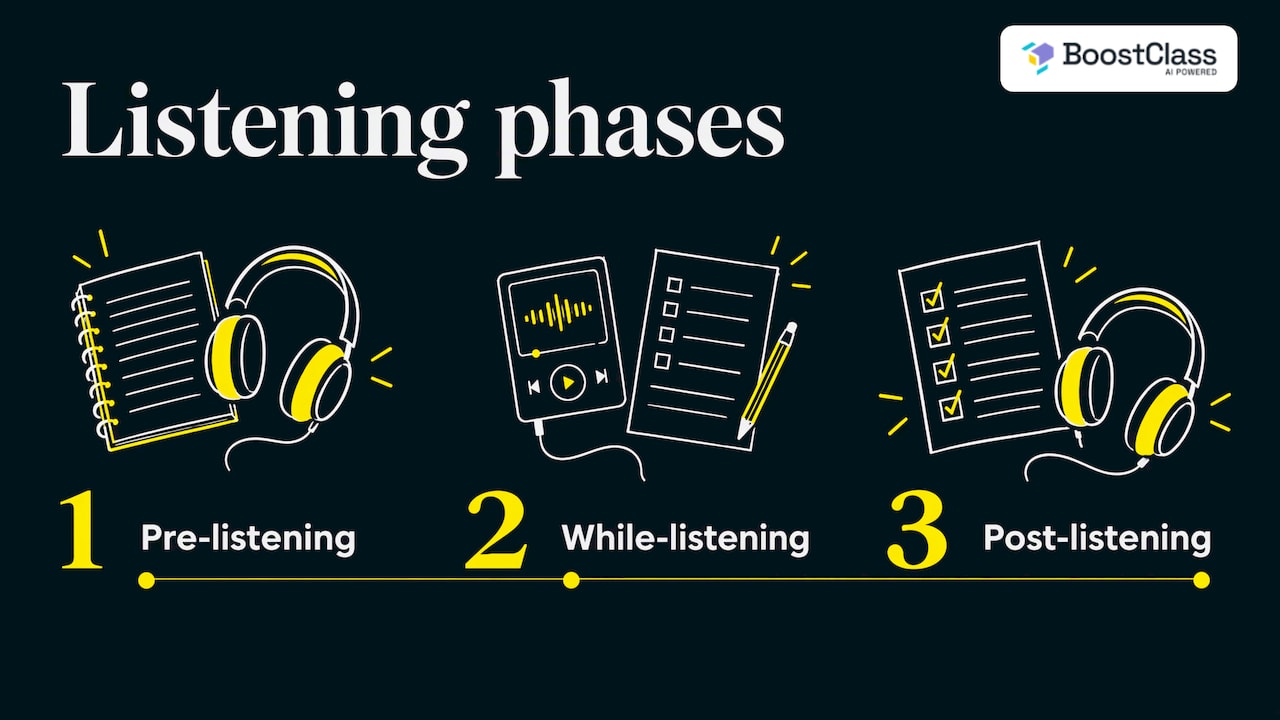
Pre-listening: give learners a reason to listen
This phase wakes up what learners already know and sets a purpose. Three activities that take five minutes or less:
- Predict from a picture or title. Show an image or the title of the recording. Learners write three words they expect to hear, then tick them off while listening.
- Vocabulary preview, lightly. Pre-teach only the two or three words without which the task is impossible. Leave the rest. Learners need practice at coping with words they do not know.
- Quick opinion poll. If the audio is about remote work, ask who prefers it and why. Learners arrive at the recording with a stake in the answer.
The British Council webinar handout on knowing the subject suggests the same: predict first, then listen for the main idea, and encourage learners to ignore unknown words rather than freeze on them.
While-listening: change the task each time
The same handout advises replacing generic tasks with purposeful ones, such as listening and drawing, or following directions on a map, and giving a different task each time the audio is replayed. A workable sequence for a two-minute recording:
- First listen, gist. One question only: who is speaking, where are they, and are they happy about it?
- Second listen, detail. Learners complete a short grid with times, names or numbers.
- Third listen, for language. Pick one feature, such as how the speaker asks someone to repeat something, and learners note the exact phrases.
Between listens, let learners compare answers in pairs before whole-class feedback. They hear their own doubts voiced by a partner, and you hear where the real confusion is.
Post-listening: turn input into output
The last phase is where understanding becomes learning. Options include:
- Summarise in 30 seconds, in pairs, then swap partners and do it again shorter.
- Headline matching. The British Council article describes learners summarising news headlines before they hear the full stories, then checking their predictions.
- Clarification practice. Learners practise asking a speaker to repeat or slow down, a real-life skill that coursebook tasks rarely train. Play a fast or mumbled clip on purpose.
- Short reflection. Two sentences: what I understood, and what stopped me. If you want a ready structure for turning that into a next step, these lesson reflection prompts show how to finish with a plan the learner owns.
Ten listening comprehension activities by purpose
The table groups activities by the skill each one trains. Use it to choose one per lesson rather than running all of them.
| Activity | Phase | What it trains | Best for |
|---|---|---|---|
| Predict and tick off | Pre / while | Top-down listening, vocabulary recall | A1 to B1 |
| Listen and draw | While | Detail, prepositions, descriptive vocabulary | A1 to A2, young learners |
| Follow directions on a map | While | Sequence, directions, precise detail | A2 to B1 |
| Gist question, then detail grid | While | Listening for different purposes | All levels |
| Spot the phrase | While | Noticing functional language | B1 to B2 |
| True, false and correct it | While / post | Careful listening, paraphrase | A2 to B2 |
| Headline summaries | Post | Summarising, prediction check | B1 to C1 |
| Note-taking and reconstruct | While / post | Memory, organisation, note-taking | B2 and above |
| Pair retell | Post | Speaking from input | All levels |
| Ask for repetition | Post | Clarification strategies | All levels |
If your groups also work on describing images, picture description activities pair well with listen-and-draw tasks, because the same vocabulary is used in both directions.
Adapting listening tasks for mixed levels
Mixed-level groups are the norm in language schools, especially in small online classes where a B1 and a B2 learner share a lesson. The good news is that you rarely need different audio. You need different tasks and supports.
The British Council’s Teachers share handout on adapting materials points out that listening tasks often fail because learners are asked to read, listen and process at once. Its fix is to split the task into a meaning-focused first listen and a detail-focused second listen, and to add visual support, change the task type or let learners work in pairs.
For a more systematic approach, the Canadian Listening to Learn framework by Elizabeth Hoerath describes six “dials of difficulty” that a teacher can turn up or down:
- Topic familiarity: choose subjects learners already know something about.
- Purpose for listening: a clear task makes the same audio easier.
- Complexity: background noise, structure, length, linearity and how spontaneous the speech is.
- Accent and register: formal announcements are easier than casual speech.
- Pace: slower speech, added pauses and repeated listening.
- Supports: visual aids, clarification questions and prediction.
A worked example
Take a 90-second recording of a customer calling a hotel to change a booking, with a group of four learners at A2 and B1.
- All learners, pre-listening: predict three words they expect to hear (“date”, “room”, “cancel”).
- First listen: everyone answers one gist question: does the customer want to cancel or change?
- Second listen, A2 version: tick the new date from three options.
- Second listen, B1 version: write the new date and the reason for the change.
- Third listen, B1 stretch: note the two polite phrases the receptionist uses.
- Post-listening: pairs role-play the call, with the B1 learner starting.
One recording, three levels of challenge, no extra audio to find. The trouble is the time it takes to write each version, which is where a tool can help.
Where AI helps with listening practice
Be clear about what AI does well here. It does not replace you listening to your learners. It takes over the preparation and follow-up that eat your evenings.
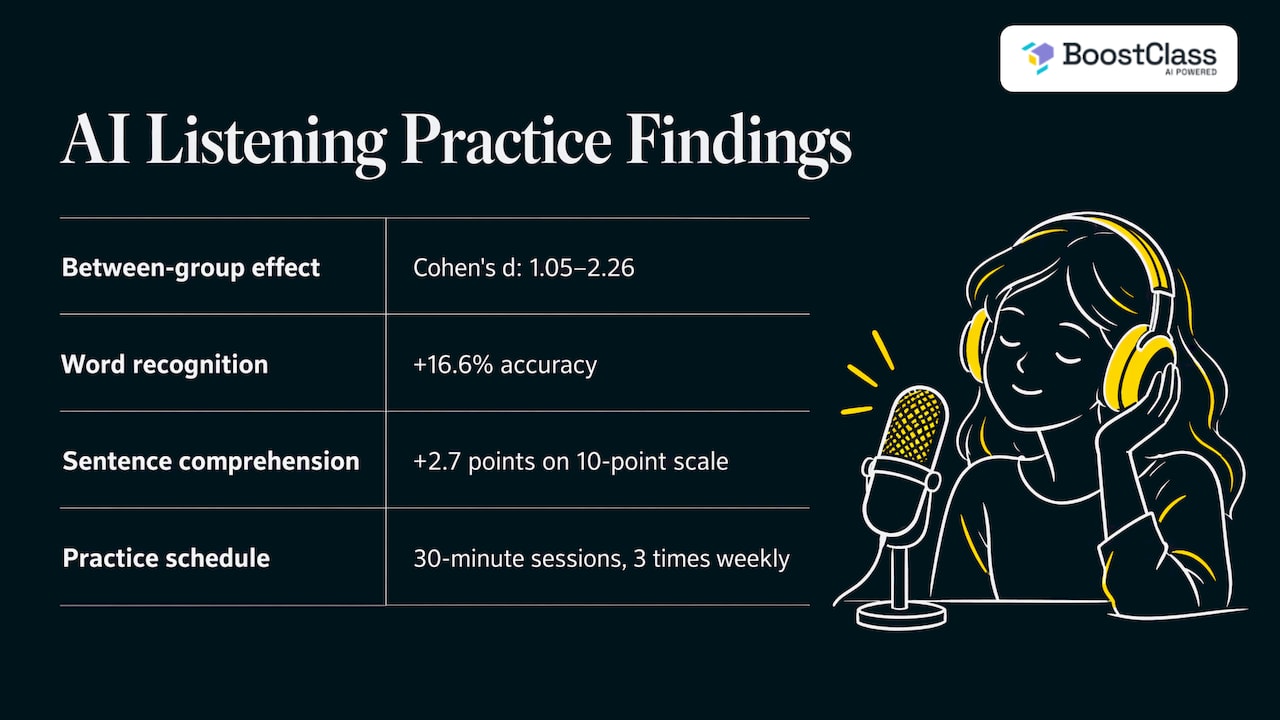
The research on AI-supported listening is promising. In a 16-week quasi-experimental study of 67 Chinese university students, learners who used a chatbot for listening tasks with individualised feedback showed large within-group gains and substantial differences against a control class, with Cohen’s d values between 1.05 and 2.26 for the between-group comparison. Students reported that the materials were tailored to specific topics, question types and difficulty, with one describing the challenge as just beyond their grasp but still within reach.
A 12-week study of 50 first-year students in Kyrgyzstan found that an AI-assisted group using speech recognition achieved a 16.6% increase in word recognition accuracy and a 2.7-point improvement in sentence comprehension on a ten-point scale. Learners worked in 30-minute sessions three times a week, with colour-coded feedback: green for correct words, yellow for minor errors and red for significant mistakes, repeating lines until everything turned green.
The common thread is not the technology itself. It is personal feedback, frequent short practice and tasks matched to the learner’s level. Those are exactly the things a teacher with 25 learners struggles to provide by hand.
Connecting listening to what happens in your class
Most AI listening tools work in isolation: the learner talks to a bot, and the teacher sees nothing. BoostClass takes a different route. It connects lesson preparation, classroom performance and continuous practice into one learning experience, and it integrates with Zoom, Microsoft Teams and Google Meet. It also supports in-person teaching, so the same workflow applies whether you teach online, in a classroom or both.
In practice, this changes the listening lesson in three places.
Before class: Connected Activities
BoostClass Connected Activities lets teachers generate over 20 types of ready-to-use exercises in minutes. You build them from your teaching objectives, from insights from previous lessons and from the learning gaps BoostClass has identified. If last week’s class showed that three learners kept missing reduced forms or numbers, your next activity set can start from that, rather than from a generic worksheet.
This answers a real owner and academic director concern: preparation quality should not depend on how tired a teacher is on Thursday night. It also keeps your teaching style and materials in place. BoostClass automates the tedious part, and you still choose the recording and run the lesson.
After class: feedback and personalised practice
After the lesson, BoostClass automatically generates individual student feedback, tracks progress and delivers personalised practice that targets each learner’s actual mistakes and areas for improvement. Students do not need to install anything. For listening, that means the follow-up you wish you had time to write for each learner arrives without you writing it. The real-time feedback guide explains how to use that feedback well.
For the school: visibility
For owners and academic directors, retention depends on learners feeling they are progressing. BoostClass gives schools visibility into learning outcomes and engagement, and it analyses teacher performance with a particular focus on Teacher Talk Time and other metrics. Listening lessons are a good example: if a teacher talks for most of the lesson, learners are not getting the listening and speaking practice they are paying for. See the guide to AI for language schools for how owners approach this.
A weekly routine you can start with
You do not need to rebuild your curriculum. A light routine is enough:
- Choose one recording per week of one to three minutes, tied to the unit.
- Run the three phases in class, using different tasks on each listen.
- Note two or three recurring problems from what learners missed.
- Send targeted practice on those points before the next class.
- Review progress monthly, looking at which learners improve and which stall.
Steps 3 to 5 are the ones that usually fail, because they happen after the lesson, when nobody is paid to do them. That is why automating them matters most. For ideas on structuring that practice by level, read the guide to adaptive learning in ESL.
Try it with your next listening lesson
If you want to see how this works with your own groups, BoostClass offers a plan for activities alone and plans for student feedback and tracking. The Activities plan costs 5 € per month. Student Intelligence costs 19 € per month for up to 10 students and 34 € per month for up to 20 students, and the student feedback plan costs 49 € per month for up to 30 students. You can compare them on the BoostClass pricing page.
To see how the platform fits your classes first, start at BoostClass and build your first set of activities from a real lesson objective.
Our perspective
Listening is the skill that language schools most often teach by accident. A recording is played, answers are checked and everyone moves on. The learner who struggled leaves with no more idea of why than when they arrived.
We built BoostClass around a different idea: the real class, with a real teacher, is the best source of information about what each learner needs. When a platform captures what happened in the lesson, it can prepare the next activity from actual gaps and send personalised practice afterwards, instead of offering the same exercise to everyone.
That is why Connected Activities starts from your objectives, previous lessons and detected gaps. You keep your style and your materials. We take the repetitive preparation and the individual follow-up, which is where teachers lose the most hours and where learners benefit most.
For school owners, the result is simple to describe: more relevant lessons, learners who stay engaged, and a clearer view of teaching quality across the school.
Cesar
FAQ
What are the best listening comprehension activities for ESL classes?
Start with activities that give learners a purpose: predicting words before listening, listening and drawing, following directions on a map, and a gist question followed by a detail grid. Then add a post-listening task such as a 30-second summary or a pair retell. Use a different task on each replay of the audio.
How long should a listening activity be?
One to three minutes of audio is enough for most lessons, with three listens and a task each time. For longer material, break it into shorter segments, for example a 15-minute episode into three five-minute parts, and give a separate task for each segment.
How do I adapt one recording for different levels?
Keep the audio the same and change the task. Give one learner a tick-box answer and another a written answer, or ask one for detail and another for a summary. You can also change the pace, add visuals or let learners work in pairs, as the dials-of-difficulty framework suggests.
Can AI create listening exercises for my class?
AI can speed up the preparation of exercises and follow-up practice. With BoostClass, teachers generate over 20 types of classroom-ready activities from teaching objectives, previous class insights and detected learning gaps. You stay in control of the recording and the lesson, and the platform works with Zoom, Microsoft Teams, Google Meet and in-person teaching.
How do I know whether my listening activities are working?
Look at whether learners improve on the same kind of task over several weeks, not just on a single quiz. Track recurring mistakes per learner and check that they shrink. BoostClass tracks progress and generates individual feedback after each class, so that comparison is already in front of you.
Sources
- Systematic review of effective teaching listening practices
- Ten activities to practise listening fluency in the English classroom, British Council
- Knowing the subject: a practical introduction, British Council webinar handout
- Teachers share: How do we adapt our materials?, British Council handout
- French as a Second Language: Listening to Learn, Elizabeth Hoerath
- Integrating AI chatbots in informal digital English learning, Education and Information Technologies, 2025
- The impact of AI-driven speech recognition on listening, Discover Computing, 2026
